
Best Time to Hike Larapinta Trail
The best time to hike the Larapinta Trail is during the cooler months, May to September, according to the official season guidance. Summer is dangerously hot on this remote desert route, and the modelled data backs that up: May to August are the coldest and driest months of the year.
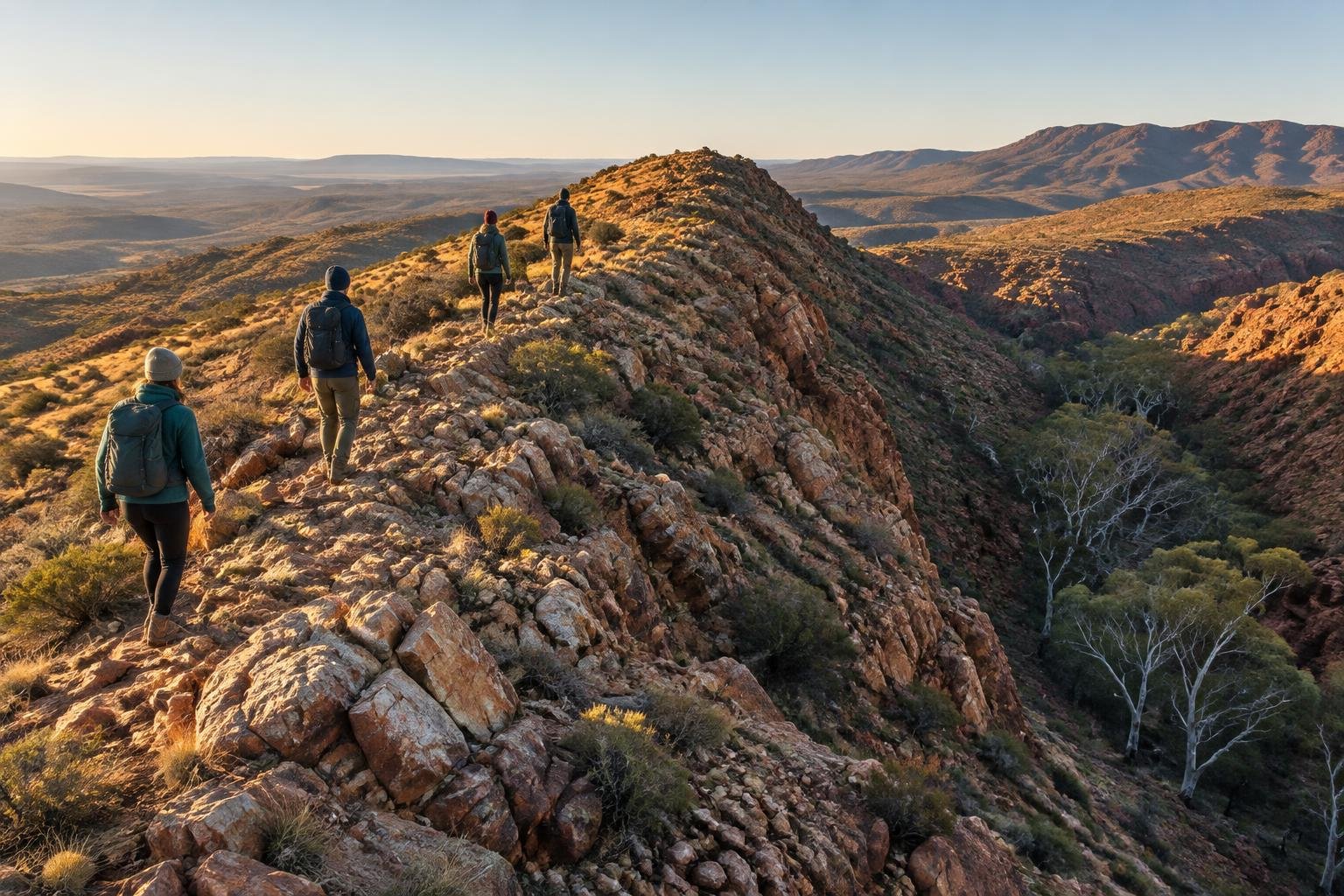
Month-by-month climate for Larapinta Trail
| Month | Relative warmth | Rain | Daylight |
|---|---|---|---|
| Jan | Warmest | 66 mm | 13.3 h |
| Feb | Warmest | 40 mm | 12.8 h |
| Mar | Warm | 28 mm | 12.2 h |
| Apr | Mild | 15 mm | 11.4 h |
| May | Coldest | 9 mm | 10.9 h |
| Jun | Coldest | 5 mm | 10.5 h |
| Jul | Coldest | 15 mm | 10.7 h |
| Aug | Coldest | 3 mm | 11.2 h |
| Sep | Mild | 11 mm | 11.9 h |
| Oct | Warm | 16 mm | 12.6 h |
| Nov | Warmest | 33 mm | 13.2 h |
| Dec | Warmest | 43 mm | 13.5 h |
Modelled regional averages for 2010–2023 (rainfall) and calculated daylight hours; they describe the wider area, not a reading taken on the trail. “Relative warmth” compares each month with the warmest and coldest months of this place’s own year. It is not a temperature, and the high parts of a route are colder than the region around them.
The modelled averages show a clear dry window in the cooler months. June (about 5 mm) and August (about 3 mm) are among the driest, while January is the wettest at roughly 66 mm, followed by February and December. May through August are labeled the coldest months of this place's own year, while November through February are the warmest. Daylight swings from about 10.5 hours in June to about 13.5 hours in December, so winter days are noticeably shorter for planning each day's walking.
Larapinta Trail season by season
Peak cool season · May to August
This is the core of the recommended window. These are the coldest months of the year here, and rainfall is typically low, with June and August among the driest at about 5 mm and 3 mm. Daylight is at its shortest, roughly 10.5 to 11.2 hours, so you have fewer hours of walking light each day. The official season guidance names May to September as the time for this trail, and it reflects why most walkers choose these months for a multi-day trip.
Shoulder spring · September to October
September is still inside the official May to September window and is labeled mild, with around 11 mm of rain and about 11.9 hours of daylight. October is already labeled warm and gets about 16 mm, with daylight stretching to roughly 12.6 hours. Conditions are getting hotter toward the end of this period, so the margin shrinks quickly. Check the managing authority's current guidance for the cutoff before committing to dates late in the season.
Hot summer · November to February
These are the warmest months of the year here, with the longest daylight at about 12.8 to 13.5 hours, and the official guidance is blunt: summer is dangerously hot. January is also the wettest month on average at about 66 mm, with February and December also wetter than the cool season. A remote desert trail with limited water tanks leaves little room for error in these conditions, so this is not the time to plan a multi-day walk.
Early autumn · March to April
March is labeled warm and April mild, with rainfall falling from about 28 mm in March to about 15 mm in April, and daylight shortening from roughly 12.2 to 11.4 hours. April sits just outside the official May to September window, and it is a period of transition rather than a settled season. Treat it as a time to confirm current conditions and any advice from NT Parks and Wildlife before deciding whether the trail suits you.

Official season guidance
NT Parks and Wildlife: Cooler months, May to September (summer is dangerously hot)
Multi-day walks and campsites must be booked online before you arrive (NT Parks and Wildlife), and NT Parks recommends carrying a satellite phone or personal locator beacon; plan carefully around the limited water tanks — this is a remote desert trail where summer heat is genuinely dangerous, so it is walked in the cooler months only. Many do supported sections with an operator.
Check current dates on northernterritory.com (Tourism NT, Larapinta Trail)What to pack for the season
Because the recommended months are the coldest of this place's year, pack layers that handle a range of conditions rather than assuming constant heat. Carry sun protection and plenty of water capacity, since this is a remote desert route. With only about 10.5 to 11 hours of daylight in midwinter, bring a reliable headlamp. Rain is usually light in these months, but a compact rain layer is still sensible.
For layering, rain cover and weather planning, see hiking in rain, heat and cold.
Timing mistakes to avoid
The biggest mistake is stretching your dates toward the hotter edges of the season. The official guidance calls summer dangerously hot, and October and April are already warmer than the core months. Another error is assuming a dry month means easy logistics: campsites and multi-day walks must be booked online before arrival, and water tanks are limited. Do not rely on a single month's averages; confirm current conditions with NT Parks and Wildlife before you go.
Common questions
When is the best month to hike the Larapinta Trail?
The official guidance points to the cooler months, May to September. Within that window, June and August are among the driest months in the modelled data, and May through August are the coldest of the year here. Check current conditions with NT Parks and Wildlife before fixing your dates.
Can I hike the Larapinta Trail in summer?
The official season guidance says summer is dangerously hot, and the trail is described as remote desert terrain with limited water tanks. The modelled data shows November to February as the warmest months of the year. For those reasons, the trail is walked in the cooler months, and you should confirm any current advice with the managing authority.
How much daylight will I have on the Larapinta Trail?
Calculated daylight ranges from about 10.5 hours in June to about 13.5 hours in December. During the recommended May to September window you typically have roughly 10.5 to 11.9 hours, so plan each day's walking with the shorter winter light in mind and carry a headlamp.
Does it rain much during the recommended season?
Modelled regional averages show low rainfall in the cooler months: about 9 mm in May, 5 mm in June, 15 mm in July, 3 mm in August and 11 mm in September. These are typical figures, not trail measurements, so conditions can differ. Confirm current conditions with NT Parks and Wildlife before you set out.
Sources
- NT Parks and Wildlife — northernterritory.com (Tourism NT, Larapinta Trail): official season and permit guidance.
- NASA POWER (Prediction Of Worldwide Energy Resources): monthly temperature and rainfall averages, 2010–2023, from MERRA-2 reanalysis. Daylight hours are calculated from latitude.
Conditions, closures and permit rules change without notice — confirm current information with the managing authority before you go. See our editorial policy and affiliate disclosure.