
Mountaineering & Alpine Packs: Complete Guide
Comprehensive technical analysis of sizing, materials, installation requirements, and manufacturer standards for mountaineering & alpine packs.
Recommended Products
See the full ranking →


A mountaineering pack carries technical gear with ice-axe loops, crampon patches and a stripped, close-fitting profile. Capacity runs from 20 liters for a single summit push to 75 liters for a multi-day glacier approach, but size isn't the defining trait — shape and feature reduction are. A mountaineering pack rides narrow against the back so it doesn't throw off balance on an exposed ridge or a steep snow slope, and it strips away anything that can snag a rope, a crampon point, or a rock hold. External ice-axe loops, crampon patches, a removable lid, and a minimal or removable frame let one pack move from trailhead approach to technical terrain without a gear swap.
A mountaineering pack is defined by a slim, close-fitting profile, external ice-axe and crampon attachment points, a stripped feature set, and abrasion-resistant fabric built to survive contact with rock and ice. It carries less external bulk than a general backpacking pack and keeps the load compressed tight to the spine for balance on exposed terrain.
Most mountaineering packs share a short list of traits. The main body is narrower front-to-back than a hiking or overnight pack of the same volume, so it doesn't catch on rock while chimneying or stemming. Side pockets, if present, sit low and flush rather than bulging outward. Fabric is heavier-denier nylon — commonly in the 420D to 840D range — or a hybrid weave using Dyneema or UHMWPE ripstop for cut and abrasion resistance where the pack rubs against granite or ice tools. Many models use a single top-loading main compartment instead of multiple zippered panels, since fewer zippers mean fewer failure points in cold, gritty conditions. A reinforced haul loop above the shoulder straps lets the pack (or its owner) be hoisted, which matters on roped glacier travel.
Alpine pack capacity should match the objective, not a general trip-length rule: 20–35 liters for a single-day scramble or summit push, 35–50 liters for a one-to-three-day alpine climb, and 50–75 liters for multi-day glacier travel or an expedition approach. Ski mountaineering objectives generally fall in the 30–45 liter band.
| Objective | Typical Capacity | What It Carries |
|---|---|---|
| Single-day scramble or summit push | 20–35L | Layers, water, food, a light rack, sometimes crampons and an axe |
| 1–3 day alpine climb | 35–50L | Rope, rack, stove, minimal bivy gear, food for the route |
| Multi-day glacier travel or expedition approach | 50–75L | Tent, sleeping system, extended food and fuel, technical gear for a basecamp-to-route carry |
| Ski mountaineering | 30–45L | Similar to an alpine climb, plus a ski or splitboard carry system |
A pack sized for glacier travel or an expedition approach is deliberately larger than what's carried on summit day itself — the extra volume covers the walk-in with a full kit, then gets stripped down once camp is established. Packs built for technical scrambling and climbing stay closer to the 20–35 liter range year-round, since the terrain — not the trip length — sets the ceiling on how much a climber wants swinging on their back.
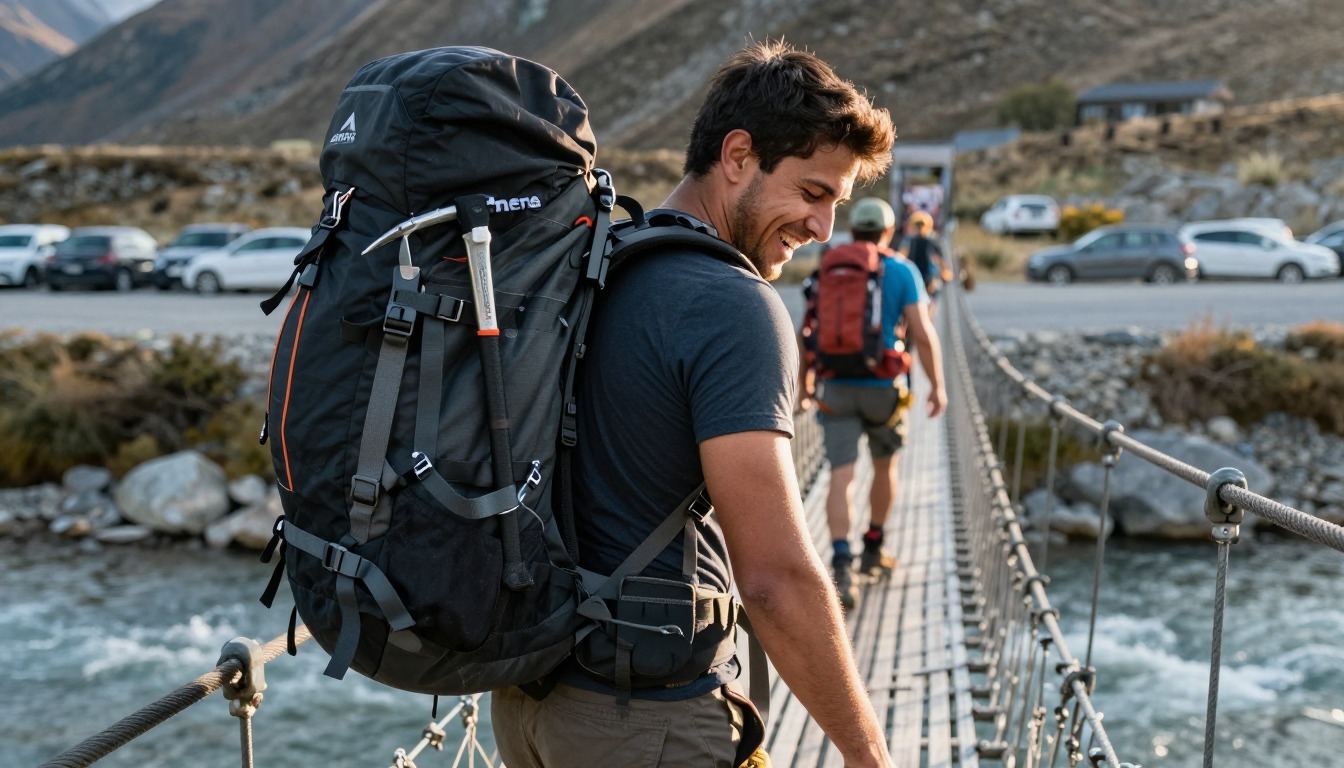
An ice axe attaches through a bottom loop that captures the head or pick, paired with an adjustable upper strap or bungee that cinches the shaft flat against the pack body. Crampons attach either in a dedicated fabric pouch that shields the pack from the points, or on an exterior strap platform that compresses the crampons against the front panel with the points facing out.
The two crampon-carry systems suit different priorities:
- Pouch or pocket system: a reinforced fabric sleeve on the front of the pack fully encloses the crampon points, protecting the pack fabric, the wearer's back on approach, and anything packed nearby. Slower to load and unload with gloves on.
- Strap or platform system: an external bungee or webbing cross-pattern compresses the crampons directly against the pack's front panel, points exposed. Faster on and off at a boot-crampon transition, but the exposed points can wear pack fabric and snag gear over repeated use.
Stripping a pack for summit day means removing everything not needed for the push itself — the framesheet or stay, the floating lid, the hipbelt padding, and any unused pockets — and leaving it at high camp or a cache point. What stays on the pack is the harness-compatible waistbelt (or none at all), the ice-axe loop, and the haul loop.
Many mountaineering packs are built around this strip-down from the start: a removable aluminum stay, a lid that detaches and doubles as a small summit pack or first-aid pouch, and a hipbelt that either unclips entirely or sits low and slim enough to clear a climbing harness. The goal is matching pack weight to the terrain rather than the trip. The same load-safety guidance that applies to any hiking backpack still applies here — a pack loaded to roughly 20% of bodyweight stays manageable on technical ground, and the hipbelt carries the majority of that load whenever it's worn, so a climber who removes the hipbelt for a technical pitch is deliberately shifting weight onto the shoulders for a short stretch, not for the whole day. Fitting the torso correctly before the trip — measuring from the C7 vertebra at the base of the neck down to the iliac crest — matters more on a mountaineering pack than a hiking pack, since there's less adjustable padding to compensate for a poor size match once gear is stripped down for summit day.
Go Deeper
Detailed companion guides for mountaineering & alpine packs.
Best Mountaineering & Alpine Backpacks
Buyer's guide: best hiking backpack for mountaineering.
Best Backpacks For Scrambling & Climbing
Buyer's guide: best backpack for scrambling and climbing.
Best Backpacks For Alpine Climbing
Buyer's guide: best backpack for alpine climbing.
Best Backpacks For Glacier Travel
Buyer's guide: best backpack for glacier travel.
Ice-Axe & Crampon Attachment Systems
How ice axes, crampons, and trekking poles attach to a mountaineering backpack, and how to choose between loop and platform crampon systems.
Travel & Hiking Hybrid Packs
Related backpacks by activity guide.
Hunting Backpacks
Related backpacks by activity guide.