

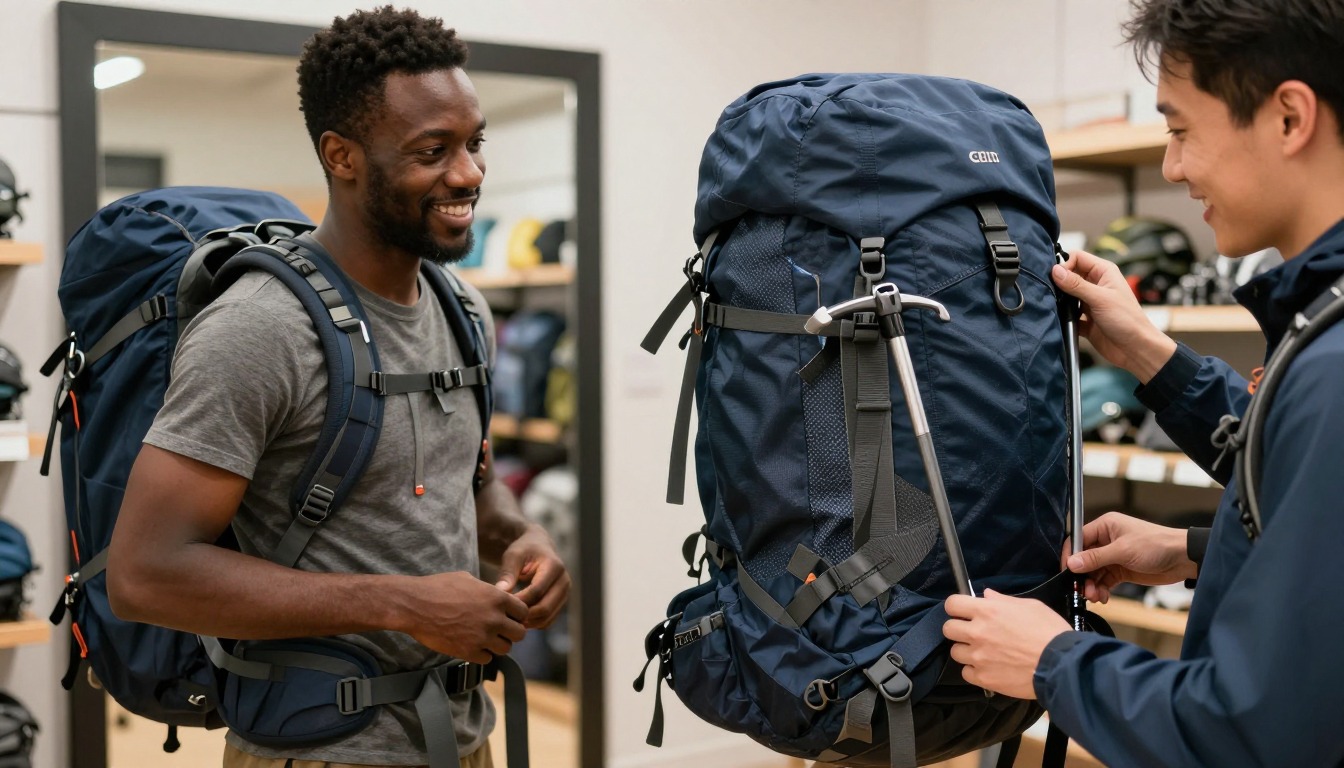


Attaching an ice axe, crampons, or trekking poles to a mountaineering pack means using the pack's dedicated external loops and straps rather than stowing sharp or awkward gear inside the main compartment, where it can puncture fabric or shift load. Each tool has its own standard attachment method.
How do you attach an ice axe to a backpack?
An ice axe attaches by sliding the head or pick through a reinforced loop at the base of the pack, then cinching an adjustable strap or bungee near the top of the shaft to hold it flat against the pack body. This two-point system — bottom loop plus upper retention strap — keeps the axe from swinging while walking and from working loose on rough ground.
Most mountaineering and alpine packs include two axe loops side by side, letting a climber carry a second tool or an ice tool for steeper terrain. The upper strap is usually webbing with a buckle, though some ultralight alpine packs use a simple bungee-and-hook instead to save weight. The axe head should sit close to the pack body with the pick oriented so it can't catch a sleeve or a passing hiker on the trail.
How do you attach crampons to a backpack?
Crampons attach either inside a dedicated front pouch that fully covers the points, or on an exterior strap platform that compresses them against the pack's front panel with points exposed. The choice is a trade-off between speed and protection.
- Pouch system: fully encloses crampon points in a reinforced sleeve, protecting the pack fabric and anything nearby, but slower to pack and unpack with gloves on.
- Platform system: an external bungee or strap cross-pattern holds crampons against the front panel with points facing out, quick to use at a boot-crampon transition but harder on pack fabric over repeated trips.
How do you attach trekking poles to a backpack?
Trekking poles attach to a mountaineering pack using side compression straps or a dedicated pole-carry loop, with the pole tips secured low and the grips held near the top by a cinch strap or bungee. This keeps poles out of the way once a climber switches to hands-on scrambling or an ice axe for balance.
The most common method loops the pole tips through a lower side-compression strap, then folds the poles up against the pack body where an upper strap or the same compression system holds the grips in place. Packs with a quick-release bungee-and-hook system allow poles to go on or come off in a few seconds without unclipping a full buckle, which matters when the terrain changes from a maintained trail to a scramble or glacier crossing multiple times in one day.
Choosing between loop and platform crampon systems
A climber whose route mixes long snow approaches with technical rock should lean toward a pouch system, since it protects both the pack and the rock from crampon points during scrambling sections. A climber doing frequent, fast crampon transitions — glacier travel with repeated boot changes — benefits more from an exterior platform, since it can be strapped on or off in seconds. Neither system is universally better; the right choice follows the objective, matching the same logic used to size a pack for glacier travel versus a pack built for technical scrambling and climbing.