
Frame Types: Complete Guide
Comprehensive technical analysis of sizing, materials, installation requirements, and manufacturer standards for frame types.


Recommended Products
See the full ranking →

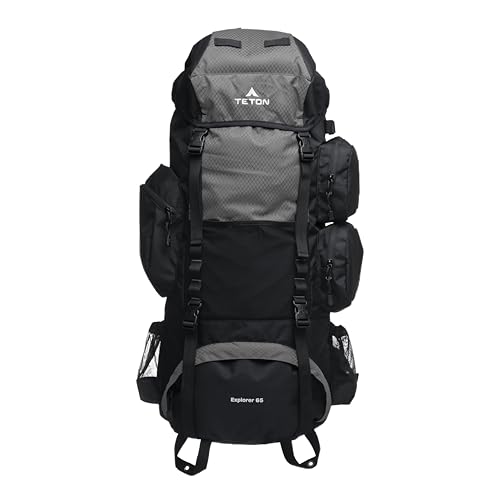
A backpack frame — internal, external or frameless — transfers load to the hips and sets the pack's stability and weight. The frame is the structural core of any hiking backpack, running from the shoulder harness through the back panel down to the hipbelt. Frame type drives how a loaded pack balances on the trail, how much air reaches your back, and how many empty ounces you carry before adding any gear. Every hiking backpack falls into one of these three frame categories, and the right choice depends on load weight, terrain, and how much pack weight you're willing to trade for comfort.
An internal-frame backpack hides its structure — usually a pair of aluminum stays, a molded plastic frame sheet, or both together — inside the pack body against a padded back panel. The frame curves to follow the spine, keeping the load close to your center of gravity. This is the frame type used on the large majority of hiking and backpacking packs sold today.
Internal frames took over the market starting in the 1970s and 1980s as hikers moved from maintained trails onto steeper, rougher terrain where a narrow, body-hugging profile mattered more than raw ventilation. Most current internal-frame packs — Osprey's Atmos AG and Aura AG, Gregory's Baltoro and Deva, Deuter's Aircontact line, Mystery Ranch's Bridger — use dual aluminum stays paired with a shaped plastic or foam frame sheet. Lighter internal-frame packs, including many from ULA and REI Co-op's Trailmade line, use a single stay or a stiff frame sheet alone to save weight while still giving the pack shape.
Internal frames hug the back for a narrow profile and better balance on uneven ground; external frames hold the pack away from the back on a rigid structure, trading some balance for airflow and easier handling of heavy or irregular loads on maintained trails. Neither type is objectively better — the right one depends on terrain and what you're carrying.
| Attribute | Internal frame | External frame |
|---|---|---|
| Load position | Close to the spine, low center of gravity | Held away from the back on a rigid frame |
| Balance off-trail | Better on scrambles, talus and brush | Less stable; the frame can catch on branches |
| Back ventilation | Less airflow; padding sits against the back | More airflow; a gap separates pack and back |
| Best suited to | General hiking, backpacking, thru-hiking | Heavy or irregular loads on maintained trails |
| Typical empty weight | Roughly 3–5 lb | Roughly 4–6 lb |
| Availability today | Dominant; most major backpack brands | Niche; made by a small number of brands |
Kelty pioneered the aluminum tube external frame in the 1950s, and that basic design is still made today by Kelty and ALPS Mountaineering, among others. External frames remain popular for hauling heavy, irregular loads — a game quarter strapped to the frame, a cooler, jerry cans of water — because the rigid platform holds an odd-shaped load steady in a way a soft internal-frame pack body cannot.
Frameless packs suit hikers carrying a light total load, generally under about 20 to 25 pounds, who value low pack weight over structure and load-hauling comfort. Without aluminum stays or a plastic frame sheet, a frameless pack relies on careful packing — often a rolled sleeping pad or a removable foam pad placed against the back panel — to hold its shape and pass load down to the hipbelt.
Frameless packs suit hikers who:
- Carry a total pack weight under roughly 20 to 25 pounds on most trips
- Pack a rolled sleeping pad or foam pad against the back panel for structure
- Prioritize ounces saved over hauling comfort at higher loads
- Hike established, maintained trails rather than steep off-trail terrain
- Have practiced packing technique to keep the load's shape from sagging
A pack's frame routes weight down through the back panel and into the hipbelt, which should carry roughly 80% of a loaded pack's total weight off the shoulders and onto the hips. Getting that transfer right depends on both the frame and the fit — a well-built frame on a poorly fitted pack still dumps too much weight onto the shoulders.
Correct fit starts with torso length, measured from the C7 vertebra — the bony bump at the base of the neck — down to the iliac crest, the top of the hip bones. Internal-frame stays are curved to match this line, directing load down and back into the hipbelt, which should sit centered over the iliac crest, not above or below it. External-frame packs transfer load the same way in principle: the hipbelt attaches at the base of the rigid frame's lower bar, so the tubular structure carries weight down to the same hip-centered contact point.
A common guideline caps a comfortable hiking load at around 20% of body weight, though this varies with fitness, trip length and terrain. Whatever the total, a frame that fits the hiker's torso and a hipbelt that's cinched to sit on the hips — not the waist — determine how much of that load actually reaches the hips instead of the shoulders.
Go Deeper
Detailed companion guides for frame types.
Best Internal-Frame Backpacks
Buyer's guide: best internal frame backpack.
Best External-Frame Backpacks
Buyer's guide: best external frame backpack.
Internal vs External Frame Backpacks
Compares internal-frame and external-frame hiking backpacks on balance, load-hauling ability, ventilation and weight to help you pick the right structure.
Suspension & Ventilation
Related features, frames & materials guide.
Hipbelts & Load Transfer
Related features, frames & materials guide.