

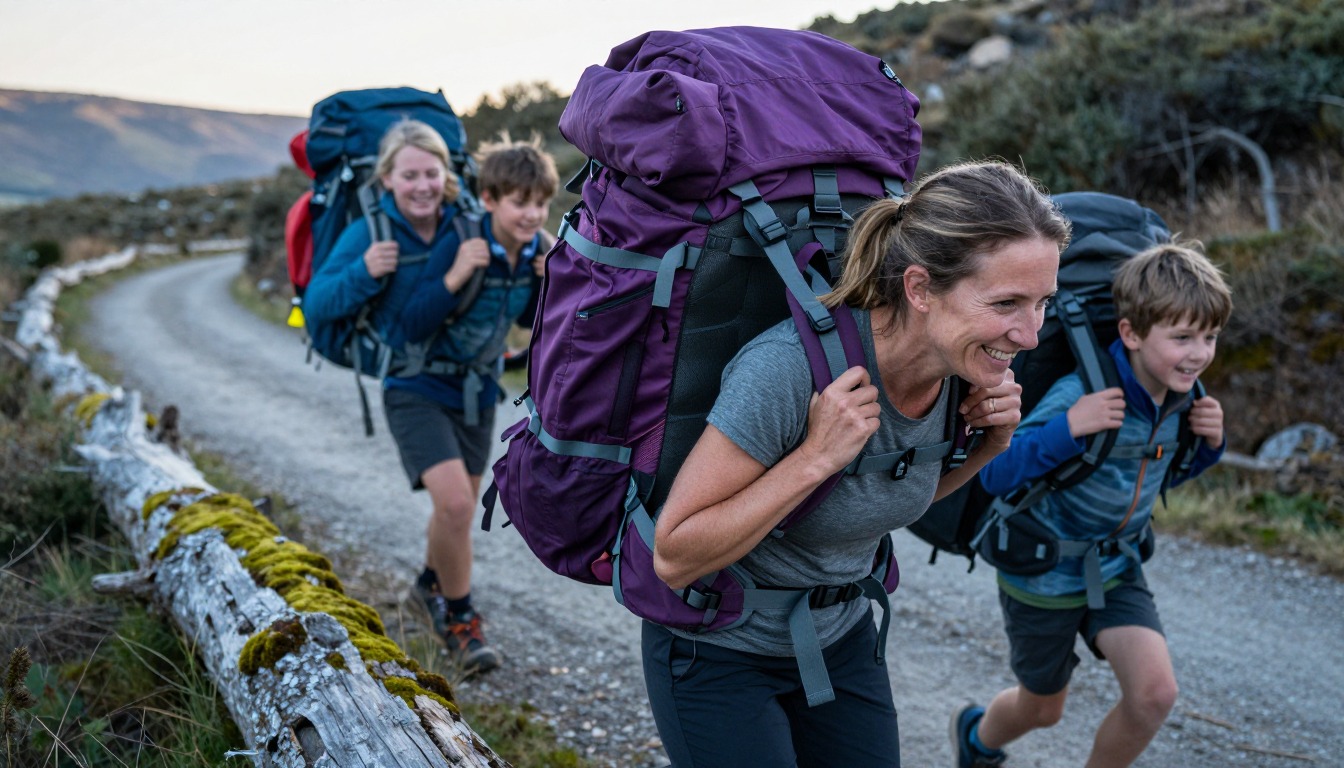


Load-lifter straps are a fine-tuning adjustment, not the main connection carrying pack weight — that job belongs to the hipbelt, which is built to carry the majority of a loaded pack's weight on the hips. Load lifters instead manage how the top of the pack leans against your shoulders and upper back.
How tight should load lifters be?
The target is a moderate pull at roughly a 45-degree angle between the shoulder strap and the pack body, not a strap cranked flat against the fabric. Over-tightening pulls the top of the pack into the back of your head or neck, while leaving them completely loose lets the load's weight fall backward, away from your spine, which tires the shoulders faster over a long day.
Where are they located?
Load lifters sit just above where the shoulder straps attach to the pack, running from that point up to a higher anchor on the frame or upper pack body. They're only effective on packs with enough torso length between the anchor points to create a real angle — on a pack that's too small for a hiker's torso, load lifters can end up nearly vertical and lose most of their pulling effect. Matching torso length correctly, generally by measuring from the C7 vertebra at the base of the neck down to the top of the hip bones, keeps this angle in the useful range.
What happens if they're skipped entirely?
Some minimalist and ultralight packs omit load lifters altogether to save a small amount of weight, relying instead on a simple shoulder-strap-to-frame connection. On a light load, roughly under 20 pounds, the difference is minor. On a heavier multi-day load, skipping load lifters tends to let the top of the pack drift backward over the course of a day, which shows up as extra fatigue across the front of the shoulders rather than a sudden, obvious problem.
| Adjustment | Effect |
|---|---|
| Load lifters loose | Pack top leans back, away from the body |
| Load lifters at ~45° | Weight pulled in toward shoulders, balanced |
| Load lifters cranked flat | Pack pulled too high, can press into head or neck |