
Best Frameless Backpack
Best Frameless Backpack, ranked from aggregated owner ratings and reviews, not first-hand testing. Real pros, cons, and who each pick is best for.
Our Top 3 Picks
Quick Comparison
| Product | Best for | Buy | |
|---|---|---|---|
| Teton 55L Scout Internal Frame Backpack for Hiking | Top Overall Pick | See Amazon | View |
| Teton 75L Explorer Internal Frame Backpack for Hiking | Best Value | See Amazon | View |
| TIDEWE Hunting Backpack for Men | Best Hydration Pack | See Amazon | View |
| Loowoko 50L Hiking Backpack with Rain Cover for Both Men & Women | Best for Women | See Amazon | View |
| Teton 65L Explorer Internal Frame Backpack for Hiking | Best for Multi-Day | See Amazon | View |
A frameless pack carries weight through a rolled sleeping pad, foam sheet, or the packed contents themselves, which give the pack body enough rigidity to sit against your back and distribute some load to the hipbelt. Without aluminum stays or a frame sheet, the pack relies entirely on how you pack it and on a snug hipbelt to keep weight from sagging away from your body.
How does a frameless pack carry weight without a frame?
Most frameless packs include a sleeve or open back panel designed to hold a closed-cell foam pad, rolled into a cylinder and positioned against your back. This pad-as-frame approach only works if the pad is rolled tightly and the pack is loaded with heavier items close to your back and centered between your shoulder blades. A poorly packed frameless bag, with heavy items at the bottom or sides, shifts and sways with each step regardless of how light it is.
What loaded weight is a frameless pack designed for?
Frameless packs are designed for loaded weights under roughly 20 to 25 pounds, since above that range the lack of a frame sheet means more weight transfers to the shoulders instead of the hips. This ceiling depends on the specific pack and hipbelt design — some frameless packs with a structured hipbelt handle slightly more, while minimal webbing-belt models are more sensitive to overloading. Check the manufacturer's stated maximum load and stay under it, especially on trips requiring extra food or water carries between resupply points.
When does a frameless pack stop making sense?
A frameless pack stops making sense once your loaded weight consistently exceeds its comfort ceiling, which shows up as shoulder soreness, a pack that sways or sags, or pressure points where a frame would normally sit. Common triggers include adding winter gear, carrying more than four or five days of food, or hauling extra water through a dry stretch — all of which push loaded weight up temporarily even if your base weight hasn't changed. In these situations, a single-stay pack, which adds one aluminum or carbon rod for structure while staying close to the same weight class, bridges the gap between frameless and full internal-frame packs.
How do you pack a frameless bag correctly?
Packing a frameless bag correctly means placing your rolled sleeping pad against the back panel first, then loading heavier items — food, water, cook system — centered and close to your back, with lighter items like your quilt or clothing at the bottom and outside. This order keeps the pack's center of gravity close to your body, which matters more on a frameless design than on a framed pack, where stays help correct for uneven loading. A snug hipbelt, cinched before the shoulder straps, also matters more here, since it's doing the structural job a frame would otherwise handle.
Which hikers get the most out of a frameless pack?
Frameless packs suit hikers who have already trimmed their shelter and sleep system down to a light quilt and trekking-pole tent, since the pack's low weight ceiling only pays off once the rest of the kit is light enough to fit under it. A hiker still carrying a heavier sleeping bag or a freestanding tent will likely exceed a frameless pack's comfortable load before they exceed its volume, which defeats the purpose of choosing the lightest pack option. Thru-hikers on established long-distance trails, where resupply points keep food carries short, are the most common users of fully frameless packs, since short food carries keep loaded weight consistently low between towns.
Full Ranking, Reviewed

Best for Frameless backpacks
- 45–65 L capacity
- 4.1 lb empty
- Rain cover included
- Teton tough
- Set up to carry a reservoir for hands-free sipping
- Breathable mesh back keeps air moving against your spine
- That 45–65 L volume is overkill for quick hikes and better suited to multi-night trips.
Verdict: TETON Sports’s 45–65 L backpacking pack pairs a breathable back with room for a bladder, making it the one we would grab first for Frameless Backpacks.

Best for Frameless backpacks
- 65–85 L capacity
- 5.5 lb empty
- Rain cover included
- Teton tough
- Set up to carry a reservoir for hands-free sipping
- Airflow channels help your back stay cooler under load
- That 65–85 L volume is overkill for quick hikes and better suited to multi-night trips.
- At 5.5 lb it is heavier than the lightest packs in its class before you load it.
Verdict: TETON Sports’s 65–85 L backpacking pack pairs a breathable back with room for a bladder, making it a strong option for Frameless Backpacks.

Best for Frameless backpacks
- 90 L capacity
- Rain cover included
- Ergonomic Design & Comfortable
- Set up to carry a reservoir for hands-free sipping
- Includes a rain cover for sudden downpours
- That 90 L volume is overkill for quick hikes and better suited to multi-night trips.
Verdict: This 90 L backpacking pack pairs room for a bladder with a bundled rain cover, making it an easy shortlist pick for Frameless Backpacks.

Best for Frameless backpacks
- 50 L capacity
- Nylon shell
- 2.4 lb empty
- Rain cover included
- Rain Cover Included
- Airflow channels help your back stay cooler under load
- Includes a rain cover for sudden downpours
- That 50 L volume is overkill for quick hikes and better suited to multi-night trips.
Verdict: This 50 L backpacking pack pairs a breathable back with a bundled rain cover, making it a strong option for Frameless Backpacks.
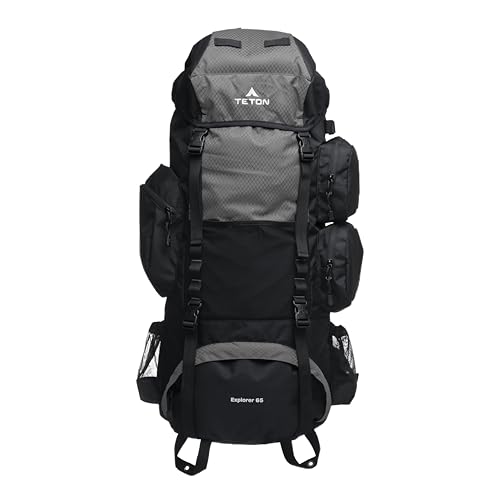
Best for Frameless backpacks
- 65–85 L capacity
- 5.0 lb empty
- Rain cover included
- Teton tough
- Set up to carry a reservoir for hands-free sipping
- Airflow channels help your back stay cooler under load
- At 65–85 L it is more pack — and more weight — than a day hiker needs; it earns its keep on overnight and multi-day loads.
- Empty weight (5.0 lb) runs above ultralight rivals.
Verdict: TETON Sports’s 65–85 L backpacking pack pairs a breathable back with room for a bladder, making it a strong option for Frameless Backpacks.
Frequently Asked Questions
Do frameless backpacks need a foam pad to work?
Most frameless packs are designed to use a rolled closed-cell foam pad as their structure, inserted into a sleeve or against the back panel. Without it, the pack has little shape and sags under load. Some hikers use a foam sit pad for this purpose, giving it double duty as sleeping-pad backup and frame.
Can a frameless pack handle winter backpacking gear?
A frameless pack can handle winter gear only if the added bulk and weight stay within its loaded-weight ceiling, typically 20 to 25 pounds. Winter layers, a warmer quilt, and extra fuel often push loaded weight above that range, making a single-stay or lightweight internal-frame pack a better fit for cold-weather trips.
How do I know if my pack is overloaded for a frameless design?
Signs of an overloaded frameless pack include the pack sagging away from your back, shoulder soreness despite a tightened hipbelt, and the bag swaying side to side while walking. If these show up, check your loaded weight against the manufacturer's stated maximum, and consider redistributing weight closer to your back first.