
Best Minimalist Hiking Backpack
Best Minimalist Hiking Backpack, ranked from aggregated owner ratings and reviews, not first-hand testing. Real pros, cons, and who each pick is best for.

Our Top 3 Picks
Quick Comparison
| Product | Best for | Buy | |
|---|---|---|---|
| G4Free 20L Lightweight Packable Hiking Backpack for Women Men | Top Overall Pick | See Amazon | View |
| FIORETTO 10L Hiking Backpack for Men Women Lightweight Foldable Small Da | Best Value | See Amazon | View |
| Seektop 15L Small Hiking Backpack for Women Men | Best Ultralight | See Amazon | View |
| 4Monster Hiking Daypack | Best Compact Pack | See Amazon | View |
A minimalist backpack is defined by a reduced feature set — fewer external pockets, a single main compartment, simple webbing or roll-top closures, and little to no internal organization — rather than strictly by weight, though minimalist packs are often also lightweight as a side effect of having less material. Two packs can weigh the same, with one built minimalist (few features, simple construction) and the other built ultralight through premium fabric alone (full-featured but in DCF).
What makes a backpack "minimalist" rather than just light?
Minimalist packs typically include one main compartment, sometimes a single front mesh or shove-it pocket, and one or two hipbelt or shoulder-strap pockets for small items. They skip features common on full-featured packs: multiple zippered compartments, dedicated hydration sleeves, trekking-pole attachment systems, and frame-sheet-integrated organization. This simplicity appeals to hikers who find more pockets mean more places to lose track of gear, and who prefer packing the same way every trip.
Who should choose a minimalist pack over a full-featured one?
Hikers who have a settled gear list and a consistent packing routine benefit most from a minimalist pack, since they already know where each item goes without needing dedicated pockets to sort it. Hikers who still experiment with gear, carry variable amounts of food or water, or need quick access to items like rain gear or snacks during the day often do better with a pack that has at least a couple of external pockets, even if it costs a bit more weight. Consider your habits against these patterns:
- Settled routine, same gear every trip: a single-compartment minimalist pack works well.
- Frequent gear changes or trip-to-trip variation: a pack with a front pocket and side pockets adds flexibility.
- Need quick access to snacks, layers, or a water filter: external pockets save time over digging through a single compartment.
- Prioritize simplicity and lower cost above all: minimalist construction usually costs less than full-featured packs at the same weight.
Does a minimalist pack sacrifice durability?
A minimalist pack doesn't inherently sacrifice durability, since fewer seams, zippers, and pocket attachment points actually mean fewer failure points compared to a full-featured pack. Zippers are the most common wear item on any backpack, and a minimalist pack's roll-top or drawcord closure has no zipper to fail. The trade-off is organizational, not structural: without dedicated pockets, small items like a phone or snacks either ride loose in the main compartment or require a separate pouch clipped to the hipbelt or shoulder strap.
How do you organize gear in a minimalist pack?
Organizing a minimalist pack well means using a packing order and small stuff sacks rather than relying on the pack's built-in pockets, since there are few or none. A common approach: sleeping pad and quilt at the bottom, heavier items like food and water in the middle close to the back, and frequently needed items — rain jacket, snacks, headlamp — in a small pouch near the top or clipped externally where they stay reachable without unpacking the main compartment. This system takes a trip or two to settle into but works reliably once established, and it transfers to any minimalist pack regardless of brand.
Full Ranking, Reviewed

Best for Minimalist Hiking backpacks
- 20 L capacity
- Nylon shell
- 12 oz empty
- Compact & Packable
- Low carry weight pays off on big-mileage days
- Folds down small when you do not need the space
- At 20 L it is best kept to shorter outings — it fills up once you add layers, lunch and water for a full day.
- The fabric is water-resistant rather than fully waterproof, so a pack liner helps in sustained rain.
Verdict: This 20 L daypack offers a packable build, making it the one we would grab first for Minimalist Hiking Backpacks.

Best for Minimalist Hiking backpacks
- 10 L capacity
- 11 oz empty
- Compact & Hiking Backpack
- Low carry weight pays off on big-mileage days
- Folds down small when you do not need the space
- At 10 L it is best kept to shorter outings — it fills up once you add layers, lunch and water for a full day.
Verdict: This 10 L daypack offers a packable build, making it a strong option for Minimalist Hiking Backpacks.

Best for Minimalist Hiking backpacks
- 15 L capacity
- Polyester shell
- 12 oz empty
- Light enough that you forget you are wearing it
- Packable build stows into its own pocket for travel
- Plenty of pockets keep small gear sorted and findable
- The 15 L capacity is snug for anything beyond a half-day on the trail.
Verdict: This 15 L daypack offers a packable build, making it a strong option for Minimalist Hiking Backpacks.
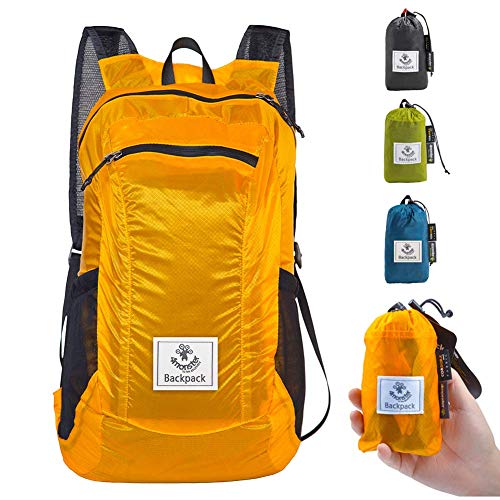
Best for Minimalist Hiking backpacks
- 16 L capacity
- Nylon shell
- Light enough that you forget you are wearing it
- Packable build stows into its own pocket for travel
- Plenty of pockets keep small gear sorted and findable
- The 16 L capacity is snug for anything beyond a half-day on the trail.
- Water-resistant shell handles showers, but a liner or cover is wise for all-day rain.
Verdict: This 16 L daypack offers a packable build, making it a strong option for Minimalist Hiking Backpacks.
Frequently Asked Questions
Are minimalist backpacks harder to pack than full-featured ones?
Minimalist backpacks take longer to learn to pack well since there are few dedicated pockets to guide where items go, but most hikers settle into a consistent system within a trip or two. Using small stuff sacks for categories like cooking gear or clothing makes a single-compartment pack easier to manage.
Do minimalist packs work for longer trips with more food?
Minimalist packs work for longer trips as long as their main compartment has enough volume for extra food between resupplies, since there's no separate pocket system to help spread bulk out. Check the pack's total liters against your food-carry needs, not just your usual gear list, before a longer stretch.
What's the difference between minimalist and frameless backpacks?
Minimalist describes a pack's feature set — few pockets, one main compartment, simple closures — while frameless describes its structural design — no aluminum stays or frame sheet. A pack can be one, both, or neither; many frameless ultralight packs are also minimalist, but the terms describe different design choices.