By Marcus Hale, Lead Pack Research Editor · Published September 14, 2026, 6:03 PM ET · Updated September 29, 2026, 6:16 PM ET
Direct Answer
Yes, a 30L backpack is good for hiking on day trips of any length and for single-night trips using an ultralight kit. It suits fastpacking and shoulder-season overnights well but is generally too small for standard multi-night backpacking unless gear volume stays minimal.
Affiliate disclosure: this page contains affiliate links. Purchases made through them may earn us a commission at no extra cost to you. See our affiliate disclosure.
In plain English
A 30-liter backpack sits between a small daypack and a camping pack. For a day outdoors it is roomy: plenty of space for water, food, warm clothes and a rain jacket. For a night outdoors it is small, because a tent, a sleeping bag and a pad take a lot of room.
What makes a pack comfortable is how it sits on your body. A good pack has a padded belt that wraps around the top of your hip bones. That belt lets your legs, which are strong, carry much of the load instead of your shoulders. Think of it like carrying a heavy box: holding it against your hips is easier than dangling it from your hands.
The rule people repeat about carrying no more than a fifth of your body weight is a rough guide, not a law. Lighter is almost always more comfortable, especially for beginners.
A 30L backpack is good for hiking across a range of trip types, though the right fit depends on how far and how long you're going. For day hikes, 30L offers more room than a small daypack for layers, food, water, and safety gear without carrying excess unused volume.
What makes a 30L pack comfortable on the trail?
Comfort at 30L comes down to hip belt design and torso fit rather than raw capacity. A well-fitted hip belt is meant to carry most of a loaded pack's weight (makers such as Big Agnes aim for about 80%, though sources differ), so a padded, structured belt matters even at this smaller size. A common rule of thumb keeps total loaded weight, including water and food, near 20% of a hiker's body weight, but it is a starting point rather than a standard.
When does a 30L pack fall short?
A 30L pack falls short on standard three-season backpacking trips longer than one night, since a full sleeping bag, tent, and multiple days of food rarely fit alongside day-hike essentials. Cold-weather trips push the limits even faster, as insulated layers and a warmer sleeping bag add bulk quickly.
Trip Type
30L Suitability
Day hike
Good fit
Single-night ultralight trip
Good fit with minimal kit
Two-plus night standard trip
Usually too small
Hikers who mostly day hike but take occasional fast overnight trips often find 30L hits the right balance between capacity and weight. Sizing up to 35L or 40L adds comfort margin for the rare longer trip but means carrying a partly empty pack on the far more common day-hike outings, which is why many hikers keep a 30L pack as their primary size and rent or borrow larger gear only when a longer trip actually comes up.
How much weight really goes on the hips
The page's 80% figure is one estimate among several. The Washington Trails Association says a hip belt transfers around 80% of pack weight to the hips,1 and Big Agnes aims for about the same.2 Alpkit gives a range of 60 to 80%.3 US Army doctrine is much lower: with a frame and hip belt, it estimates about 30% of the load on the hips and lower back and 70% on the shoulders.4
The sources agree on direction even if not on the number. Research on load carriage found the hips tolerate pack pressure much better than the shoulders.5 Makers also disagree slightly on belt placement: Deuter centers the hip fins over the top of the hip bone,6 while Gossamer Gear says the top third of the belt should rest at the iliac crest.7 Follow the instructions for the pack you own.
Where the 20% rule comes from
The 20%-of-body-weight guideline has no primary source; it is a hiking-community rule of thumb. Deuter, a manufacturer, says people can carry a maximum of 20 to 25%.8 A study of long-distance hikers found forefoot pressure rose clearly once packs passed about 10% of body weight.9 At the other end, US Army doctrine sets an ideal fighting load of about 30% and an approach-march load of about 45% for properly conditioned soldiers.4
Real hikers often exceed 20%. A study of Appalachian Trail backpackers found packs averaged 25.0% of body weight for men and 27.9% for women.10 For a 30-liter pack, the load rarely approaches these numbers on a day hike, but on an overnight with water and food it can climb quickly.
Making a single night fit
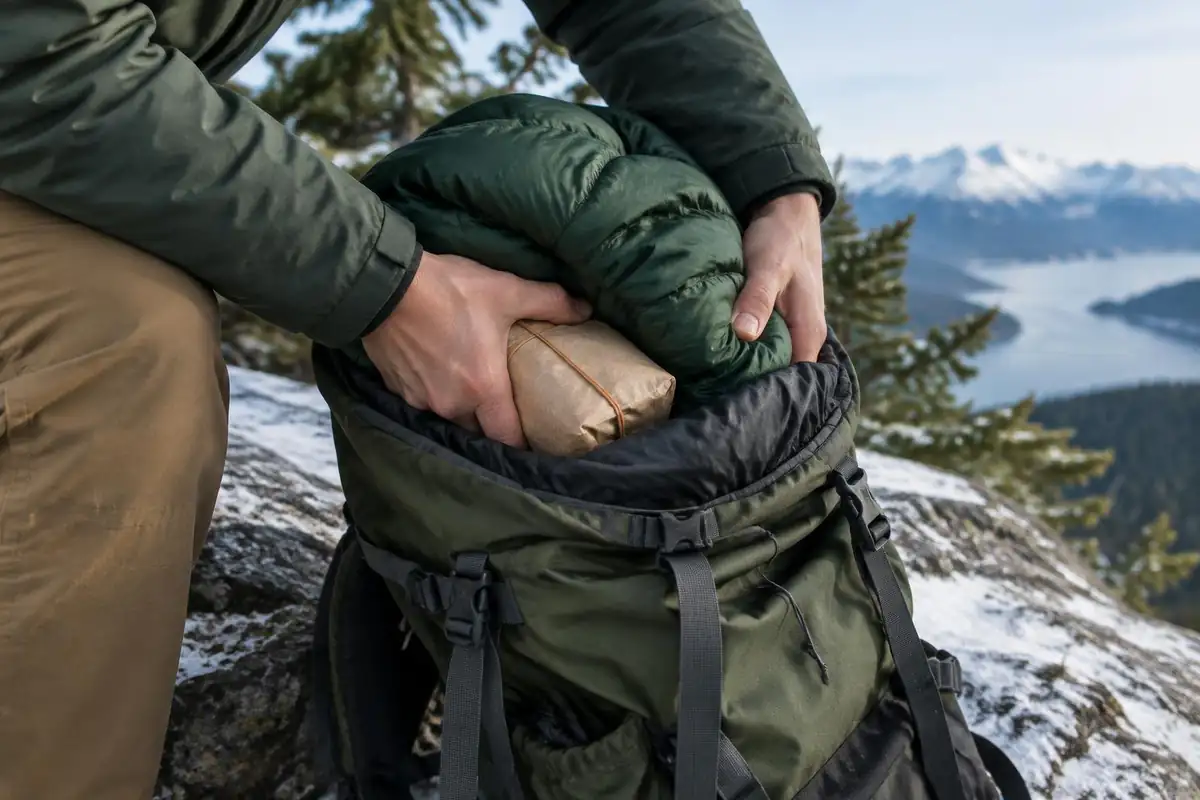
An overnight in 30 liters depends on very compact gear. Zpacks says ultralight generally means a base weight of 10 pounds or less,11 and gear at that weight is usually small as well. The packing order that works in larger packs applies here: the sleeping bag goes in the bottom,12 dense items such as food and cook gear sit about two-thirds of the way up against the back, and the compression straps are cinched once everything is in.13 If the tent or pad ends up strapped to the outside, the pack is too small for the trip.
Looking for Complete Category Guidance?
Explore our complete, evidence-based master guide for Backpacks by Capacity.