By Marcus Hale, Lead Pack Research Editor · Published September 14, 2026, 6:03 PM ET · Updated September 29, 2026, 6:16 PM ET
Direct Answer
Yes, a 40L backpack is big enough for one- to two-night backpacking trips when packed with lightweight, three-season gear: a compact sleeping bag or quilt, an inflatable pad, a one-person shelter, and two days of food. It's not big enough for winter trips, bear-canister routes, or hikers still carrying heavier starter gear.
Affiliate disclosure: this page contains affiliate links. Purchases made through them may earn us a commission at no extra cost to you. See our affiliate disclosure.
In plain English
A 40-liter backpack is a common size for a first overnight trip. It is roughly the size of a small carry-on suitcase. With light camping gear, it fits a tent, a sleeping bag, a pad, a small stove and two days of food.
Some things refuse to squish. In areas with bears, many parks require a hard plastic food container called a bear canister. It is like packing a large paint can: it takes the same space no matter how you push. Winter sleeping bags and puffy jackets also need much more room than summer ones.
Space is only half the question. A pack can close easily and still be too heavy to carry comfortably. Weigh your packed bag at home on a bathroom scale before the trip. If it feels heavy walking around the house, it will feel heavier after a few miles uphill.
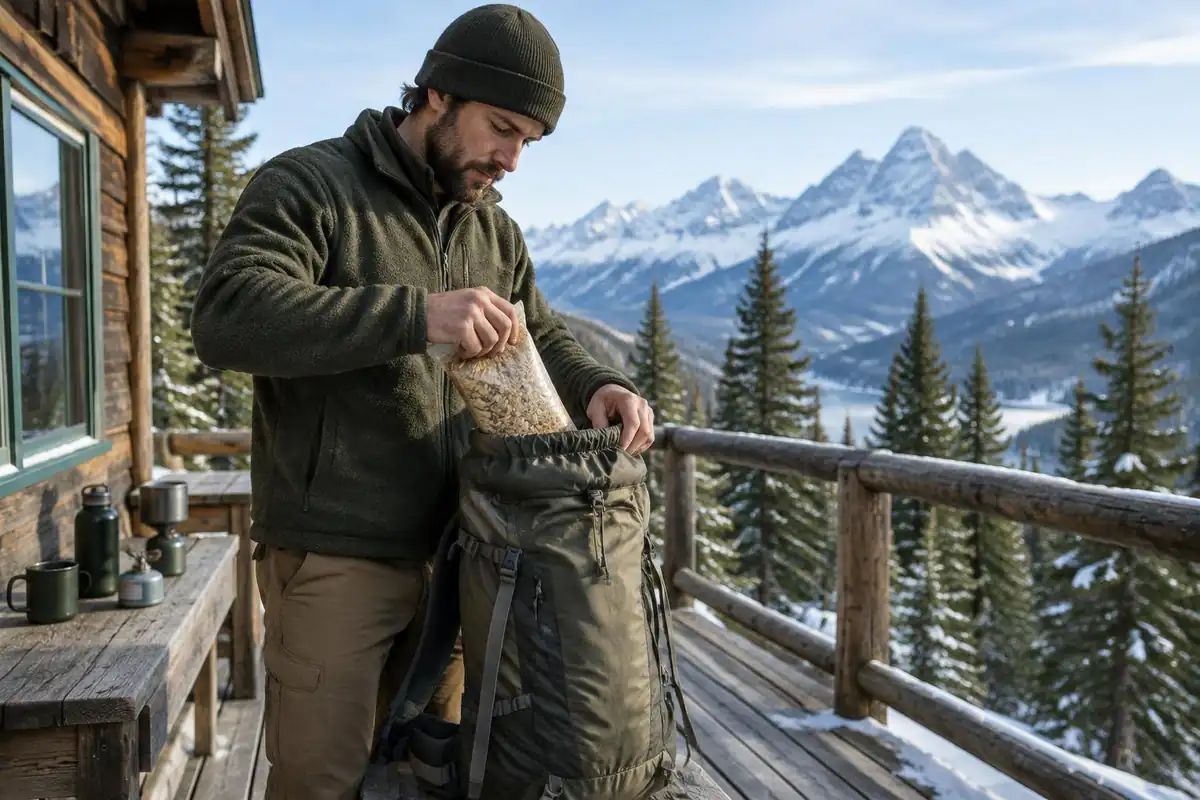
A 40L backpack fits one- to two-night trips comfortably when the gear inside it is already lightweight. The pack needs to hold a 3-season sleeping bag or quilt, an inflatable sleep pad, a one- or two-person shelter, roughly two days of food, a stove and water filter, and one spare layer.
What limits a 40L pack
Three things push a 40L pack past its comfortable limit: winter insulation, a hard-sided bear canister, and a non-ultralight sleep system. A 15°F-or-colder sleeping bag alone can take 8–12 liters packed, compared to 6–9 liters for a 3-season bag, and a bear canister takes up a fixed, non-compressible chunk of space that a soft stuff sack doesn't.
Who a 40L pack suits
Hiker Profile
40L Fit
Dialed-in ultralight packer
Good fit
Standard 3-season backpacker
Workable with discipline
Winter or bear-canister route
Too small
New backpacker with heavier gear
Often too small
Load weight matters as much as volume
Even when gear fits inside a 40L pack by volume, a common rule of thumb keeps total carried weight near 20% of body weight, though it is a starting point rather than a standard. A 40L pack stuffed to capacity with heavy gear can exceed that even though everything technically fits, which is why experienced backpackers weigh their kit, not just measure its volume, before choosing this size. Hikers who consistently pack under 35 liters of actual gear are well matched to a 40L pack; those who regularly need more room are better served by sizing up to 45–50 liters rather than compressing a 40L pack past its comfortable working capacity.
The bear-canister math
Canisters are the clearest reason a 40-liter pack runs short. Glacier Bay National Park's loaner canister has a volume of 560 cubic inches, which converts to about 9 liters, weighs 2.8 pounds, and holds about six days of food for one person.1 New York's Department of Environmental Conservation describes typical canisters as about 8 by 12 inches, holding up to five days of food.2 Denali's small canister weighs 3 pounds and holds three to five days of food.3
Rules are set park by park. Rocky Mountain National Park requires canisters for all wilderness overnights,4 and hanging food is illegal everywhere in Yosemite.5 Check the current rules for the specific area before choosing a pack size, since a required canister takes a fixed chunk of space.
Sleeping bag volume and how ratings work
The page gives packed volumes of 8 to 12 liters for a 15°F bag and 6 to 9 liters for a three-season bag. Those figures are estimates, not a published standard; packed size varies with insulation type, fill amount and stuff sack. The more reliable comparison is the temperature rating. NEMO explains that the ISO comfort rating is the temperature at which an average woman sleeps comfortably, while the lower limit rating is where an average man stays in thermal balance while curled up.6 Therm-a-Rest notes that the updated ISO standard replaced the older EN ratings in April 2017.7
Choose the bag for the coldest night you expect, using the comfort rating, then check its packed size against your pack. A warmer bag usually needs more room, which is why cold trips outgrow 40 liters first.
What the 20% guideline does and doesn't mean
The page advises keeping carried weight close to 20% of body weight. That figure is a widely repeated rule of thumb without a primary source. Deuter says a maximum of 20 to 25%,8 a 2022 review says adult loads should generally stay under 40%,9 and a study of long-distance hikers found plantar pressure rose clearly above about 10%.10 Actual Appalachian Trail hikers in one study averaged 25 to 28%.11 Lighter is more comfortable, but there is no single safe number.
Looking for Complete Category Guidance?
Explore our complete, evidence-based master guide for Backpacks by Capacity.