
Best Time to Hike Huangshan — Yellow Mountain
The best time to hike Huangshan is spring to fall, according to the official season guidance, with winter recommended if you want snow scenes. On average, October and December are the driest months, while June and July bring the heaviest rain, so plan around that.
Month-by-month climate for Huangshan — Yellow Mountain
| Month | Relative warmth | Rain | Daylight |
|---|---|---|---|
| Jan | Coldest | 80 mm | 10.3 h |
| Feb | Coldest | 116 mm | 10.9 h |
| Mar | Cool | 195 mm | 11.8 h |
| Apr | Mild | 199 mm | 12.7 h |
| May | Warm | 269 mm | 13.5 h |
| Jun | Warmest | 394 mm | 13.9 h |
| Jul | Warmest | 342 mm | 13.8 h |
| Aug | Warmest | 199 mm | 13.1 h |
| Sep | Warm | 135 mm | 12.2 h |
| Oct | Mild | 76 mm | 11.2 h |
| Nov | Cool | 86 mm | 10.5 h |
| Dec | Coldest | 60 mm | 10.1 h |
Modelled regional averages for 2010–2023 (rainfall) and calculated daylight hours; they describe the wider area, not a reading taken on the trail. “Relative warmth” compares each month with the warmest and coldest months of this place’s own year. It is not a temperature, and the high parts of a route are colder than the region around them.
The modelled averages show a clear wet peak in early summer: June averages about 394 mm of rain and July about 342 mm, against roughly 60 mm in December and 76 mm in October. Rain climbs steadily from February (116 mm) through May (269 mm), then eases from August onward. Daylight swings from about 10.1 hours in December to 13.9 hours in June. Relative to this place's own year, June through August are the warmest months and December through February the coldest, with spring and autumn sitting in between.
Huangshan — Yellow Mountain season by season
Spring · March to May
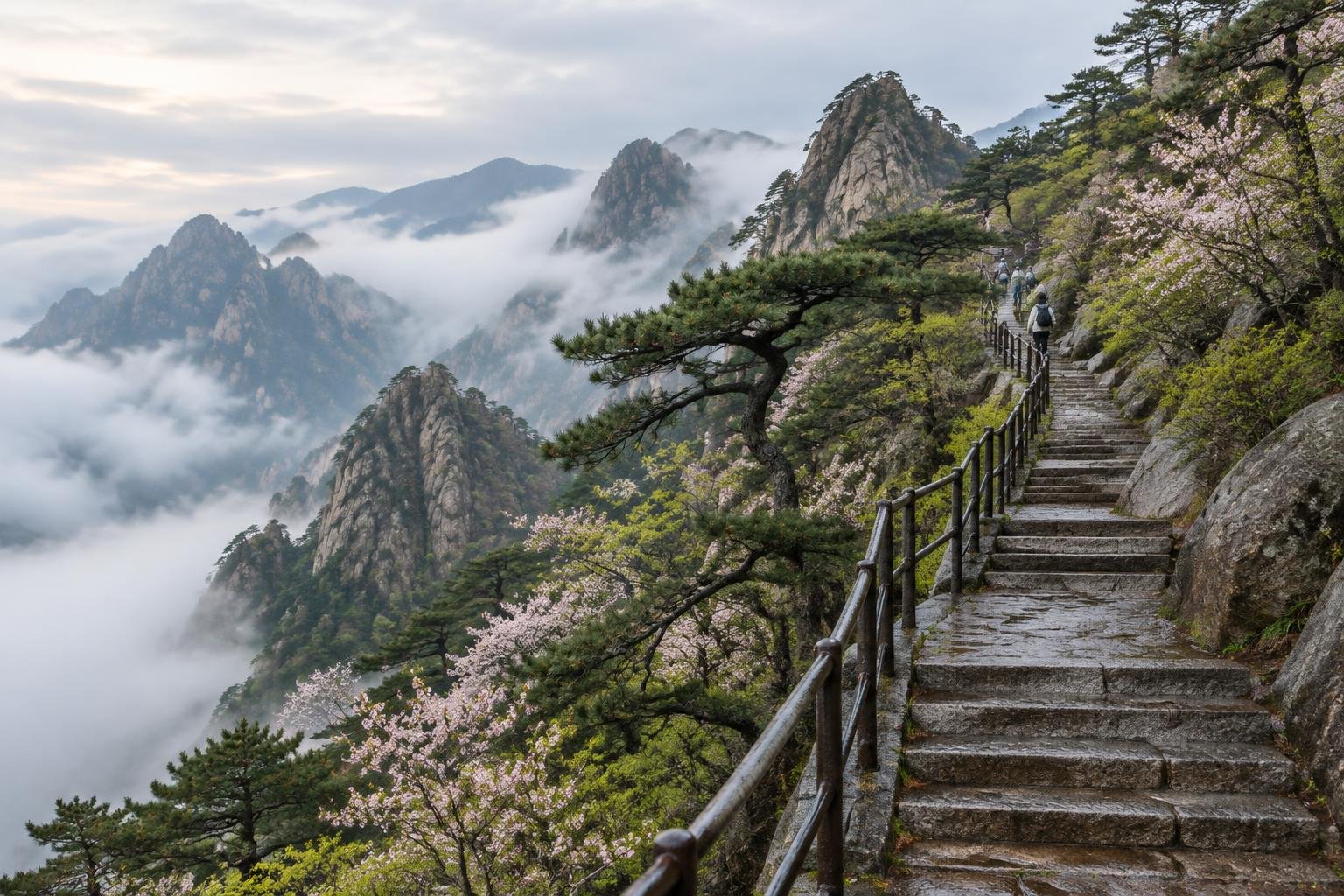
Spring fits the official season guidance and brings longer days, from about 11.8 hours in March to 13.5 hours in May. Warmth moves from cool in March to warm by May, but rain rises too, from about 195 mm in March to 269 mm in May. Expect damp stone stairs and the cloud the area's peaks are known for. This is a reasonable window if you pack rain cover and accept that views can come and go.
Early summer rains · June to July
These are the warmest months of the year here, but also the wettest on average, with roughly 394 mm in June and 342 mm in July. Daylight is at its longest, close to 14 hours, which helps with pacing on the staircases. The trade-off is frequent wet weather and cloud that can hide the views. Summer falls inside the official spring-to-fall window, so it is workable if you are comfortable hiking in rain, but it is not the driest choice.
Late summer to autumn · August to November
Rainfall drops steadily through this stretch, from about 199 mm in August to 135 mm in September, then 76 mm in October and 86 mm in November. Warmth eases from the year's warmest in August to mild in October and cool in November. October stands out as one of the two driest months on average, and it sits within the official spring-to-fall season. Daylight shortens from about 13.1 hours to 10.5 hours, so start earlier as the weeks pass.
Winter · December to February
These are the coldest months of the year here, and the official season guidance specifically points to winter for snow scenes. December is the driest month on average at about 60 mm, with January at 80 mm and February at 116 mm. Daylight is shortest, around 10.1 to 10.9 hours, which limits how much stair-climbing you can fit in. The peaks are described as cold and often cloudy, so plan for a short day and confirm current conditions with the managing authority.
Official season guidance
Regional scenic authority: Spring to fall; winter for snow scenes
A scenic-area ticket (and separate cable-car fares) is required; check current ticketing and cable-car arrangements before you go. The trails are paved stone staircases — steep and strenuous but not technical — and the peaks are cold and often cloudy; an overnight in a mountaintop hotel is how most people catch the sunrise.
Check current dates on UNESCO World Heritage Centre (Mount Huangshan)What to pack for the season
Packing follows the season more than the calendar. For the wetter months, bring reliable rain cover and a way to keep gear dry on long staircase climbs. Since the peaks are described as cold and often cloudy, carry warm layers in every season, adding more for winter. Pack sun protection for clearer spells, and a headlamp if you plan a pre-dawn start for sunrise, since daylight is short in winter.
For layering, rain cover and weather planning, see hiking in rain, heat and cold.
Timing mistakes to avoid
The biggest mistake is picking a month on the assumption that clear views are guaranteed. The peaks are described as often cloudy, and early summer is the wettest stretch on average. Another is treating the spring-to-fall window as uniform: rainfall varies a lot within it. Skipping the ticketing and cable-car check is also easy to do, since arrangements can change. Finally, if you want the summit-hotel sunrise, remember that most people overnight on the mountain, so build that into your dates.
Common questions
What is the driest time to hike Huangshan?
On average, December is the driest month at about 60 mm of rain, followed by October at about 76 mm. These are modelled regional averages, not measurements at the trail, so conditions on any given day can differ. October also falls within the official spring-to-fall season.
Is summer a good time to hike Huangshan?
Summer is inside the official spring-to-fall window and has the longest daylight, close to 14 hours in June. It is also the warmest period of the year here and has the heaviest average rainfall, about 394 mm in June. It can work if you are prepared for wet weather and cloudy views.
Should I hike Huangshan in winter?
The official season guidance recommends winter for snow scenes, so it is a deliberate choice rather than an off-season. Expect the coldest months of the year, shorter daylight of about 10 to 11 hours, and peaks that are often cloudy. Check current ticketing, cable-car arrangements and conditions with the managing authority before going.
When should I go if I want to see the sunrise?
Most people overnight in a mountaintop hotel to catch the sunrise, so the timing question is really about which season gives you the best chance of a clear morning. The numbers show October and December as the driest months on average, but cloud is common on the peaks in any season, so keep your dates flexible if you can.
Sources
- Regional scenic authority — UNESCO World Heritage Centre (Mount Huangshan): official season and permit guidance.
- NASA POWER (Prediction Of Worldwide Energy Resources): monthly temperature and rainfall averages, 2010–2023, from MERRA-2 reanalysis. Daylight hours are calculated from latitude.
Conditions, closures and permit rules change without notice — confirm current information with the managing authority before you go. See our editorial policy and affiliate disclosure.