
Best Time to Hike Trolltunga
The best time to hike Trolltunga is mid-June to September, which is the window the official season guidance gives. Outside mid-summer, conditions are harder and guiding is often advised. These months also bring the warmest stretch of the year and the longest daylight for such a long mountain day.
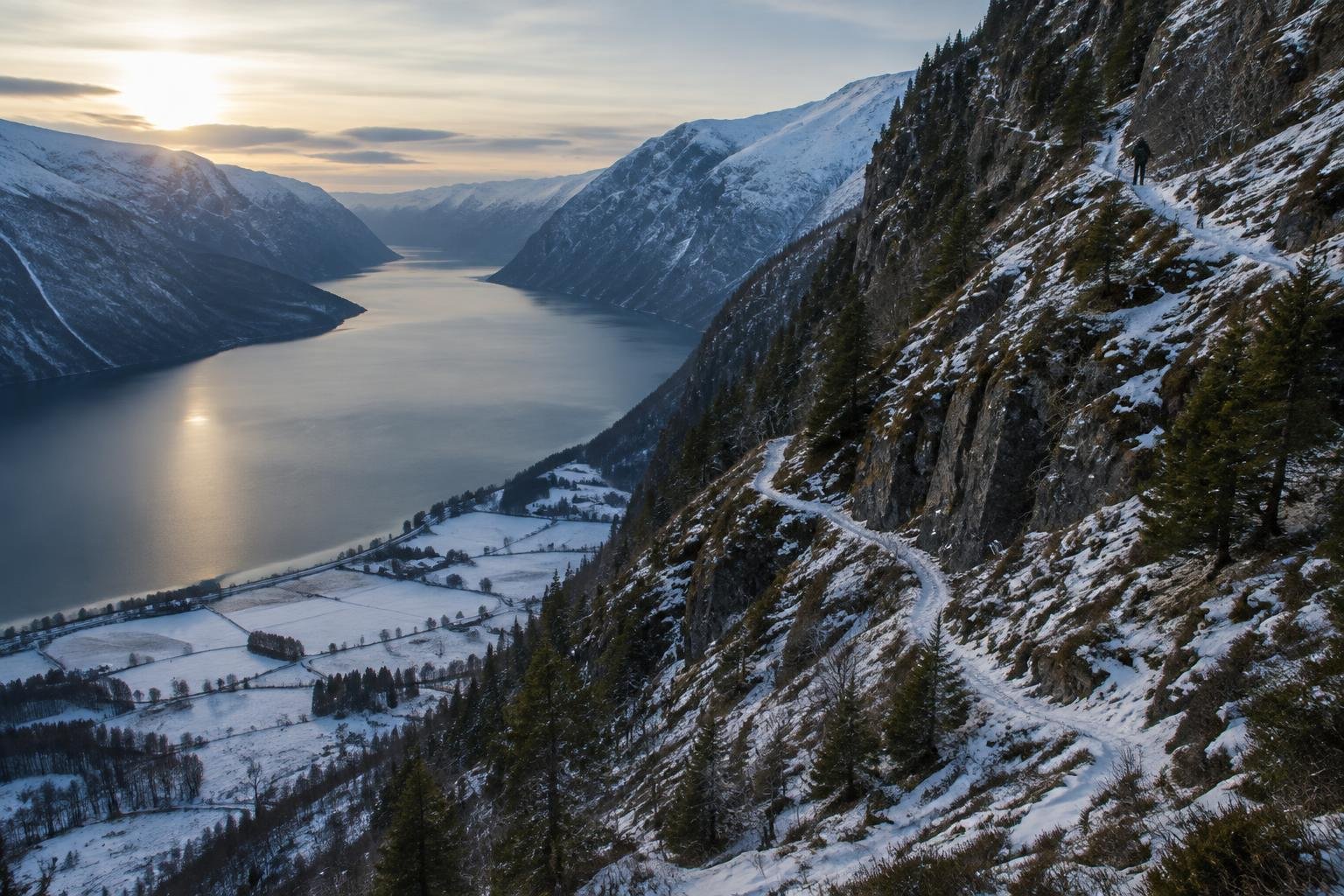
Month-by-month climate for Trolltunga
| Month | Relative warmth | Rain | Daylight |
|---|---|---|---|
| Jan | Coldest | 213 mm | 6.3 h |
| Feb | Coldest | 179 mm | 8.8 h |
| Mar | Coldest | 163 mm | 11.3 h |
| Apr | Cool | 121 mm | 14.2 h |
| May | Mild | 126 mm | 16.8 h |
| Jun | Warmest | 157 mm | 18.5 h |
| Jul | Warmest | 185 mm | 17.8 h |
| Aug | Warmest | 184 mm | 15.4 h |
| Sep | Warmest | 209 mm | 12.5 h |
| Oct | Mild | 230 mm | 9.7 h |
| Nov | Coldest | 200 mm | 7 h |
| Dec | Coldest | 265 mm | 5.5 h |
Modelled regional averages for 2010–2023 (rainfall) and calculated daylight hours; they describe the wider area, not a reading taken on the trail. “Relative warmth” compares each month with the warmest and coldest months of this place’s own year. It is not a temperature, and the high parts of a route are colder than the region around them.
The modelled averages show a wet place in every month. Rainfall is lowest in April and May at around 121 and 126 mm, and highest in December at about 265 mm, with October also heavy at 230 mm. Daylight swings dramatically, from about 5.5 hours in December to 18.5 hours in June. Relative to this place's own year, June through September are the warmest months, while November through March are the coldest, with April, May and October sitting in between. Even in the warmest months, rain is typical, so cover matters.
Trolltunga season by season
Winter · December to March
This is the coldest part of this place's own year, and daylight is at its shortest, from about 5.5 hours in December to 11.3 hours by March. Rainfall averages are among the highest, with 265 mm in December and 163 mm in March. The official season guidance points to mid-June through September, noting that conditions outside mid-summer are much harder and a guide is often advised. For a long, exposed day hike, this window leaves very little margin, so check with the managing authority before considering it.
Spring · April to mid-June
Spring is a transition. April is cool and May mild relative to the year, and both are among the drier months at about 121 and 126 mm, while daylight stretches from roughly 14 to nearly 17 hours. Even so, this sits before the mid-June start of the official season guidance, which says conditions outside mid-summer are harder and guiding is often advised. The longer light helps with a big day, but conditions can still be demanding, so confirm the current situation with the managing authority.
Summer · Mid-June to August
This is the core of the recommended window. June, July and August are the warmest months of this place's year, and daylight is at its best, with about 18.5 hours in June and 15.4 in August. Rain still falls, averaging about 157 mm in June and 185 mm in July, so waterproofs belong in the pack. Because the route is a very long, exposed day, the generous light gives you room to start early and turn back if weather closes in, as the rules advise.
Early autumn and late autumn · September to November
September still falls inside the official season guidance and remains among the warmest months, though it is the wettest of the recommended window at about 209 mm, and daylight drops to roughly 12.5 hours. October is mild but wetter still at 230 mm with about 9.7 hours of light, and November turns coldest with about 7 hours. As the season guidance notes, conditions outside mid-summer become harder, so the shortening days and rising rainfall reward careful planning and a guide where advised.
Official season guidance
Regional tourism & landowners: Mid-June to September; outside mid-summer conditions are harder and guiding is often advised
No permit is needed, but this is a very long, exposed mountain day — start early, carry full layers and food, and turn back if weather closes in. Outside mid-summer conditions are much harder and a guide is often advised.
Check current dates on visitnorway.com (Visit Norway, national tourist board)What to pack for the season
Packing follows the season and the long, exposed nature of the day. Carry full layers, since the rules call for them, plus reliable rain cover because every month is wet. Bring enough food for a very long day and sun protection for the long summer light. Pack a headlamp if you might finish late, particularly outside the longest days, when daylight shrinks quickly.
For layering, rain cover and weather planning, see hiking in rain, heat and cold.
Timing mistakes to avoid
The biggest mistake is treating this as a casual outing. The official season guidance and rules stress that this is a very long, exposed mountain day, so starting late or ignoring the mid-June to September window is risky. Another is assuming warm months mean dry weather, when rain is typical year-round. Do not rely on one month's averages, and do not skip turning back if weather closes in. Always confirm current conditions with the managing authority.
Common questions
When is the best time to hike Trolltunga?
The official season guidance gives mid-June to September as the best window. These months are the warmest relative to the rest of the year and offer long daylight, which matters for such a long, exposed day. Outside mid-summer, conditions are harder and guiding is often advised.
Is it a good idea to hike Trolltunga outside summer?
The official guidance says conditions outside mid-summer are much harder and a guide is often advised. Daylight is also far shorter, down to about 5.5 hours in December. If you are considering it, check current conditions with the managing authority before committing to the route.
How much daylight is there for the hike?
It varies widely. Daylight is about 18.5 hours in June and 17.8 in July, but only about 12.5 in September and 5.5 in December. Because this is a very long day, the generous light in mid-summer gives you much more margin to start early and turn back if needed.
Does it rain on the Trolltunga hike in summer?
Yes, rain is typical in every month. Modelled regional averages show about 157 mm in June, 185 mm in July and 184 mm in August. These are regional figures rather than trail measurements, so plan for wet weather and carry full layers and rain cover even in the warmest months.
Sources
- Regional tourism & landowners — visitnorway.com (Visit Norway, national tourist board): official season and permit guidance.
- NASA POWER (Prediction Of Worldwide Energy Resources): monthly temperature and rainfall averages, 2010–2023, from MERRA-2 reanalysis. Daylight hours are calculated from latitude.
Conditions, closures and permit rules change without notice — confirm current information with the managing authority before you go. See our editorial policy and affiliate disclosure.