
Best Time to Hike Mount Fuji — Yoshida Trail
The best time to hike Mount Fuji is during the official climbing season, which runs from early July to September 10. Outside those dates the huts and facilities above the 5th station are closed and climbing is dangerous, so plan your trip around the season rather than the weather alone.
Month-by-month climate for Mount Fuji — Yoshida Trail
| Month | Relative warmth | Rain | Daylight |
|---|---|---|---|
| Jan | Coldest | 47 mm | 9.9 h |
| Feb | Coldest | 70 mm | 10.7 h |
| Mar | Cool | 121 mm | 11.7 h |
| Apr | Cool | 145 mm | 12.9 h |
| May | Mild | 143 mm | 13.9 h |
| Jun | Warm | 194 mm | 14.4 h |
| Jul | Warmest | 221 mm | 14.2 h |
| Aug | Warmest | 161 mm | 13.3 h |
| Sep | Warm | 227 mm | 12.2 h |
| Oct | Mild | 175 mm | 11.1 h |
| Nov | Cool | 80 mm | 10.1 h |
| Dec | Coldest | 61 mm | 9.6 h |
Modelled regional averages for 2010–2023 (rainfall) and calculated daylight hours; they describe the wider area, not a reading taken on the trail. “Relative warmth” compares each month with the warmest and coldest months of this place’s own year. It is not a temperature, and the high parts of a route are colder than the region around them.
The regional numbers show a clear wet and dry pattern. September is the wettest month at 227 mm, followed closely by July at 221 mm and June at 194 mm. January is the driest at 47 mm, with December at 61 mm. Daylight swings from about 9.6 hours in December to 14.4 hours in June. July and August are the relatively warmest months of this place's year, while December through February are the coldest. These are modelled regional averages, not readings from the mountain itself.
Mount Fuji — Yoshida Trail season by season
Winter and early spring · December to April
This stretch brings the coldest months of the year and the shortest days, with roughly 9.6 to 12.9 hours of daylight between December and April. Rainfall is modest early on, with January at about 47 mm, then climbs through March and April. This is far outside the official season, when the trails above the 5th station and the huts are closed. The official guidance says climbing outside the season is dangerous, so this is not the time to attempt the summit.
Late spring · May to June
May is mild and June turns warm, with long days of about 13.9 to 14.4 hours of daylight. Rainfall is substantial, with May near 143 mm and June near 194 mm on average, which marks the approach to the wetter summer months. The official climbing season has not yet begun, so huts and facilities are still closed and climbing is dangerous. Use this window for planning, reservations and checking current rules with the managing authority, not for the climb itself.
Official climbing season · Early July to September 10
This is the window when huts and facilities are open and climbing is allowed. July and August are the warmest months of the year here, with daylight of about 14.2 and 13.3 hours. Rain is still significant, with July around 221 mm and August around 161 mm. Early September is the last part of the season, and the month is the wettest on average at 227 mm. Remember the hut-reservation rule and the trail-access system with daily limits, and confirm current details before you go.
Autumn · Mid-September to November
After the season ends on September 10, the trails above the 5th station and the huts close, and climbing is dangerous. October is mild with about 175 mm of rain, and November turns cool and drier at roughly 80 mm, while daylight shrinks from about 12.2 hours in September to 10.1 hours in November. Even when the lower slopes feel pleasant, the official guidance is to climb only in season, so autumn is not a summit window.
Official season guidance
Yamanashi Prefecture / national park: Official season runs from early July to September 10 (the 2026 season ended on September 10)
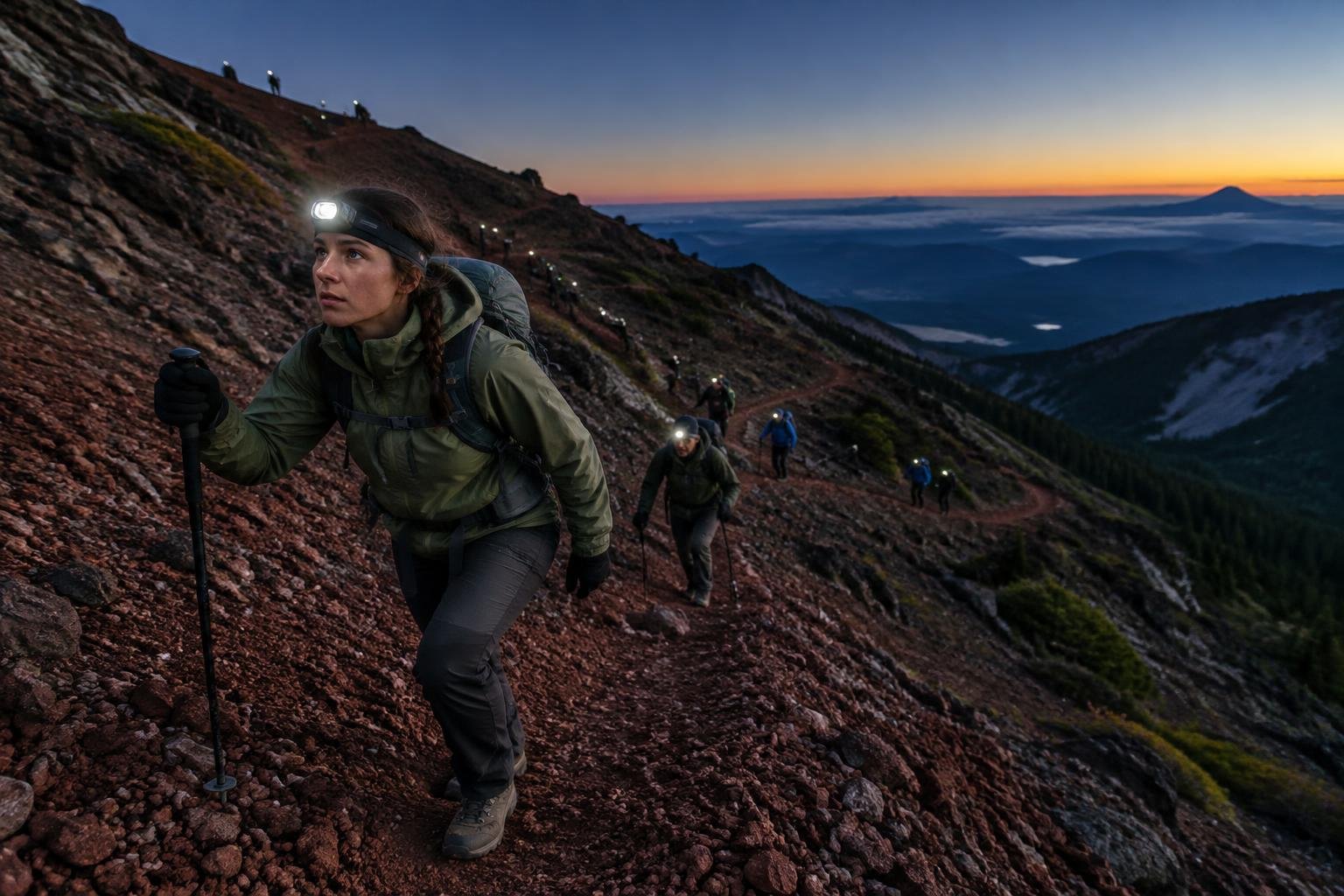
Climb only in the official season, when huts and facilities are open. As of September 2026 the season has ended and the trails above the 5th station and the huts are closed; climbing outside the season is dangerous. In season, climbers without a hut reservation are not allowed on the trail between roughly 2 PM and 3 AM. the Yoshida Trail now has a trail-access reservation/fee system and daily limits, so check current rules. Altitude and cold are real even on this busy route.
Check current dates on fujisan-climb.jpWhat to pack for the season
Because the season sits in the warmest and wettest part of the year, pack for variable conditions rather than a single forecast. Bring layers, since altitude and cold are real even on this busy route, plus reliable rain cover and sun protection. Hiking overnight means darkness, so carry a headlamp and spare batteries for the night ascent.
For layering, rain cover and weather planning, see hiking in rain, heat and cold.
Timing mistakes to avoid
The biggest timing mistake is treating Fuji like an ordinary summer day hike and showing up outside the official season, when huts and facilities are closed and climbing is dangerous. Another is arriving without a hut reservation, since climbers without one are not allowed on the trail between roughly 2 PM and 3 AM. Do not rely on a single warm month either. Check the current trail-access reservation, fee and daily limits with the managing authority.
Common questions
When does the Mount Fuji Yoshida Trail climbing season start and end?
The official season runs from early July to September 10. Within that window the huts and facilities are open. Outside it, the trails above the 5th station and the huts are closed. Exact opening dates can vary, so confirm the current dates with the managing authority before booking.
Can I climb Mount Fuji outside the official season?
The official guidance says to climb only in the official season, when huts and facilities are open. Climbing outside the season is dangerous. After the season ends, the trails above the 5th station and the huts are closed, so this is not recommended.
Which months are wettest around Mount Fuji?
On the modelled regional averages, September is wettest at about 227 mm, with July close behind at about 221 mm and June at about 194 mm. January is the driest at about 47 mm. These are regional averages rather than measurements at the trail, so expect conditions to vary.
Do I need a reservation to climb in season?
Yes, in two ways. Climbers without a hut reservation are not allowed on the trail between roughly 2 PM and 3 AM. The Yoshida Trail also has a trail-access reservation and fee system with daily limits. Rules can change, so check current requirements with the managing authority.
Sources
- Yamanashi Prefecture / national park — fujisan-climb.jp: official season and permit guidance.
- NASA POWER (Prediction Of Worldwide Energy Resources): monthly temperature and rainfall averages, 2010–2023, from MERRA-2 reanalysis. Daylight hours are calculated from latitude.
Conditions, closures and permit rules change without notice — confirm current information with the managing authority before you go. See our editorial policy and affiliate disclosure.