
Tall & Long-Torso Backpacks: Complete Guide
Comprehensive technical analysis of sizing, materials, installation requirements, and manufacturer standards for tall & long-torso backpacks.

Recommended Products
See the full ranking →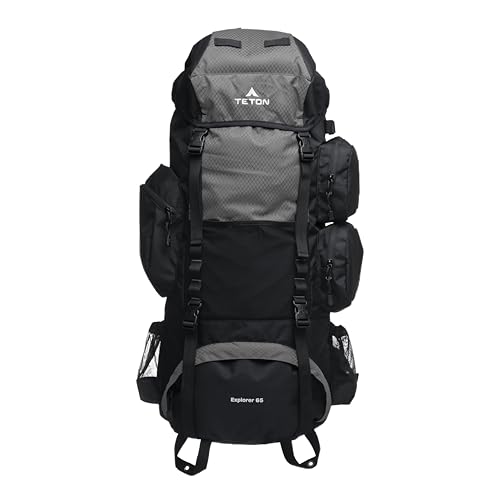


A long-torso hiking backpack offers extended frame sizes so tall hikers keep the load on their hips instead of letting it hang off the shoulders or ride too high above the waist. Torso length, not overall height, determines correct fit, and standard backpack size charts often stop short of the range many tall hikers actually need. Hikers with a longer-than-average torso do best shopping by measured torso length and a pack's stated size range or adjustment range, checking those numbers before capacity, weight, or price.
A torso length is generally considered long once it passes about 19.5 to 20 inches, measured from the C7 vertebra at the base of the neck to the iliac crest at hip level. Most backpack size charts label this range "Large," though the exact cutoff shifts by half an inch or more between brands.
Measuring torso length takes two people and a flexible tape measure:
Height and torso length correlate loosely but not directly. A 6-foot-2 hiker can carry a 19-inch torso, while a 5-foot-9 hiker with proportionally longer legs and a shorter torso can also measure 19 inches, or the reverse. Leg length makes up the difference, so a tall hiker should still measure rather than assume a Large or Extra-Large size fits.
Packs built for the longest torsos come from brands offering an Extra-Large or extended-Large size, or from cottage manufacturers that cut a frame to an exact measurement instead of a size band. Mainstream Large sizes commonly reach into the low-20-inch range, while custom-built frames extend further.
Large-size hiking backpacks come from a mix of major and cottage manufacturers, each taking a different approach:
- Osprey offers a Large torso option on multi-day packs such as the Aether Plus, Ariel Plus, and Atmos AG lines, sized to fit the upper end of the standard torso range.
- Gregory builds a Large size into the Baltoro and Deva backpacking series, aimed at the same long-torso band.
- Deuter extends several Aircontact models into a Large fit for taller frames.
- ULA Equipment, a cottage maker, builds frames to a hiker's exact measured torso length rather than a fixed size band, which suits hikers whose torso falls outside standard Large sizing.
- Mystery Ranch offers frame size options across several models, with some built on the brand's adjustable harness platform.
Adjustable suspension uses a hook-and-loop or ladder-lock harness that slides several inches to fine-tune fit within one size, while a fixed frame is cut and sewn to a specific torso length with no in-pack adjustment. Adjustable frames suit hikers near a size boundary; fixed frames, common on ultralight packs, fit best once torso length is already known precisely.
The two approaches trade off differently for a tall hiker:
- Adjustable harnesses add a small amount of weight from the sliding hardware but let one pack fit a torso length that shifts slightly, or let two people in the same household share a pack.
- Fixed frames, common on ultralight and cottage packs, remove that hardware weight but require ordering the exact size or custom length up front, with no room to correct a measurement error after purchase.
- An adjustable harness typically covers roughly a 3-inch range within its stated size band, not the full jump from a Medium to a Large, so it corrects small measurement uncertainty rather than replacing correct sizing.
A correctly fit long-torso pack keeps the hip belt centered on the iliac crest, the shoulder straps meeting the top of the shoulder without a gap, and the load-lifter straps running at roughly a 45-degree angle from shoulder to pack. Any deviation from these checkpoints signals the wrong torso length rather than a flawed pack.
| Checkpoint | Correct Fit | Sign of Wrong Torso Length |
|---|---|---|
| Hip belt | Centered on the iliac crest, wraps around the hip bones | Sits on the waist (frame too long) or rides low on the hips (frame too short) |
| Shoulder straps | Wrap over the shoulder and meet the frame close to the base of the neck | Visible gap above the shoulder (too long) or straps dig in above the shoulder (too short) |
| Load-lifter straps | Run at roughly a 45-degree angle from shoulder to the top of the pack | Nearly flat (frame too long) or steep and vertical (frame too short) |
These checks only tell the full story once the pack carries a real load. Load the pack to roughly 20% of bodyweight, the guideline most hikers use for a comfortable multi-day carry, before judging fit, since an empty pack can look correctly adjusted while collapsing out of alignment once weighted. Walk for several minutes, then recheck the hip belt position and load-lifter angle, since straps that felt right when standing still sometimes shift once the frame settles under load. A hip belt that migrates upward off the iliac crest after walking usually means the torso length is still too short even if it looked correct at first.
Go Deeper
Detailed companion guides for tall & long-torso backpacks.
Best Backpacks For Tall & Long Torsos
Buyer's guide: best hiking backpack for tall torso.
Best Long-Torso Backpacks
Buyer's guide: best backpack for long torso.
Best Backpacks For A Wide Torso
Buyer's guide: best backpack for wide torso.
Long-Torso Fit Guide
Learn how to measure torso length correctly and match it to backpack size charts, so a long-torso frame actually fits and carries weight properly.
Petite & Short-Torso Backpacks
Related backpacks by hiker guide.
Women's Hiking Backpacks
Related backpacks by hiker guide.