
Petite & Short-Torso Backpacks: Complete Guide
Comprehensive technical analysis of sizing, materials, installation requirements, and manufacturer standards for petite & short-torso backpacks.
Affiliate disclosure: this page contains affiliate links. Purchases made through them may earn us a commission at no extra cost to you. See our affiliate disclosure.
In plain English
Your torso, for backpack purposes, is the stretch of your back between your neck and your hips. Pack makers size packs by that stretch, not by how tall you are, because a pack has to reach from the tops of your shoulders down to your hip bones. If the pack is too long, the padded belt that should hug your hips slides down toward your bottom. If it is too short, the belt rides up onto your belly and the shoulder straps pull at your neck.
Think of the shoulder straps and the hip belt as suspenders and a belt sewn together. They have to be the right distance apart, or neither one does its job. That is why a short person and a tall person with the same torso can wear the exact same pack.
Measuring takes two minutes and a friend with a soft tape measure. Tilt your head forward, find the bump at the base of your neck, and measure straight down your spine to an imaginary line joining the tops of your hip bones. Then compare that number with each brand's own size chart, because every brand draws its lines a little differently.
Recommended Products
See the full ranking →

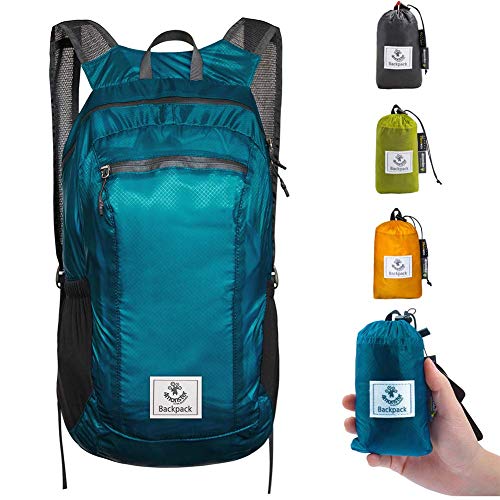

A short-torso hiking backpack uses extra-small (XS) or short-back-length frame sizing so a petite hiker's hipbelt lands on the hip bones instead of sliding toward the pelvis, and so the shoulder straps don't ride up off the collarbone. Torso length — not overall height — decides whether a pack fits a short frame; a 5'9" hiker with a short torso can need the same XS frame as someone 5'2" tall. Getting the size band right prevents the two classic misfit symptoms on a petite frame: shoulder strain from an overreaching harness, and a hipbelt that can't find the hip bones to carry its share of the load.
A torso length under roughly 16 inches (41 cm) is generally sized as XS or short in adult hiking-backpack charts, though the exact cutoff varies by brand — some draw the line at 17 inches, others at 15.5 inches. Torso length is measured from the C7 vertebra at the base of the neck to the iliac-crest line at the top of the hip bones, not from height.
To find the C7 vertebra, tilt your head forward and feel for the bony bump at the base of your neck. To find the iliac crest, place your hands on your waist with thumbs pointing back until you feel the top ridge of your hip bones, then draw an imaginary line between them. Torso length is the straight-line distance down the spine between those two points. Height correlates poorly with this number — a tall hiker can have a short torso and a short hiker can have a long one — which is why brands size packs to torso length instead of height or weight.
Adult size charts generally fall into these approximate bands, though every brand publishes its own numbers and they should be checked directly:
| Size Label | Typical Torso Range | Common Fit |
|---|---|---|
| XS / Short | Under 16 in (41 cm) | Petite adults, older kids |
| Small | 16–18 in (41–46 cm) | Petite-to-average adults |
| Medium | 18–20 in (46–51 cm) | Average-torso adults |
| Large | Over 20 in (51 cm) | Long-torso hikers |
These bands overlap between brands, so a torso that measures 16.5 inches might land in one brand's Small and another brand's XS. Always check a specific brand's chart in inches or centimeters, and try on a loaded pack when possible rather than relying on the band alone.
Several major brands publish a dedicated XS or short-back-length option built for torsos under about 16 inches, including Osprey, Gregory, Deuter, and Mystery Ranch. Adjustable-harness packs from REI Co-op and Granite Gear can also slide down to fit short torsos without a separate XS size.
- Osprey offers a fixed XS or S frame on select packs, and interchangeable hipbelt sizing on some backpacking models so hipbelt width and torso length can be matched independently.
- Gregory builds a shorter frame option on women's-specific lines such as Jade and Facet, using its FreeFloat suspension to keep the hipbelt seated on shorter hips.
- Deuter labels shortened, narrower-fit versions of its packs "SL" (Slim Line) — a shorter back length paired with a narrower harness and hipbelt, found on packs like the Aircontact Lite SL and Futura SL.
- Mystery Ranch uses an interchangeable frame-and-harness system across sizes from XS to XL, letting a petite hiker mix a shorter frame with a hipbelt sized to their own hips.
- REI Co-op and Granite Gear use hook-and-loop or single-frame adjustable back panels that slide down to short-torso lengths without a distinct XS SKU.
For torsos shorter than about 14 inches — typically school-age kids rather than petite adults — a dedicated kids' hiking backpack fits better than an adult XS, since kids' suspensions use shorter, lighter frames sized under most adult charts' minimums.
Brands including Deuter (Fox), Gregory (Wander), REI Co-op (Tarn), and Kelty's youth line build packs specifically for this range, with capacities commonly between 10 and 18 liters and lighter fabrics than adult packs use. A loaded kids' pack should stay light: one review of pack ergonomics suggests keeping a child's total load to about 10% of body mass or less, and younger or smaller kids should carry less still. Once a young hiker's torso reaches the low end of adult XS charts — usually in the young-teen years, though this varies by individual growth — an adult XS or short-torso pack becomes the better long-term fit.
Short-torso hikers who choose a women's-specific pack get a shorter default torso range — many women's packs top out around 18–19 inches versus 20–22 inches on men's or unisex versions — plus a shaped hipbelt and shorter, more curved shoulder straps built for a narrower, shorter frame.
Short torso isn't exclusive to women, though: plenty of men and non-binary hikers have short torsos too, which is part of why unisex XS options exist alongside women's-specific ones. A short-torso man is generally better served by a unisex or men's XS pack than by a women's pack, since the hipbelt and strap shaping on women's packs is cut for a different hip-to-waist ratio, not just a shorter overall length. Hikers deciding between the two should compare how a women's pack differs from a unisex one on shoulder-strap curvature and hipbelt angle, not torso length alone, and should measure their own torso length using the same C7-to-iliac-crest method regardless of which size chart they end up shopping.
Go Deeper
Detailed companion guides for petite & short-torso backpacks.
Best Backpacks For Short & Petite Torsos
Buyer's guide: hiking backpack for short torso.
Best Backpacks For Narrow Shoulders
Buyer's guide: best backpack for narrow shoulders.
Short-Torso Fit Guide
How to measure torso length for a hiking backpack: find the C7 vertebra and iliac crest, then match your number to a short-torso frame size.
Women's Hiking Backpacks
Related backpacks by hiker guide.
Men's Hiking Backpacks
Related backpacks by hiker guide.
Why size charts disagree at the short end
There is no industry-wide XS standard, so the size bands on this page are an approximation rather than a published rule. Granite Gear, for example, lists Short as 15 to 18 inches, Regular as 18 to 21 and Long as 21 to 24.1 Deuter works in centimeters: its SL fit targets a back length of about 42 cm (roughly 16.5 inches) for body heights of about 160 to 175 cm, with its regular fit near 46 cm and its EL fit near 50 cm.2 Hyperlite's Southwest runs five torso sizes from under 15 inches to 21 inches and up.3 A 16-inch torso is therefore squarely Short at Granite Gear and close to Deuter's SL, while landing in a different named size elsewhere.
The measurement itself can differ too. Most brands, including Gregory, measure from the C7 vertebra to the iliac crest, but Mystery Ranch measures from C7 down to a point just behind the belly button, so its numbers should not be plugged into another brand's chart.4,5 Mystery Ranch also advises sizing down when you fall between sizes, so the waist belt can still tighten securely on the hips.5 Hyperlite notes that height is not a reliable stand-in for torso length, which is why the tape measure matters more than the height column on any chart.6
Hip belts and straps on a small frame
A short torso often comes with narrow hips, and a belt that is too big is one of the most common petite fit problems. Granite Gear sizes hip belts by the circumference at the hip crest, roughly your regular pant waist size, and says a correctly sized belt wraps over the hip bones while leaving a gap in the padding at the front.1 Osprey puts a number on that gap: 3 to 6 inches between the pad tips once the belt is tightened.7 ULA sizes men's belts at pant waist plus 2 inches, and for women adds 5 inches to the smallest waist measurement for curvier builds or 3 inches for straighter ones.8 If the pad tips touch before the belt feels snug, the belt is too large.
Strap shape matters as much as length. Gossamer Gear notes that straps set too high pinch the neck, while straps set too low reduce weight transfer to the hip belt.9 Deuter's SL packs use narrower S-shaped straps and conically shaped hip fins, and Granite Gear says its women's hip belts are built for hips with a greater angle.2,1 Gregory, by contrast, sizes packs identically regardless of gender, so a medium is the same torso size in its men's, women's and unisex packs.4 That supports the page's advice that a short-torso man can look at unisex XS sizes. The page's figure that women's packs top out around 18 to 19 inches is a general pattern the verified sources here do not confirm, so check the specific chart. No authoritative source says women's torsos are shorter on average; Deuter's statement that its SL panel matches the average female torso is the brand's own claim.2
Kids at the bottom of the chart
Some guides give a 10 to 20% body-weight range for a child's pack, drawing on guidance such as Nemours KidsHealth.10 The American Academy of Pediatrics' current advice is tighter: no more than 15% of body weight, carried on both shoulder straps.11 Researchers in one student study suggested that even a 20% upper bound may be too high for younger children.12 Deuter gives weights instead of percentages: up to about 1 kg for preschoolers, 3 kg for elementary-school kids, 4 to 5 kg for under-12s and 7 kg for teens up to 16.13 For volume, Deuter suggests packs of no more than 5 liters for ages 1 to 3 and 11 to 22 liters for school-aged kids.13 If a child has ongoing back or shoulder pain, see a doctor.