
Winter & Snow Backpacks: Complete Guide
Comprehensive technical analysis of sizing, materials, installation requirements, and manufacturer standards for winter & snow backpacks.
Recommended Products
See the full ranking →

A winter hiking backpack adds volume and external attachment points for the bulky insulation, snowshoes, skis, and avalanche safety tools that three-season hiking doesn't demand. The difference from a summer pack usually isn't a special "winter" frame or fabric — it's more liters plus carry systems built around cold-weather gear: a warmer sleeping bag, a four-season tent, a heavier puffy jacket, traction devices, and often a shovel and probe for avalanche terrain. Most hikers moving from summer to winter trips size up one full capacity tier and check that the pack's buckles and zipper pulls still work with gloves on before they buy.
Winter gear takes up more physical space than three-season gear even when it doesn't weigh dramatically more. A down or synthetic parka, insulated pants, a warmer-rated sleeping bag, and a four-season tent all pack bulkier than their summer equivalents, so winter hikers typically need 10 to 15 liters more capacity than they'd carry for the same trip length in summer.
Insulation loft is the main driver. A 0°F sleeping bag compresses to a noticeably larger stuff sack than a 30°F bag, and a heavyweight belay parka takes up more room than a lightweight fleece even when both weigh close to the same. Avalanche safety gear adds further bulk: a collapsible shovel and probe typically ride in a dedicated exterior pocket or diagonal front pocket rather than the main compartment, so packs built for backcountry ski or snowshoe travel often add a purpose-built "avy pocket" that a three-season pack skips entirely. Melting snow for water also means carrying a stove and fuel that a summer hiker with a flowing creek nearby wouldn't need.
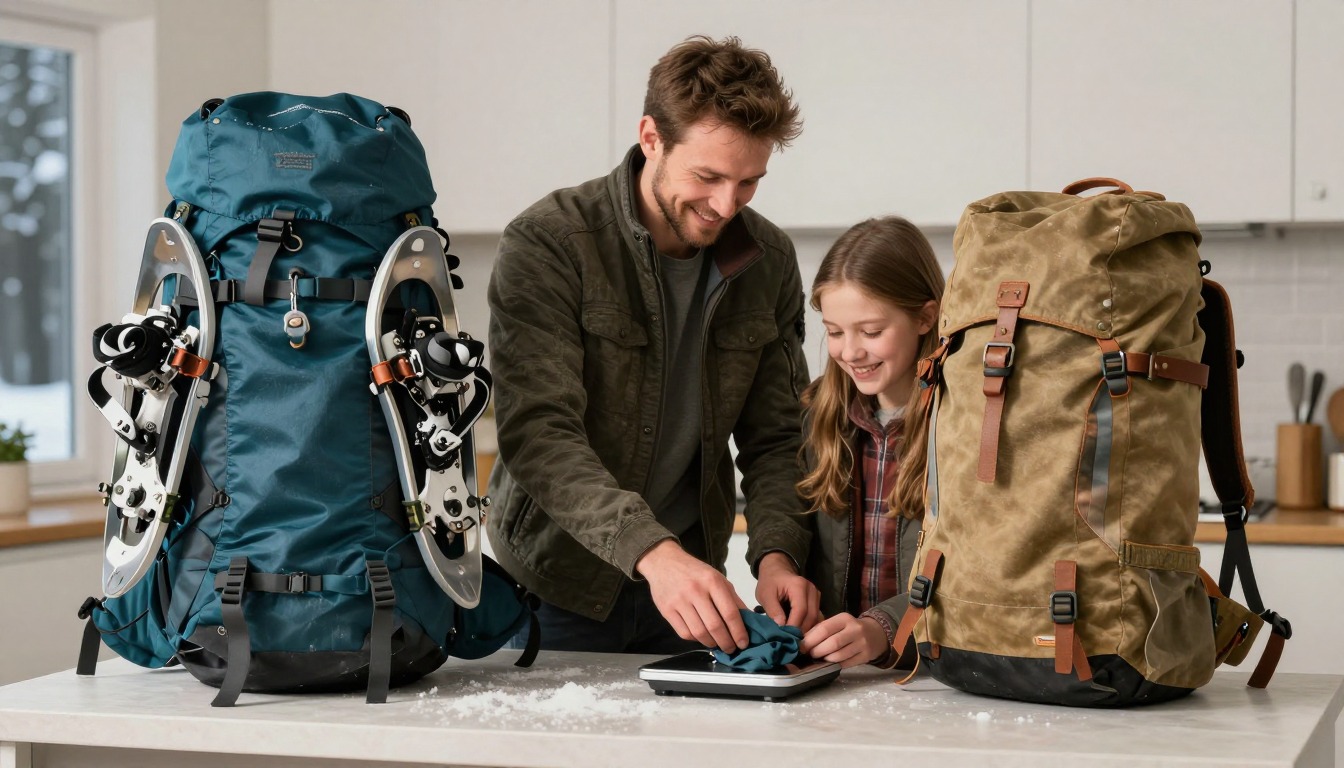
Snowshoes attach with dedicated side compression straps or a rear bungee-and-daisy-chain lash system that holds the deck flat against the pack body, while an ice axe attaches through a reinforced loop at the pack's base with an upper retention strap. Most winter and four-season packs include both attachment types even when the pack itself is sold as a general backpacking model rather than a dedicated winter pack.
Skis carry in one of two positions. Diagonal ski carry runs the skis at an angle across the back of the pack, tips up, secured by two straps — it's faster to load and unload and works well on approaches that mix skinning with boot-packing. A-frame carry mounts the skis vertically on either side of the pack body, which balances the load better for longer carries but needs a pack built with side compression straps rated for the extra leverage. Trekking poles use the same basic hardware most three-season packs already have: a loop near the base of the pack to catch the pole tip or basket, paired with a shock-cord or webbing keeper higher up that cinches around the shaft. The same loop-and-keeper system usually doubles for an ice axe when poles aren't in use. A quick-access exterior pocket sized for a folding shovel blade and a probe rounds out the attachment set most winter hikers look for, since digging gear needs to come out fast in avalanche terrain.
A winter pack's hardware needs to work with thick gloves or mittens on, so look for oversized zipper pulls, wide webbing buckles instead of narrow side-release clips, and a minimum of small cord locks — any component that assumes bare-finger dexterity becomes a liability once temperatures drop. Cold also stiffens plastic, so hardware that's already generously sized performs more reliably than a compact buckle rated fine at room temperature.
Zipper pulls extended with a loop of cord or webbing are easier to grab with a mitten than the small metal tab most zippers ship with; some winter-oriented packs add these as standard, and hikers commonly retrofit summer packs with paracord loops for the same reason. Buckle size matters more than buckle count — a single wide hipbelt buckle is easier to close blind, by feel, than a narrow one, which matters when hands are numb or hidden inside mitten shells. The table below compares hardware built for warm-weather dexterity against hardware built for winter use.
| Component | Summer-Oriented Design | Winter-Friendly Design |
|---|---|---|
| Zipper pulls | Small metal or plastic tab | Extended cord loop or fabric tab |
| Hipbelt/sternum buckles | Compact side-release clip | Oversized side-release or magnetic buckle |
| Compression straps | Thin webbing, small cam buckle | Wider webbing, larger cam buckle |
| Cord adjusters | Small toggle cord lock | Minimized or replaced with webbing |
| Pocket closures | Zipper only | Zipper plus flap-and-buckle backup |
Not every winter hiker needs every item on the winter-friendly side of that list, but a pack that leans toward the right column will be noticeably easier to operate at a cold trailhead or a wind-scoured ridge camp than one built purely around warm-weather ergonomics.
A winter day hike generally calls for 30 to 40 liters, an overnight winter trip runs 50 to 65 liters, and a multi-day winter traverse or hut-to-hut trip often reaches 65 to 80 liters. Winter capacity needs typically run 10 to 20 liters above the equivalent three-season trip because of bulkier insulation, a heavier sleep system, and avalanche safety gear.
- Winter day hike (30–40L): insulated layers, thermos, traction devices, and a compact emergency kit.
- Winter overnight (50–65L): four-season tent or bivy, a cold-rated sleeping bag, stove and extra fuel for melting snow, and full avalanche safety kit where terrain warrants it.
- Multi-day winter or hut trip (65–80L): the overnight list plus several days of food, a change of insulated layers for wet conditions, and often skis, snowshoes, or a sled attached externally.
Go Deeper
Detailed companion guides for winter & snow backpacks.
Best Winter Hiking Backpacks
Buyer's guide: best hiking backpack for winter.
Best Winter Backpacking Packs
Buyer's guide: best backpack for winter backpacking.
Carrying Snowshoes, Skis & Ice Tools
How to attach trekking poles, snowshoes, skis, and an ice axe to a hiking backpack using the standard external loops, straps, and daisy-chain systems.
Hut-to-Hut & Lodge Hiking
Related backpacks by activity guide.
Day-Hiking Backpacks
Related backpacks by activity guide.