
Best Backpack For Thru Hiking
Best Backpack For Thru Hiking, ranked from aggregated owner ratings and reviews, not first-hand testing. Real pros, cons, and who each pick is best for.
Our Top 3 Picks
Quick Comparison
| Product | Best for | Buy | |
|---|---|---|---|
| Lightweight Hydration Backpack | Top Overall Pick | See Amazon | View |
| Kelty Coyote 60-105 Liter Internal Frame Backpack - Hiking | Best Value | See Amazon | View |
| 25L Hydration Hiking Backpack with Water Bladder | Best Ultralight | See Amazon | View |
| WATERFLY Hiking Backpack 20L | Best Hydration Pack | See Amazon | View |
| Maelstrom 40L Hiking Backpack | Best for Women | See Amazon | View |
| Seektop 15L Small Hiking Backpack for Women Men | Best Compact Pack | See Amazon | View |
Choosing the best thru-hiking backpack starts with matching capacity and frame type to your base weight and the specific trail's resupply pattern, not with picking the single lightest pack on the market.
What capacity does a thru-hiking pack need?
Most thru-hiking packs run 45 to 65 liters, sized to carry three to seven days of food between resupply towns along with a full 3-season kit; trails with longer stretches between towns, like remote sections of the Continental Divide Trail, often call for the higher end of that range. Several trip-specific factors push capacity up beyond a base 3-season kit: a bear canister required through the Sierra Nevada section of the Pacific Crest Trail, extra water capacity for desert stretches, or added insulation layers for an early or late-season start. Hikers doing a long, continuous food carry between towns generally need more volume than hikers on trails with frequent, close-together resupply points, even at the same base weight.
Which frame type matches your base weight?
Frameless packs work best for a base weight under roughly 10 pounds and loaded weights under 20 to 25 pounds, single-stay packs suit a base weight of 10 to 15 pounds with moderate food carries, and full internal-frame packs with dual stays suit a base weight above 15 pounds or trips that regularly involve a bear canister or heavy water carries. Matching frame type to base weight matters more on a thru-hike than on a shorter trip, since the pack carries that same load class every day for months rather than occasionally.
What fabric survives a full thru-hike?
Dyneema Composite Fabric (DCF), used on packs like the Hyperlite Mountain Gear Southwest and the Zpacks Arc Blast and Arc Haul, is lighter and fully waterproof at the seams but can wear less predictably against sharp granite and dense brush over months of contact. Robic nylon in the 100 to 210 denier range, used across models like the Gossamer Gear Mariposa, Granite Gear Crown3, and REI Co-op Flash, weighs a bit more but generally resists rock and brush abrasion better over a full trail, at the cost of needing a pack liner for full water protection. Neither fabric is universally "better" for a thru-hike — the right choice depends on how much of the trail crosses abrasive terrain versus how much weight savings matters to the hiker.
How important is fit on a multi-month trail?
Fit matters more on a thru-hike than on any shorter trip, since a poor fit compounds daily over months instead of over a single weekend. Measure torso length from the C7 vertebra at the base of the neck to the iliac crest at the top of the hip bones, then match that number to the pack's size chart rather than guessing from height. Some packs, including the Osprey Exos and Eja and the Gregory Baltoro and Deva, offer adjustable torso length or interchangeable hipbelt sizes, useful for hikers whose fit needs might shift slightly as they lose weight over a long trail; others, like the ULA Circuit, are ordered in a fixed torso length chosen at purchase.
Which pack features matter most for daily thru-hike use?
A few features get used constantly on a thru-hike rather than occasionally, and are worth prioritizing over less-used extras:
- Side pockets reachable without removing the pack, for grabbing water bottles on the move.
- A front shove-it pocket, for a wet rain jacket, tent fly, or snacks.
- Hipbelt pockets sized for a phone, snacks, or a small camera.
- External attachment points for trekking poles and, on some trails, an ice axe.
- A back panel design, like a trampoline mesh panel, that manages sweat on long, hot days.
Full Ranking, Reviewed

Best for Backpacks for Thru-Hiking
- 12 L capacity
- Nylon shell
- 9 oz empty
- Hydration-ready
- Leakproof & Anti-popping Water Bladder
- Set up to carry a reservoir for hands-free sipping
- Ventilated back panel cuts sweat on long climbs
- At 12 L it is best kept to shorter outings — it fills up once you add layers, lunch and water for a full day.
Verdict: NEVO RHINO’s 12 L hydration pack pairs a breathable back with room for a bladder, making it the one we would grab first for Backpacks for Thru-Hiking.
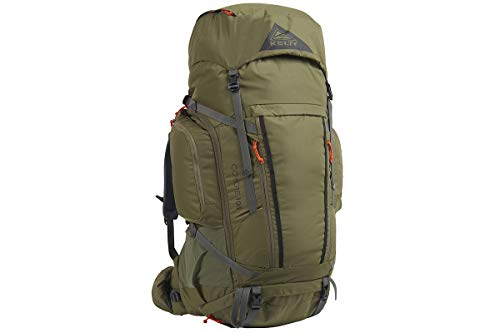
Best for Backpacks for Thru-Hiking
- 105 L capacity
- 4.0 lb empty
- Hydration-ready
- Plenty of Pockets
- Routes a hydration bladder and hose without fuss
- Breathable mesh back keeps air moving against your spine
- That 105 L volume is overkill for quick hikes and better suited to multi-night trips.
Verdict: This 105 L backpacking pack pairs a breathable back with room for a bladder, making it an easy shortlist pick for Backpacks for Thru-Hiking.

Best for Backpacks for Thru-Hiking
- 5–25 L capacity
- 2.1 lb empty
- Hydration-ready
- Detachable Phone Pouch
- Hydration sleeve keeps water within easy reach
- Airflow channels help your back stay cooler under load
- Colours and exact capacity options change often on Amazon — confirm the current variant on the listing before buying.
Verdict: Pankay’s 5–25 L daypack pairs a breathable back with room for a bladder, making it an easy shortlist pick for Backpacks for Thru-Hiking.

Best for Backpacks for Thru-Hiking
- 20 L capacity
- 600D nylon shell
- 22 oz empty
- Hydration-ready
- Padded compartment & hydration ready
- Set up to carry a reservoir for hands-free sipping
- Airflow channels help your back stay cooler under load
- The 20 L capacity is snug for anything beyond a half-day on the trail.
- Water-resistant shell handles showers, but a liner or cover is wise for all-day rain.
Verdict: This 20 L daypack pairs a breathable back with room for a bladder, making it a strong option for Backpacks for Thru-Hiking.

Best for Backpacks for Thru-Hiking
- 40 L capacity
- 210D ripstop nylon shell
- 2.2 lb empty
- Rain cover included
- Ergonomic and Comfortable Design
- Packs an integrated rain cover to keep gear dry
- Tough, tear-resistant shell built for trail abuse
- At 40 L it sits between a daypack and a backpacking pack — a touch large for quick hikes, a touch small for long multi-night loads.
Verdict: This 40 L hiking pack pairs a bundled rain cover with a tough ripstop shell, making it an easy shortlist pick for Backpacks for Thru-Hiking.

Best for Backpacks for Thru-Hiking
- 15 L capacity
- Polyester shell
- 12 oz empty
- Light enough that you forget you are wearing it
- Packable build stows into its own pocket for travel
- Plenty of pockets keep small gear sorted and findable
- The 15 L capacity is snug for anything beyond a half-day on the trail.
Verdict: This 15 L daypack offers a packable build, making it well worth a look for Backpacks for Thru-Hiking.
Frequently Asked Questions
What's the most popular pack among thru-hikers?
No single pack dominates; gear surveys of Appalachian Trail and Pacific Crest Trail hikers each year show Osprey, ULA, Gregory, and Hyperlite Mountain Gear packs among the most common brands carried. The right pack depends on your base weight and fit more than on what's most common on trail.
Do I need a different pack for a winter or early-season start?
A winter or shoulder-season start often adds bulk from extra insulation and a warmer sleep system, which can push you toward the next frame class up from what you'd use in peak summer. Hikers starting a northbound Appalachian Trail hike in early spring commonly carry more volume than they will by summer.
Should I buy a pack before or after cutting my base weight?
Buy your shelter and sleep system first, then choose a pack sized to the base weight those choices produce, rather than buying the lightest pack first and forcing your kit to fit it. This order avoids ending up with a frameless pack that can't comfortably carry a heavier kit.