
Best Backpack For Overnight Hiking
Best Backpack For Overnight Hiking, ranked from aggregated owner ratings and reviews, not first-hand testing. Real pros, cons, and who each pick is best for.

Our Top 3 Picks
Quick Comparison
| Product | Best for | Buy | |
|---|---|---|---|
| Maelstrom 40L Hiking Backpack | Top Overall Pick | See Amazon | View |
| WoneNice 50L | Best Value | See Amazon | View |
| Loowoko 50L Hiking Backpack with Rain Cover for Both Men & Women | Best for Women | See Amazon | View |
| Osprey Atmos AG 65L Men's Backpacking Backpack | Best for Multi-Day | See Amazon | View |
| Teton 55L Scout Internal Frame Backpack for Hiking | Best Hydration Pack | See Amazon | View |
What should you look for in an overnight backpack?
Torso fit matters more than any other spec on an overnight pack, since two 35–45L packs from different brands can carry very differently depending on frame length and hipbelt shape. After fit, prioritize empty pack weight, suspension type, and how cleanly the pack's compression straps cinch down for a load that's lighter than what the pack could technically carry.
Measure torso length from the C7 vertebra at the base of the neck down to the iliac crest at the top of the hip bones, not from overall height. Most packs in this size range use small, medium, and large torso sizes, or an adjustable suspension within a set range, and hipbelt sizing is set independently. A correctly fitted hipbelt carries roughly 80% of the load, which matters even on a lighter overnight pack, since shoulder discomfort shows up quickly on a poorly fitted hipbelt regardless of how little weight is inside.
How much should an overnight pack weigh empty?
Because an overnight trip carries less food and fuel than a longer trip, hikers have more room to prioritize a lighter empty pack without sacrificing comfort on the load it actually needs to carry. Standard internal-frame packs at this volume commonly weigh in the 2 to 4 lb range, while frameless or minimalist ultralight packs built for experienced packers with light gear lists can weigh under 2 lbs. The trade-off is load support: a frameless pack transfers less weight to the hips and works best for total pack weights under roughly 20 to 25 lbs, which many overnight loads fall within, but not all.
Internal frame vs minimalist frameless packs
- Standard internal-frame packs use aluminum stays or a perimeter wire frame to transfer load to the hipbelt, carry heavier loads more comfortably, and suit hikers new to backpacking or anyone unsure how light their kit will end up.
- Frameless or minimalist packs cut frame weight and structure, ride well only when packed correctly with a rigid item like a sleeping pad against the back panel, and suit experienced packers with a dialed-in, lighter-weight gear list.
Who an overnight pack suits
An overnight pack in the 35–45L range suits hikers doing single-night trips with a standard or lightweight three-season kit. It's generally not the right size for hikers who regularly stretch to two or more nights, where a 45–55L weekend-oriented pack fits the added food and fuel more comfortably, and it's too small for bear-canister or winter trips that need extra volume regardless of night count.
Honest trade-offs to weigh
- A lighter empty pack generally means less padding, a simpler frame, and less external organization than a heavier, more structured pack at the same volume.
- Minimalist frameless packs save real weight but demand more careful packing and suit a narrower range of total loads than a framed pack.
- More external pockets and a floating lid add convenience but add weight that works against the point of choosing a smaller, lighter pack in the first place.
- A pack sized precisely for one night rides with less unused space than a larger pack, but it leaves less margin if a trip runs long or weather forces an extra layer.
How to decide between two similar overnight packs
When two packs both fit your torso length, compare empty weight against frame type first: a frameless pack only makes sense if your total loaded weight reliably stays light. Beyond that, check how each pack's compression system performs when it's only half loaded, since a one-night trip rarely fills a 40–45L pack completely, and a pack that cinches down cleanly for a light overnight load will carry more predictably than one optimized only for a full pack.
Full Ranking, Reviewed

Best for Backpacks for Overnight Hiking
- 40 L capacity
- 210D ripstop nylon shell
- 2.2 lb empty
- Rain cover included
- Ergonomic and Comfortable Design
- Includes a rain cover for sudden downpours
- Ripstop fabric shrugs off scrapes and snags on the trail
- The 40 L size is a versatile in-betweener rather than a specialist at either end.
Verdict: This 40 L hiking pack pairs a bundled rain cover with a tough ripstop shell, making it the one we would grab first for Backpacks for Overnight Hiking.

Best for Backpacks for Overnight Hiking
- 45–50 L capacity
- Nylon shell
- 2.4 lb empty
- Rain cover included
- Airflow channels help your back stay cooler under load
- Includes a rain cover for sudden downpours
- Supportive hip belt takes weight off the shoulders
- That 45–50 L volume is overkill for quick hikes and better suited to multi-night trips.
Verdict: This 45–50 L backpacking pack pairs a breathable back with a bundled rain cover, making it well worth a look for Backpacks for Overnight Hiking.
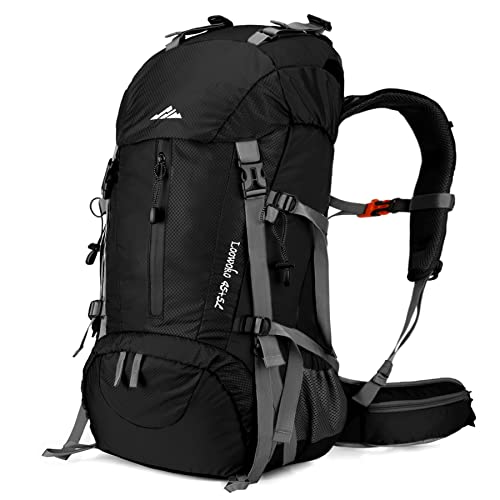
Best for Backpacks for Overnight Hiking
- 50 L capacity
- Nylon shell
- 2.4 lb empty
- Rain cover included
- Rain Cover Included
- Breathable mesh back keeps air moving against your spine
- Packs an integrated rain cover to keep gear dry
- At 50 L it is more pack — and more weight — than a day hiker needs; it earns its keep on overnight and multi-day loads.
Verdict: This 50 L backpacking pack pairs a breathable back with a bundled rain cover, making it an easy shortlist pick for Backpacks for Overnight Hiking.

Best for Backpacks for Overnight Hiking
- 65 L capacity
- 4.0 lb empty
- Rain cover included
- Floating top lid with lash points
- Includes a rain cover for sudden downpours
- That 65 L volume is overkill for quick hikes and better suited to multi-night trips.
- The fabric is water-resistant rather than fully waterproof, so a pack liner helps in sustained rain.
Verdict: This 65 L backpacking pack offers a bundled rain cover, making it well worth a look for Backpacks for Overnight Hiking.

Best for Backpacks for Overnight Hiking
- 45–65 L capacity
- 4.1 lb empty
- Rain cover included
- Teton tough
- Routes a hydration bladder and hose without fuss
- Ventilated back panel cuts sweat on long climbs
- At 45–65 L it is more pack — and more weight — than a day hiker needs; it earns its keep on overnight and multi-day loads.
Verdict: TETON Sports’s 45–65 L backpacking pack pairs a breathable back with room for a bladder, making it a strong option for Backpacks for Overnight Hiking.
Frequently Asked Questions
What size backpack do I need for one night?
Most one-night trips fit comfortably in a 35–45L backpack, depending on gear bulk and season. Minimalist or lightweight packers can often manage with 30–35L, while hikers carrying a bulkier kit or extra layers may prefer the upper end of that range.
Can I use a daypack for an overnight trip?
A standard daypack under 30L usually can't fit a shelter, sleep system, and cook kit together, and most daypacks lack the hipbelt support needed to carry that weight comfortably. A dedicated overnight backpacking pack with a real hipbelt is a better fit even for a single night.
Is a frameless pack a good choice for a first overnight trip?
Generally no. Frameless packs demand careful, experienced packing to ride comfortably and offer less margin for error. A standard internal-frame pack is a more forgiving choice for a first overnight trip, with a frameless or minimalist pack better suited to later trips once your gear list is dialed in.