
Best Backpack For Multi Day Hiking
Best Backpack For Multi Day Hiking, ranked from aggregated owner ratings and reviews, not first-hand testing. Real pros, cons, and who each pick is best for.

Our Top 3 Picks
Quick Comparison
| Product | Best for | Buy | |
|---|---|---|---|
| Maelstrom 40L Hiking Backpack | Top Overall Pick | See Amazon | View |
| Teton 65L Explorer Internal Frame Backpack for Hiking | Best Value | See Amazon | View |
| Teton 55L Scout Internal Frame Backpack for Hiking | Best Hydration Pack | See Amazon | View |
| Osprey Sportlite 25L Lightweight Hiking Backpack | Most Breathable | See Amazon | View |
| Teton Oasis Hydration Backpack | Best Ultralight | See Amazon | View |
What changes as trip length grows?
As a trip grows from three days to five or more, food weight and volume become the main variable, since shelter, sleep system, and clothing stay roughly constant regardless of trip length. Food adds roughly 1.5 to 2.5 lbs per person per day, so a five-day trip can carry two to three times the food volume of a three-day trip in the same pack.
How do you size a pack to the number of days?
Match pack capacity to the specific number of nights and your gear list rather than rounding up by default:
| Nights | Typical Capacity | Main Driver |
|---|---|---|
| 2–3 | 45–55L | Standard 3-season kit plus modest food weight |
| 4–5 | 55–65L | Added food volume, possible resupply gap |
| 6+ without resupply | 65–75L | Food volume becomes the limiting factor |
A pack sized correctly for the actual number of days between resupply points, rather than the total trip length, usually fits better than one sized for the whole itinerary at once.
What role does resupply play?
Trips with a planned resupply — mailing food ahead or restocking in town — only need to carry food for the days between stops, which can keep a longer overall trip within a smaller pack than an unsupported trip of the same total length. This is a key difference between multi-day hiking, where resupply is common, and shorter unsupported backpacking trips where every day's food rides the whole time.
Packing strategy for longer multi-day trips
Longer multi-day trips reward efficient packing more than shorter ones, since inefficiencies compound over more days:
- Repackage food out of bulky retail packaging into resealable bags to save real volume
- Plan a resupply if the route allows it, rather than defaulting to a bigger pack
- Choose a lighter sleep system if trip length is pushing your pack near its rated load range
- Keep worn and carried clothing to a minimum set that layers, rather than a change per day
What features help most as days add up
A few features earn their weight more on longer multi-day trips than on a single overnight: a hipbelt with enough pocket space to carry snacks and a map without opening the main pack repeatedly, a lid or top pocket sized for frequently used small items, and side compression straps that still cinch a partially eaten-into food supply down cleanly by the trip's later days. None of these change the core buying criteria — torso fit, frame support, and capacity — but they reduce daily friction over a trip long enough for that friction to add up.
How to decide
Choose pack capacity based on the number of days between resupply points and your specific food and gear list, not a flat assumption that longer trips always need a much bigger pack. A well-planned five-day trip with one resupply can fit the same 55–65L pack that handles an unsupported four-night trip, while an unsupported six-day carry usually pushes toward 65–75L regardless of how light the rest of the kit is. Whichever capacity you land on, confirm torso length and hipbelt fit before finalizing a purchase, since a pack sized correctly for the trip still needs to fit your body to carry it well across every one of those days.
Full Ranking, Reviewed

Best for Backpacks for Multi-Day Hiking
- 40 L capacity
- 210D ripstop nylon shell
- 2.2 lb empty
- Rain cover included
- Ergonomic and Comfortable Design
- Includes a rain cover for sudden downpours
- Ripstop fabric shrugs off scrapes and snags on the trail
- The 40 L size is a versatile in-betweener rather than a specialist at either end.
Verdict: This 40 L hiking pack pairs a bundled rain cover with a tough ripstop shell, making it the one we would grab first for Backpacks for Multi-Day Hiking.
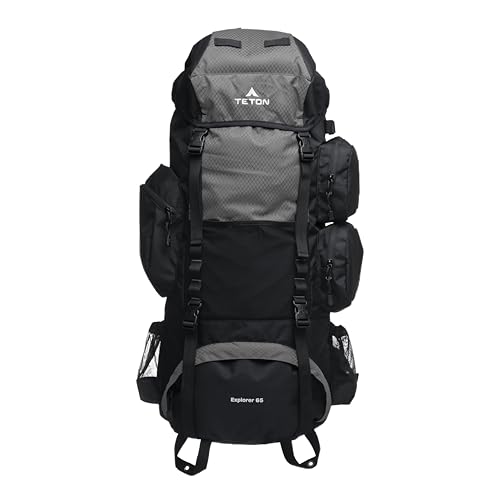
Best for Backpacks for Multi-Day Hiking
- 65–85 L capacity
- 5.0 lb empty
- Rain cover included
- Teton tough
- Hydration sleeve keeps water within easy reach
- Ventilated back panel cuts sweat on long climbs
- That 65–85 L volume is overkill for quick hikes and better suited to multi-night trips.
- At 5.0 lb it is heavier than the lightest packs in its class before you load it.
Verdict: TETON Sports’s 65–85 L backpacking pack pairs a breathable back with room for a bladder, making it a strong option for Backpacks for Multi-Day Hiking.

Best for Backpacks for Multi-Day Hiking
- 45–65 L capacity
- 4.1 lb empty
- Rain cover included
- Teton tough
- Routes a hydration bladder and hose without fuss
- Airflow channels help your back stay cooler under load
- At 45–65 L it is more pack — and more weight — than a day hiker needs; it earns its keep on overnight and multi-day loads.
Verdict: TETON Sports’s 45–65 L backpacking pack pairs a breathable back with room for a bladder, making it an easy shortlist pick for Backpacks for Multi-Day Hiking.

Best for Backpacks for Multi-Day Hiking
- 25 L capacity
- Ripstop nylon shell
- 2.2 lb empty
- Hydration-ready
- Minimalist technical daypack
- Hydration sleeve keeps water within easy reach
- Ventilated back panel cuts sweat on long climbs
- Colours and exact capacity options change often on Amazon — confirm the current variant on the listing before buying.
Verdict: This 25 L hiking pack pairs a breathable back with room for a bladder, making it well worth a look for Backpacks for Multi-Day Hiking.

Best for Backpacks for Multi-Day Hiking
- 18–22 L capacity
- 2.0 lb empty
- Rain cover included
- Stay hydrated on the go
- Hydration sleeve keeps water within easy reach
- Packs an integrated rain cover to keep gear dry
- Colours and exact capacity options change often on Amazon — confirm the current variant on the listing before buying.
Verdict: TETON Sports’s 18–22 L daypack pairs room for a bladder with a bundled rain cover, making it an easy shortlist pick for Backpacks for Multi-Day Hiking.
Frequently Asked Questions
Does a longer multi-day trip always need a bigger pack?
Not if you resupply along the way. A trip with a planned resupply only needs to carry food for the days between stops, which can keep a longer overall trip within a smaller pack than an unsupported trip of the same length.
How much extra capacity does each additional day add?
There's no fixed liter-per-day rule, but food alone adds roughly 1.5 to 2.5 lbs per person per day, which takes up real volume. Most hikers notice a meaningful capacity jump is needed once a trip crosses from four to six unsupported days.
Is it better to size up or pack lighter for a long trip?
Packing lighter, especially the sleep system and food repackaging, is usually the better first move, since it keeps pack weight and volume down together. Sizing up should be the second option, used when a lighter kit still doesn't fit comfortably.