

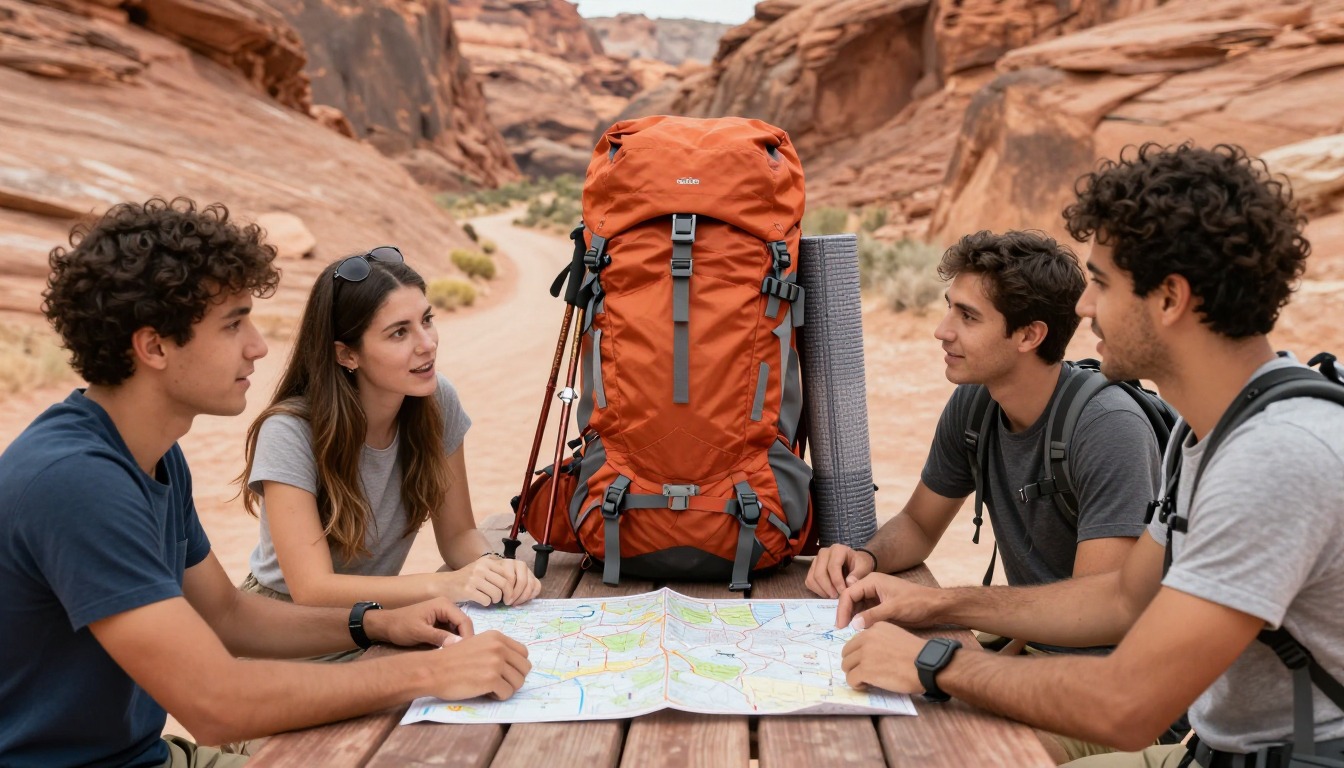


A Continental Divide Trail backpack needs more capacity and load-carrying structure than a typical Appalachian Trail or Pacific Crest Trail pack, driven by the CDT's longer resupply gaps, its unmarked and often braided route, and wider swings in weather across roughly 3,100 miles from New Mexico to Montana. Hikers who undersize a CDT pack often end up strapping food and water to the outside for days at a time.
What pack size works best for the CDT?
Most CDT thru-hikers use a 55- to 65-liter pack, larger than the typical Appalachian Trail or Pacific Crest Trail range, to handle food carries that regularly stretch past six days and the extra layers needed for a trail that can see snow at both its southern and northern ends.
Hikers with lower base weights or a strategy built around frequent short carries sometimes run smaller, in the 45- to 55-liter range, but they remain a minority on the CDT compared with the PCT. Because loaded weight runs higher for a larger share of the CDT than on other long trails, a torso measurement taken carefully from the C7 vertebra to the iliac crest matters more here: an oversized or undersized frame shifts load off the hips and onto the shoulders exactly when the pack is heaviest.
How remote are CDT resupply stretches?
The CDT produces the longest average resupply carries of the three major U.S. long trails covered in this guide: New Mexico's Gila River corridor, Wyoming's Great Divide Basin, and Montana's Bob Marshall Wilderness are well-known stretches where hikers commonly carry six to nine days of food, sometimes more depending on route choice and resupply strategy.
The CDT is not a single fixed path. Hikers choose among marked alternates through much of its length, so the distance between reliable resupply points varies more from hiker to hiker than it does on the AT or PCT. That variability is a defining feature of the trail, not an exception, and it is the main reason CDT pack capacity trends higher across the board.
What frame type suits the CDT?
A single aluminum-stay or full dual-stay internal frame generally suits the CDT better than a frameless design, since the trail's longer food carries push loaded pack weight higher than on the AT or PCT for a larger share of the hike, especially through New Mexico's early, water-heavy stretches.
A common pattern among CDT hikers is starting with an ultralight frameless pack and upgrading to a sturdier framed pack partway through the trail, once the gap between the AT's or PCT's typical load and the CDT's becomes clear on trail. A properly sized frame also carries the extra water weight New Mexico's dry stretches often require more comfortably than a frameless design.
What fabric holds up on the CDT?
Higher-denier nylon or a DCF-nylon hybrid tends to outlast lightweight ripstop fabric on the CDT, since the trail's cross-country alternates and off-trail navigation expose a pack to more brush, rock, and bushwhacking abrasion than the more consistently maintained tread of the AT or PCT.
Heavier average loads over longer carries also accelerate wear at the hipbelt and shoulder-strap attachment points, so reinforced stitching at those spots matters more on a CDT-length carry than it does on a shorter trip. Real models built or commonly chosen for this kind of load include the ULA CDT and Circuit, the Granite Gear Crown3, and the Gossamer Gear Mariposa, all of which pair a durable nylon body with a frame rated for higher loads than the lightest frameless packs.
Weather adds another durability factor unique to the CDT: a hike can start or end in snow at either end of the trail, and hikers crossing Colorado's San Juan Mountains or Montana's Glacier-adjacent sections sometimes lash an ice axe or microspikes to the pack's exterior. A pack with solid external attachment points, not just interior volume, earns its keep on a trail that shifts between desert, high alpine, and forested terrain within one thru-hike season.