



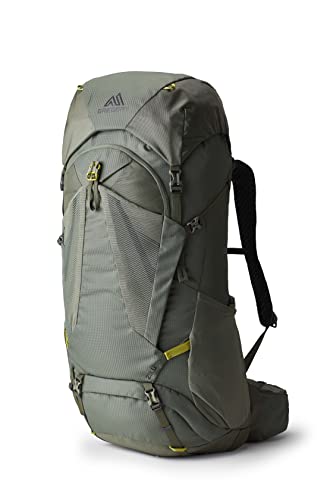
What is the Gregory Baltoro 65 designed for?
The Gregory Baltoro 65 is designed to carry heavier multi-day loads comfortably on extended backpacking trips, using a structured internal frame and a padded hipbelt built to move weight onto the hips rather than the shoulders. It sits in the Baltoro/Deva family, Gregory's heavier-duty suspension line, positioned above the ventilated Zulu/Jade packs and the lighter Paragon/Maven packs for hikers whose loaded pack weight runs on the higher side.
That heavier-duty positioning shows up throughout the build: a padded, contoured back panel rather than a fully ventilated mesh one, a stiffer perimeter frame, and a hipbelt with more substantial padding than Gregory's lighter lines use. The trade-off is a pack that runs warmer against the back on a hot climb than a ventilated design, in exchange for a more stable, load-hauling carry when the pack is full for several days at a time. Within the wider Baltoro family, the 65-liter size sits in the middle of the range, larger than the smallest Baltoro sizes but smaller than the largest expedition-oriented versions, which makes it a common choice for standard multi-day trips rather than the longest or heaviest expeditions.
How does the Baltoro 65 fit and carry weight?
The Baltoro 65 fits through an adjustable or size-specific torso length paired with a hipbelt available in more than one size, so the frame length and hip circumference can be matched independently rather than compromising on one to fit the other. That two-part sizing approach is the core of Gregory's fit philosophy across its multi-day packs, not unique to this model, but it matters most on a pack this size because a poor hipbelt fit is felt immediately once the pack is loaded near its rated capacity.
Weight transfer follows the same principle used across load-hauling packs generally: once torso length and hipbelt size are dialed in, the hipbelt should sit centered over the iliac crest so the pelvis, not the lower back or shoulders, carries most of the load. On a 65-liter pack loaded for a multi-day trip, that hipbelt fit is what determines whether the pack feels manageable or exhausting by the end of a long day. The shoulder harness on the Baltoro is contoured to follow the line of the collarbone rather than sit flat, so once the hipbelt is doing most of the work, the harness mainly stabilizes the load and keeps it from swaying rather than bearing significant weight itself.
What are the Baltoro 65's key features?
Beyond the frame and hipbelt, the Baltoro 65 carries the feature set typical of Gregory's heavier-duty multi-day packs: a top-loading main compartment, an extension collar for overpacking, and external attachment points for trekking poles, an ice axe, or a sleeping pad. Many packs in this line also include a stowable rain cover, a detail worth confirming on the specific version being considered since included accessories can shift between product generations.
- Top-loading main compartment with an extendable collar
- External attachment points for trekking poles, an ice axe, and a sleeping pad
- Adjustable torso length paired with a swappable hipbelt size
- Padded, structured back panel built for load stability over ventilation
- Hydration-sleeve compatibility inside the main compartment
- Multiple exterior pockets for organizing frequently used gear without opening the main compartment
Who should consider the Baltoro 65?
The Baltoro 65 suits hikers who regularly carry a heavier pack on multi-day trips and want a stable, load-hauling carry more than maximum breathability, such as backpackers on extended trips, hikers carrying group gear, or anyone whose loaded pack weight runs toward the upper end of a 65-liter pack's practical range. It also suits hikers who've found lighter, less structured packs uncomfortable once fully loaded, since the added frame stiffness and hipbelt padding are specifically there to handle weight that a lighter pack wouldn't carry as comfortably.
Hikers who prioritize airflow on warm-weather trips, or who pack lighter and want to shave overall weight, are usually better matched to Gregory's ventilated Zulu/Jade line or its lighter Paragon/Maven line instead. Anyone deciding between those options should weigh typical pack weight and climate more heavily than capacity alone, since several Gregory lines overlap around the 65-liter mark.