
Best 65l Backpack
Best 65l Backpack, ranked from aggregated owner ratings and reviews, not first-hand testing. Real pros, cons, and who each pick is best for.

Our Top 3 Picks
Quick Comparison
| Product | Best for | Buy | |
|---|---|---|---|
| Teton 65L Explorer Internal Frame Backpack for Hiking | Top Overall Pick | See Amazon | View |
| Osprey Atmos AG 65L Men's Backpacking Backpack | Best Value | See Amazon | View |
| Teton 65L Scout Internal Frame Backpack for Hiking | Best Hydration Pack | See Amazon | View |
| Osprey Rook 65L Men's Backpacking Backpack | Best for Multi-Day | See Amazon | View |
What should you look for in a 65L backpack?
Look first at torso-length fit, then frame type, then fabric durability — in that order, since an ill-fitting 65L pack is uncomfortable no matter how good its features are. Measure your torso from the C7 vertebra to the iliac crest and match it to the brand's size chart; many 65L packs come in fixed S/M/L sizes rather than one adjustable size, so getting this number right before buying matters more than at smaller capacities.
Which frame type suits a 65L pack?
Frame type should match your typical load and terrain: suspended-mesh frames suit ventilation and moderate loads, while framesheet-and-stay designs suit heavier or bulkier loads on rough terrain. Packs like the Osprey Atmos AG 65 or Aura AG 65 use a trampoline-style mesh back panel held off the pack body, which improves airflow and works well for three-season loads in the 30–40 pound range. Packs like the Gregory Baltoro 65 or Deuter Aircontact Lite 65+10 use a more traditional framesheet with dual aluminum stays, which sits closer to the back and transfers heavier or unevenly packed loads — including a bear canister — more predictably.
How much should a 65L pack weigh?
A 65L pack's empty weight typically runs from about 3.5 pounds for lighter framesheet designs up to around 5.5 pounds for heavily suspended, feature-rich models; the difference matters most on longer trips where every pound carried is a pound you're carrying for days. Lighter-weight options like the Granite Gear Crown2 60 or Gossamer Gear Mariposa 60 cut pack weight by using thinner frame stays and lighter fabric, at some cost to structure under a very heavy or poorly packed load.
What fabric should you choose?
Pack body fabric is usually measured in denier, a thickness rating where a higher number means a heavier, more abrasion-resistant weave; most 65L packs use 100D to 420D nylon or polyester, often reinforced with a heavier denier at the base and side panels where abrasion is worst. Ultralight-oriented packs sometimes use Dyneema Composite Fabric (DCF), which is far more tear-resistant per ounce than woven nylon but costs significantly more and offers less give under a poorly organized load.
Who should choose a 65L pack over a smaller or larger size?
A 65L pack suits hikers whose typical trip runs four to seven nights, who carry a bear canister, who hike in cold-weather conditions needing bulkier insulation, or who split shared group gear such as a tent or stove. It's the wrong choice for weekend trips under three nights, where a 45–55L pack rides tighter and more stable, and for trips over a week with heavy technical gear, where a 65L+ or true expedition pack gives more margin.
How do you decide between two 65L packs?
Decide by testing fit under a realistic load, not by comparing spec sheets. Load the pack with 30–35 pounds at a gear shop or at home, walk around for at least ten minutes, and check that the hipbelt — not the shoulders — is carrying most of the weight. Compare hipbelt padding and adjustment range, back-panel ventilation style, and whether the main compartment shape actually fits your gear list, especially a bear canister if your trips require one.
Full Ranking, Reviewed
Best for 65L backpacks
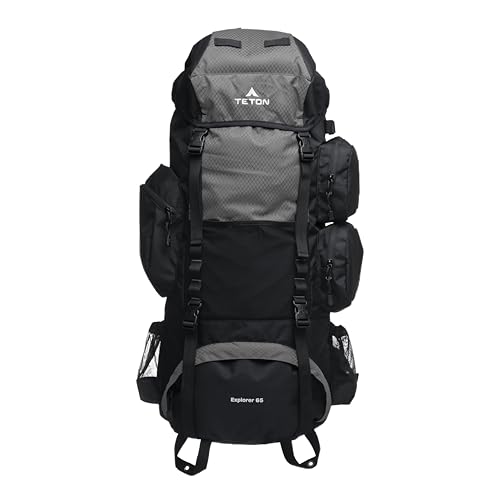
- 65–85 L capacity
- 5.0 lb empty
- Rain cover included
- Teton tough
- Set up to carry a reservoir for hands-free sipping
- Breathable mesh back keeps air moving against your spine
- That 65–85 L volume is overkill for quick hikes and better suited to multi-night trips.
- At 5.0 lb it is heavier than the lightest packs in its class before you load it.
Verdict: TETON Sports’s 65–85 L backpacking pack pairs a breathable back with room for a bladder, making it the one we would grab first for 65L Backpacks.

Best for 65L backpacks
- 65 L capacity
- 4.0 lb empty
- Rain cover included
- Floating top lid with lash points
- Includes a rain cover for sudden downpours
- That 65 L volume is overkill for quick hikes and better suited to multi-night trips.
- The fabric is water-resistant rather than fully waterproof, so a pack liner helps in sustained rain.
Verdict: This 65 L backpacking pack offers a bundled rain cover, making it well worth a look for 65L Backpacks.

Best for 65L backpacks
- 45–65 L capacity
- 4.5 lb empty
- Rain cover included
- Teton tough
- Hydration sleeve keeps water within easy reach
- Breathable mesh back keeps air moving against your spine
- At 45–65 L it is more pack — and more weight — than a day hiker needs; it earns its keep on overnight and multi-day loads.
- Empty weight (4.5 lb) runs above ultralight rivals.
Verdict: TETON Sports’s 45–65 L backpacking pack pairs a breathable back with room for a bladder, making it an easy shortlist pick for 65L Backpacks.

Best for 65L backpacks
- 65 L capacity
- 3.7 lb empty
- Rain cover included
- Adjustable AirSpeed Suspension
- Airflow channels help your back stay cooler under load
- Packs an integrated rain cover to keep gear dry
- At 65 L it is more pack — and more weight — than a day hiker needs; it earns its keep on overnight and multi-day loads.
Verdict: This 65 L backpacking pack pairs a breathable back with a bundled rain cover, making it an easy shortlist pick for 65L Backpacks.
Frequently Asked Questions
Is 65L too big for a first backpacking trip?
For a first overnight or weekend trip, yes — a 45–55L pack is easier to pack well and fits more stably. A 65L pack makes sense for a first trip only if it's a longer multi-day route or the trip requires carrying a hard-sided bear canister.
What's the difference between a 65L and a 60L backpack?
The difference is usually minor: about 5 liters of extra volume, often in the lid pocket or extension collar, and sometimes a slightly heavier frame. Both sizes suit similar four- to seven-night trips; the right one depends more on brand fit than the liter number.
Can a 65L backpack be used for shorter trips?
Yes, using the pack's compression straps to cinch the load down smaller. It won't carry a light weekend load as stably as a purpose-built smaller pack does, but it works fine as a single do-everything pack for hikers who'd rather not own two.