
Best Backpack For Ultrarunning
Best Backpack For Ultrarunning, ranked from aggregated owner ratings and reviews, not first-hand testing. Real pros, cons, and who each pick is best for.


Our Top 3 Picks

Quick Comparison
| Product | Best for | Buy | |
|---|---|---|---|
| Haimont 10L Trail Running Hydration Vest with Soft Flasks | Top Overall Pick | See Amazon | View |
| Haimont 5L Trail Running Hydration Vest with 2 Soft Flasks | Best Value | See Amazon | View |
| CamelBak Dart Run Vest 50oz - Minimalist Hydration Vest with 1.5L Reserv | Best Hydration Pack | See Amazon | View |
| Haimont 5L Trail Running Hydration Vest with Soft Flasks | Best Compact Pack | See Amazon | View |
| NOOLA Running Hydration Vest with Phone Holder for Men Women Medium | Best Ultralight | See Amazon | View |
Choosing a pack for ultrarunning starts with the race or route's format — aid-station supported versus self-supported — since that determines how much gear and food actually needs to travel with the runner at once.
What pack size do I need for an ultramarathon?
Most aid-station-supported ultras, from 50K to 100 miles, are run in a 5 to 15-liter vest, since food and water get restocked every few miles and the runner only carries mandatory safety gear, a light layer and nutrition between stops. Self-supported ultra efforts and fastpacking-style multi-day races, where resupply is infrequent or absent, call for 15 to 24 liters to fit extra food, a compressible layer and sometimes a minimal shelter.
What does a race mandatory-kit list typically require?
Ultra races commonly require a defined set of mandatory items that the pack has to fit without excessive bulk. A typical list includes:
Packing this list efficiently means using the vest's small zip pockets for the compact items and reserving the main compartment for the jacket and any spare layer.
How should an ultrarunning pack handle weight over long hours?
An ultrarunning pack should distribute its load across the chest and shoulders with adjustable sternum straps, avoiding any single pressure point that becomes painful after multiple hours on feet. Because ultra races run through temperature swings, from cold pre-dawn starts to hot midday sections, look for a vest that compresses down when half-empty rather than sagging, since a partially loaded vest bounces more than a fully loaded one. Pole loops matter for races with significant climbing, letting a runner stow trekking poles hands-free on runnable descents.
Who should choose a minimal race vest versus a higher-capacity pack?
Runners on aid-station-supported courses with frequent resupply are best served by a minimal, low-capacity race vest, since extra volume just adds unused weight. Runners tackling self-supported ultra routes, remote 100-milers with long gaps between aid, or multi-day fastpacking-format races need the added capacity of a 15 to 24-liter pack, accepting a slightly less minimal fit in exchange for genuine self-sufficiency between resupply points.
How does terrain and climb profile change the pack choice?
A course with sustained climbing changes what a pack needs to carry well beyond food and water. Trekking poles get used far more on steep, technical ultras than on flat, runnable ones, so a pack with quick-release pole loops on the front or side pays off on mountainous courses like a hilly 100-miler, while a flat road-adjacent ultra rarely needs pole storage at all. Temperature swings matter too: races that start before dawn and finish in afternoon heat need a pack that fits a packable jacket and gloves early on without feeling half-empty and bouncy once those layers come off later.
How does pack choice change for winter or shoulder-season ultras?
Cold-weather ultras add bulkier mandatory gear — insulated gloves, a warmer jacket, sometimes microspikes — that a summer-sized race vest may not fit alongside standard nutrition. Runners training or racing through shoulder-season conditions should size up slightly from their warm-weather vest, prioritizing a pack that compresses well when the extra layers come off mid-race rather than one that's already at capacity from the start line.
Full Ranking, Reviewed

Best for Packs for Ultrarunning
- 10 L capacity
- Hydration-ready
- Lightweight Comfort for Long Distance Runs
- Hydration sleeve keeps water within easy reach
- Loops and straps stash trekking poles and extra layers
- At 10 L it is best kept to shorter outings — it fills up once you add layers, lunch and water for a full day.
Verdict: This 10 L hydration pack offers room for a bladder, making it the one we would grab first for Packs for Ultrarunning.

Best for Packs for Ultrarunning
- 5 L capacity
- Hydration-ready
- Lightweight Trail Running Fit
- Set up to carry a reservoir for hands-free sipping
- Loops and straps stash trekking poles and extra layers
- At 5 L it is best kept to shorter outings — it fills up once you add layers, lunch and water for a full day.
Verdict: This 5 L hydration pack offers room for a bladder, making it well worth a look for Packs for Ultrarunning.
Best for Packs for Ultrarunning
- 5 L capacity
- 3.1 lb empty
- Hydration-ready
- Hydration for Long Distance Running
- Hydration sleeve keeps water within easy reach
- Breathable mesh back keeps air moving against your spine
- The 5 L capacity is snug for anything beyond a half-day on the trail.
- Empty weight (3.1 lb) runs above ultralight rivals.
Verdict: This 5 L hydration pack pairs a breathable back with room for a bladder, making it well worth a look for Packs for Ultrarunning.

Best for Packs for Ultrarunning
- 5 L capacity
- Hydration-ready
- Lightweight Trail Running Fit
- Routes a hydration bladder and hose without fuss
- Loops and straps stash trekking poles and extra layers
- At 5 L it is best kept to shorter outings — it fills up once you add layers, lunch and water for a full day.
Verdict: This 5 L hydration pack offers room for a bladder, making it a strong option for Packs for Ultrarunning.
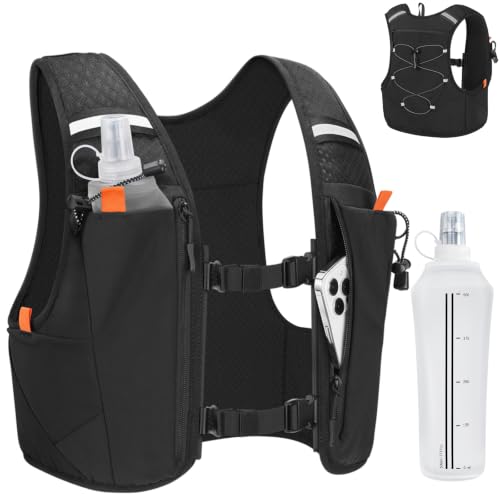
Best for Packs for Ultrarunning
- 11 oz empty
- Hydration-ready
- Adjustable Sternum Straps for Zero-Bounce Fit
- Set up to carry a reservoir for hands-free sipping
- Airflow channels help your back stay cooler under load
- Check the size and colour options on the live listing, as availability shifts.
Verdict: This hiking pack pairs a breathable back with room for a bladder, making it well worth a look for Packs for Ultrarunning.
Frequently Asked Questions
What's the difference between a race vest and a backpack for ultrarunning?
A race vest uses a close, chest-strap fit built for short aid-station gaps and mandatory kit only. An ultrarunning backpack, or a higher-capacity vest, adds more volume and slightly more structure for self-supported sections with longer gaps between resupply points.
How much weight should an ultrarunning pack carry comfortably?
Most runners keep total loaded weight, including water, under about 6 to 8 pounds for a standard race vest. Self-supported or fastpacking-format ultras with extra food and gear can push closer to 10 to 12 pounds before the lack of a hipbelt starts to matter.