An Osprey Atmos AG 65 review covering its Anti-Gravity suspended-mesh frame, torso sizing, load range, and who this multi-day backpacking pack suits best.
By Marcus Hale, Lead Pack Research Editor · Published September 14, 2026, 6:03 PM ET · Updated September 29, 2026, 6:16 PM ET
Affiliate disclosure: this page contains affiliate links. Purchases made through them may earn us a commission at no extra cost to you. See our affiliate disclosure.
In plain English
The Atmos AG 65 is a large backpack for trips of a few days to about a week. The 65 is its volume in liters, roughly the space of a big kitchen trash bag. AG stands for Anti-Gravity, Osprey's name for the stretchy mesh panel that sits against your back.
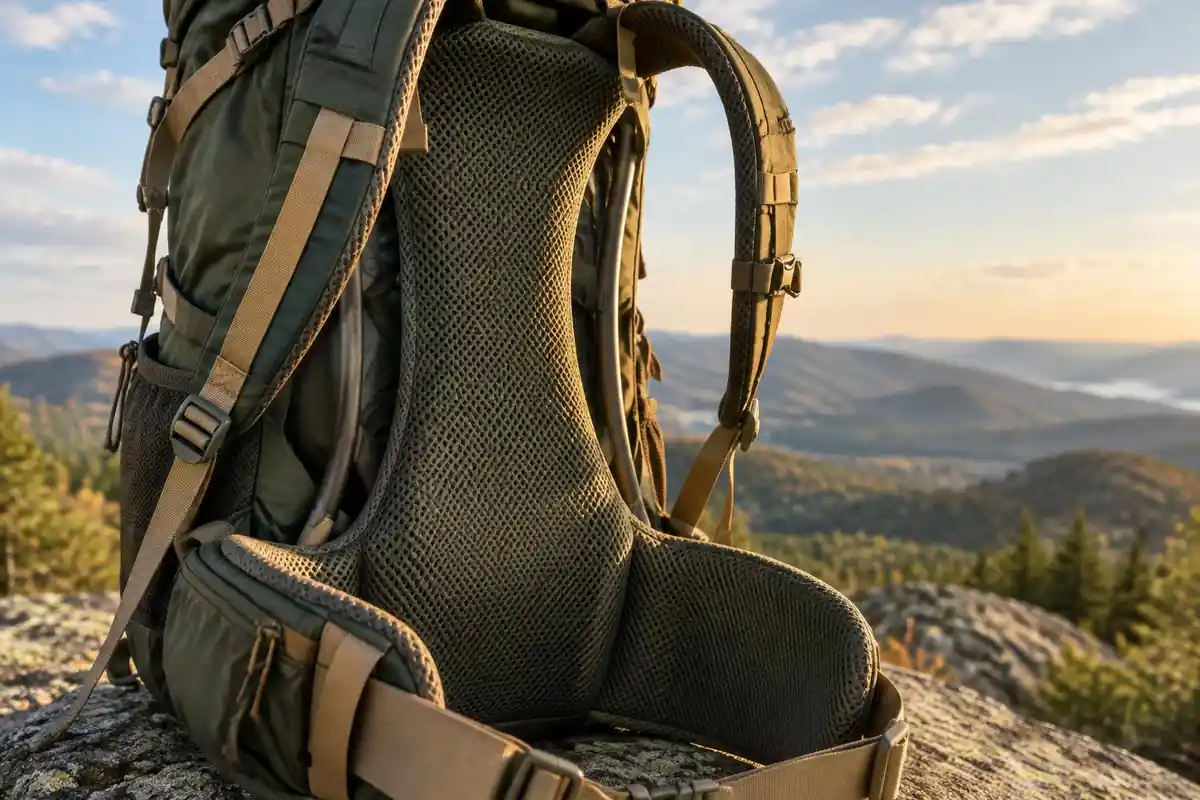
Instead of pressing a foam pad against you, the pack stretches a tight net between the edges of its frame, like a trampoline turned on its side. Your back touches only the net, so air can move behind you and you sweat less. The same net continues around your hips as part of the hip belt.
As with any big pack, fit comes first. You choose a size by measuring the length of your back, then adjust the straps so the hip belt carries most of the weight. A pack this size can hold a lot, so it pays to pack only what the trip needs.
The Osprey Atmos AG 65 is a men's multi-day backpacking pack built around Osprey's Anti-Gravity suspended-mesh back panel, sized for trips from a long weekend up to a week or more depending on load and resupply. Its women's counterpart is the Aura AG 65, built on the same suspension concept with a shorter torso range and a narrower, more contoured hipbelt.
What frame and suspension does the Atmos AG 65 use?
The Atmos AG 65 uses Osprey's Anti-Gravity, or AG, suspension, a continuous tensioned-mesh back panel that Osprey describes as enveloping the back and hips in 3D-suspended mesh. Unlike a solid foam back panel, the AG mesh stands off the pack body and wraps down into the hipbelt as one continuous piece, so air moves freely between the hiker's back and the pack rather than getting trapped against a padded surface. This design generally trades a small amount of raw load-carrying stiffness, compared with a fully structured framesheet pack, for noticeably better ventilation on warm-weather trips.
What capacity and load range is the Atmos AG 65 built for?
The "65" in the name refers to its nominal liter capacity, which is a multi-day size suited to trips of several days to about a week between resupplies, though actual volume shifts slightly across the small, medium, and large sizes Osprey sells. The AG mesh suspension and wraparound hipbelt are built to carry moderate-to-heavy backpacking loads comfortably, putting this pack in the same general use case as other 60-to-70-liter internal-frame packs rather than the lighter ultralight category. Hikers packing for winter trips or carrying technical gear on top of standard backpacking loads should still follow general load-safety guidance for heavier packs rather than treating any pack's frame as unlimited.
How does the Atmos AG 65 fit and adjust?
Like most Osprey packs, the Atmos AG 65 is sold in torso-length sizes rather than a single adjustable frame, so choosing the correct size starts with measuring torso length rather than relying on overall height. The hipbelt is Osprey's Fit-on-the-Fly adjustable design, which lets the hiker adjust the belt to their hips and helps keep more of the pack's weight on the hips rather than the shoulders, consistent with general hipbelt load-transfer principles. A floating top lid allows the collar to be cinched down when the main compartment isn't full, and side compression straps pull the load close to the frame to keep it from shifting on uneven trail.
What features does the Atmos AG 65 include?
The Atmos AG 65 includes the organizational and attachment features typical of a full-featured multi-day pack, listed here as a single attribute set.
A bottom sleeping-bag compartment with a removable divider, separating a sleeping bag from the main compartment.
A floating top lid with pockets for small, frequently needed items.
Dual mesh side pockets and a front stretch-mesh pocket for water bottles and quick-access gear.
A dedicated hydration-reservoir sleeve and hose port.
Side compression straps that cinch the load and can also carry bulky gear externally.
Who is the Atmos AG 65 best for?
The Atmos AG 65 suits backpackers taking multi-day trips who want strong ventilation and a moderate-to-heavy load capacity without moving up to a structured expedition pack. Hikers who prioritize the lowest possible base weight over ventilation and load capacity may prefer Osprey's lighter ultralight line instead, and hikers routinely carrying very heavy winter or expedition loads may find more support in Osprey's structured heavy-load line.
Frequently Asked Questions
Yes. Its wraparound hipbelt, adjustable-feeling fit within each torso size, and organized compartments make it forgiving for a first multi-day pack, and Osprey's All Mighty Guarantee (repair or replace for any damage at no cost) reduces the risk of an early purchase mistake.
They share the same Anti-Gravity suspended-mesh frame and general feature set. The Aura AG 65 is Osprey's women's version, built on a shorter default torso range with a narrower, more contoured hipbelt and shoulder straps sized for a shorter, narrower average frame.
Osprey's own description is narrower than many reviews. It says the Atmos AG 65 is built for heavyweight weekends or week-long trips where comfort and ventilation matter most, and describes Anti-Gravity as enveloping the back and hips in 3D-suspended mesh.1 Osprey lists its Fit-on-the-Fly adjustable hip belt on the Atmos and Aura AG, and it sizes packs by torso length measured from C7 to the iliac crest.5 Details that some guides give, such as the frame material and how the belt wings move, go beyond what the sources in this site's library confirm, so check the current spec sheet before buying.
Suspended mesh itself is not new. Deuter says it introduced its Aircomfort suspended-mesh back in 1984, using a flexible spring steel frame to hold a gap between the mesh and your back.2,6 REI describes the general design as holding the packbag a few inches off the back to reduce sweat.7
The cost of a gap behind your back
Airflow comes with a physics trade-off. A review of soldier load carriage found that keeping a load's center of mass as close as possible to the body's center of mass gives the lowest energy cost.3 US Army doctrine says packing heavier items higher and closer to the body can cut marching energy cost by as much as 25% compared with low, away-from-body placement.8 A mesh gap of a few inches is far milder than that comparison, but it pushes in the same direction.
Packing well offsets much of it. The Appalachian Mountain Club advises putting dense items such as food and cook gear about two-thirds up the main compartment, centered and against the back, then cinching the compression straps.9 Army doctrine notes that compression straps stop the internal load from shifting and hold it closer to the body.8
How much weight the hip belt really takes
Ventilated or not, the hip belt does the heavy lifting, though sources disagree on how much. The Washington Trails Association says around 80% of pack weight goes to the hips,10 Alpkit says 60 to 80%,11 and the US Army's manual says about 30% on the hips and 70% on the shoulders with a frame and hip belt.8 Researchers do agree the hips tolerate pack pressure significantly better than the shoulders.12
Osprey's check for belt size is a 3 to 6 inch gap between the hip-pad tips when tightened at the iliac crest.5 A 65-liter bag also invites overpacking. The WTA pairs 50 to 70 liters with trips of 3 to 7 nights,10 so on a weekend trip this pack will have space you don't need to fill.
Materials and the guarantee
Osprey says the Atmos AG 65 uses recycled main, accent and bottom fabrics, and that the included rain cover uses a PFC/PFAS-free water-repellent finish and bluesign approved materials.1 Those claims sit against a changing legal backdrop: California's AB 1817 lists backpacks as textile articles and, from January 2025, bars new ones containing regulated PFAS.13
Some guides call Osprey's guarantee a lifetime repair guarantee. Osprey calls it the All Mighty Guarantee and says it will repair or replace a bag for any damage at no cost, regardless of when it was made.4 That is broader than many competitors; Deuter, for comparison, gives a two-year warranty plus a lifetime repair service.14