
Best Osprey Backpack
Best Osprey Backpack, ranked from aggregated owner ratings and reviews, not first-hand testing. Real pros, cons, and who each pick is best for.

Affiliate disclosure: this page contains affiliate links. Purchases made through them may earn us a commission at no extra cost to you. See our affiliate disclosure.
In plain English
Osprey makes many kinds of packs, from small day bags to big packs for week-long trips. The best one for you depends on what you will carry and for how long, not on which model is most famous.
The first step is to measure your back. Ask someone to measure from the bony bump at the bottom of your neck down to the top of your hip bones. That number, not your height, tells you whether you need a small, medium or large. It is a bit like shoe size: two people of the same height can need different sizes.
Next, think about heat and weight. Some Osprey packs hold the bag away from your back on a stretched mesh panel, so air flows through and you sweat less. Others sit closer to your back, which feels steadier with heavier loads. Pick the style that matches your usual hikes, then try it on with some weight inside.
Our Top 3 Picks
Quick Comparison
Choosing the best Osprey backpack starts with matching a suspension family to a trip type, since Osprey doesn't build one universal pack but several distinct lines with different ventilation, weight, and load-carrying trade-offs.
What should you look for in an Osprey backpack?
Look for the suspension type, capacity, and torso-fit range that match your typical trip, since these three factors determine comfort more than any single feature. Osprey's suspended-mesh packs ventilate best and suit warmer climates and moderate loads; its ventilated foam-panel packs suit day hiking and fastpacking; and its structured, heavy-load packs suit extended trips carrying more gear and food. Matching capacity to trip length matters as much as suspension type, since an oversized pack for a short trip carries no better than a correctly sized one and often carries worse once compression straps are cinched down over empty space.

How do Osprey's suspension types compare?
Osprey's suspension types split into three general categories: fully suspended tensioned mesh, lighter suspended mesh, and structured foam-and-frame panels, each suited to a different priority.
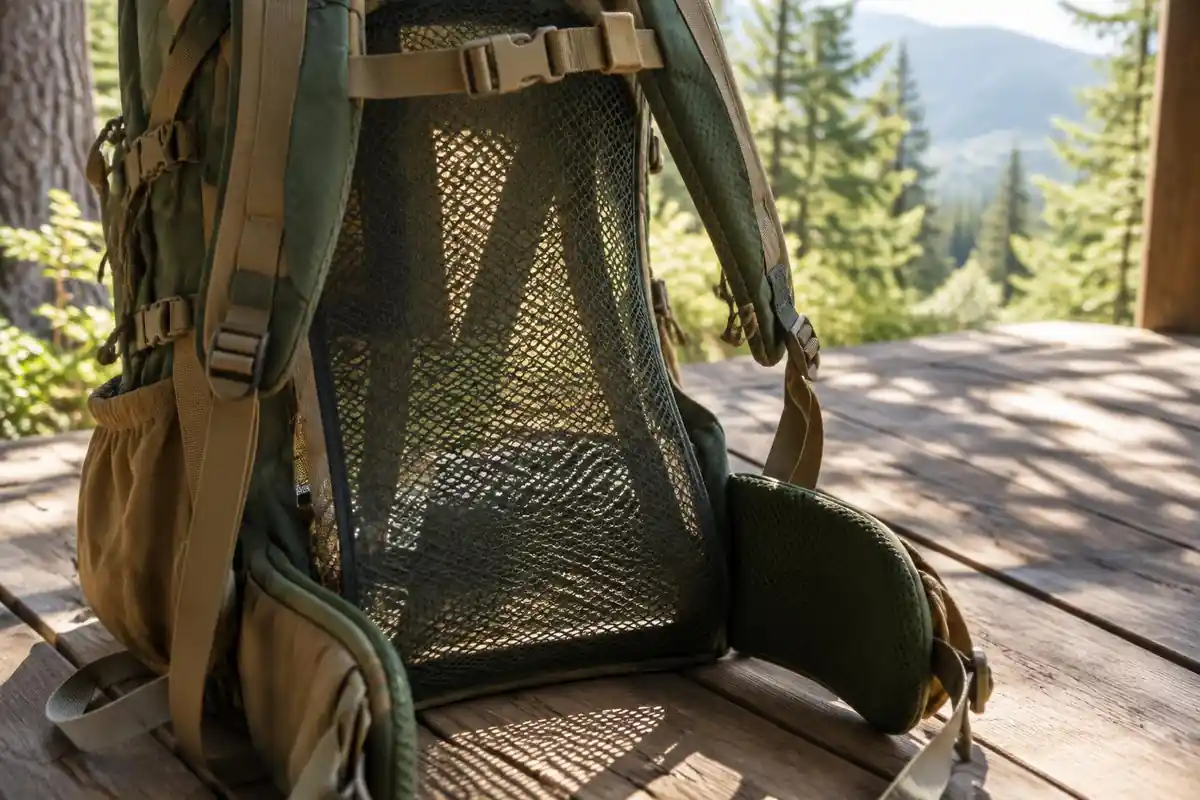
- Anti-Gravity (AG) suspended mesh — used on the Atmos AG and Aura AG line, this maximizes airflow and suits moderate-to-heavy loads on multi-day trips.
- AirSpeed suspended mesh — used on the Exos and Eja line, a lighter version of suspended mesh built for hikers who have already trimmed their gear weight.
- Ventilated contoured foam panels — used on the Talon, Tempest, Stratos, and Sirrus lines, offering a closer, more athletic fit for day hiking and fastpacking.
- Structured frame and foam panels — used on the Aether and Ariel line, prioritizing load-carrying stiffness for heavy, extended-trip loads.
How should you size an Osprey backpack?
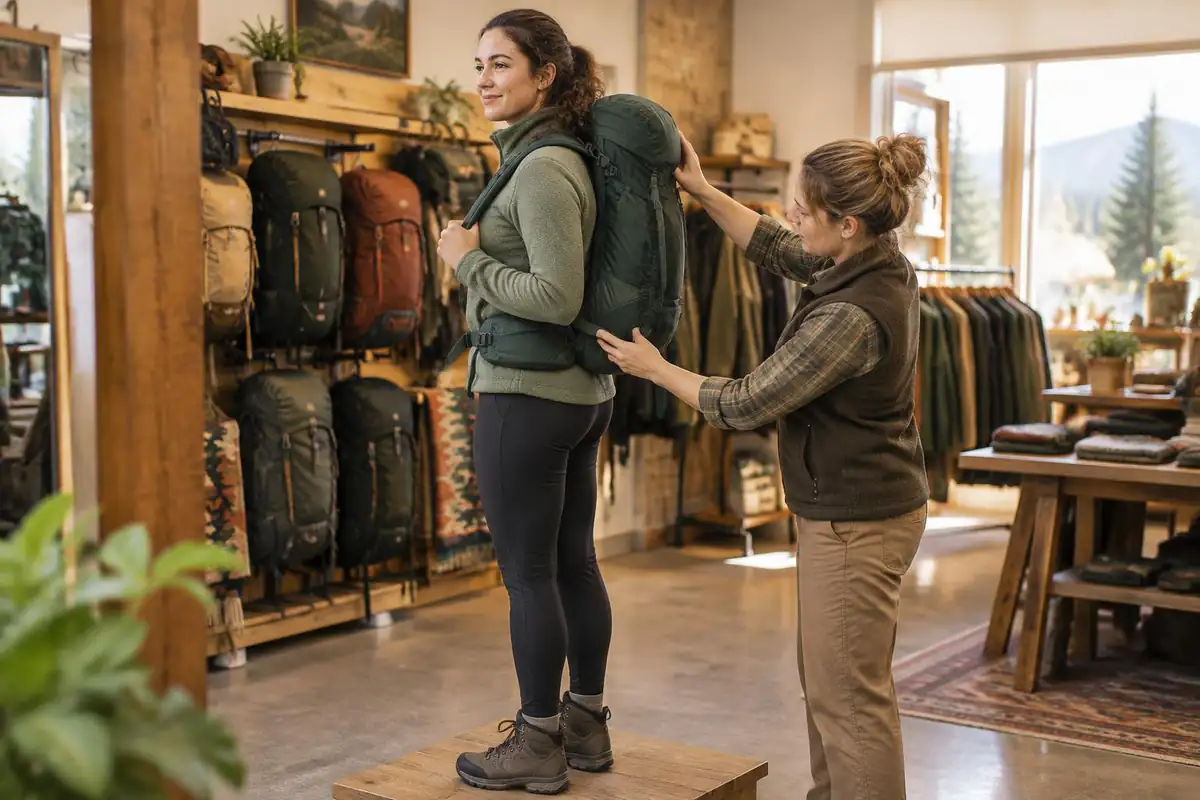
Size an Osprey backpack by torso length, not overall height, since Osprey sells most packs in small, medium, and large torso-length options rather than one adjustable fit for every body. The most reliable way to find your size is measuring your torso from the C7 vertebra at the base of the neck down to the iliac crest at the top of the hips, then matching that measurement to the size chart for the specific model, since torso ranges can shift slightly between Osprey's product lines.
Do you need a men's or women's Osprey pack?
Choose based on torso range and hipbelt shape rather than gender labels alone, since Osprey's women's-specific packs use shorter default torso ranges and more contoured hipbelts and shoulder straps, but either version can fit a hiker whose proportions match its size range. A hiker with a shorter torso or narrower frame, regardless of gender, will generally find a better fit in a women's-specific model, and the reverse holds for a hiker with a longer torso or broader frame trying a women's-specific pack.
Is a more expensive Osprey pack worth it?
A higher price within the Osprey range generally buys more suspension structure, more organizational features, or higher-capacity construction, not a different warranty tier, since the All Mighty Guarantee (repair or replace for any damage, regardless of when a pack was made) is not tied to a price tier. Budget-focused hikers can reasonably start with a simpler, less structured line like the Talon or Tempest and upgrade later, knowing the warranty coverage doesn't change with the model chosen.
Full Ranking, Reviewed

Best for Osprey backpacks
- 22 L capacity
- 2.4 lb empty
- Hydration-ready
- Lightweight & versatile design
- Routes a hydration bladder and hose without fuss
- Airflow channels help your back stay cooler under load
- Colours and exact capacity options change often on Amazon — confirm the current variant on the listing before buying.
Verdict: This 22 L daypack pairs a breathable back with room for a bladder, making it our overall pick for Osprey Backpacks.

Best for Osprey backpacks
- 33 L capacity
- 3.0 lb empty
- Hydration-ready
- Lightweight & versatile design
- Set up to carry a reservoir for hands-free sipping
- Airflow channels help your back stay cooler under load
- Colours and exact capacity options change often on Amazon — confirm the current variant on the listing before buying.
Verdict: This 33 L hiking pack pairs a breathable back with room for a bladder, making it an easy shortlist pick for Osprey Backpacks.
How Osprey's own sizing guide works
Osprey sizes its packs by torso length and says to measure from the C7 vertebra to the iliac crest.1 Hyperlite makes a point worth repeating: height is not a reliable proxy for torso length, so it should be measured rather than guessed.2 Big Agnes suggests fitting any pack with 10 to 20 pounds loaded,3 which is a useful rule when comparing two Osprey sizes that both feel fine empty.
The hip belt has its own check. Osprey says a correctly sized hipbelt leaves a 3 to 6 inch gap between the tips of the hip pads when tightened, measured at the iliac crest.1 If the pads touch, the belt is too big; if the gap is much wider, the pads may not wrap far enough forward to grip. Osprey's Fit-on-the-Fly system, used on packs including the Atmos and Aura AG, is an adjustable hipbelt.1 It helps the belt match your hips, but it does not change torso length, so it cannot rescue a pack that is the wrong size on your back.
The trade-off inside a suspended mesh back
Osprey describes its AntiGravity suspension as enveloping the back and hips in 3D-suspended mesh.4 REI explains the general idea behind these tension-mesh panels: they hold the packbag a few inches off your back to reduce sweat.5 That airflow is the main reason to choose one, especially in warm, humid weather.
The cost is a small shift of the load away from your body. Load-carriage research has found that keeping the load's center of mass as close as possible to the body's center of mass gives the lowest energy cost,6 and US Army doctrine says packing heavier items higher and closer to the body can cut marching energy cost by as much as 25% compared with low, away-from-body placement.7 Those studies did not test Osprey packs, so they don't prove a mesh back is worse. They do explain why many hikers find contact-style panels feel steadier with heavy or shifting loads, and why packing dense items against the back panel matters more in a mesh-back pack.
What the guarantee changes, and what it doesn't
Osprey calls its warranty the All Mighty Guarantee and states it will repair or replace a bag for any damage at no cost, regardless of when it was made.8 The brand frames it around repairing packs to extend their useful life, so expect a repair first rather than a new pack.8 Some guides say nearly the whole line is covered; Osprey's own wording is any damage, regardless of when a bag was made, so check the guarantee terms for the specific product before relying on it.
The terms are notably broader than some rivals. Gregory guarantees against defects for as long as you own the pack but excludes normal wear and tear,9 and Deuter gives a two-year warranty plus a lifetime repair service where repair is possible.10 Warranty is a fair tie-breaker between two packs that both fit, but it never makes up for a torso length or hip belt that is wrong for you.
Frequently Asked Questions
What is the best all-around Osprey backpack?
There isn't one universal answer, since Osprey's lines are built for different trip types. The Atmos AG and Aura AG are the most common general-purpose recommendation for multi-day backpacking, balancing ventilation, load capacity, and features.
Are Osprey backpacks true to size?
Osprey sizes by torso length rather than height or clothing size, so fit accuracy depends on measuring torso length correctly rather than assuming a size from body height alone. Torso ranges can also shift slightly between different Osprey model lines.
Related Buying Guides
Planning a hiking trip? Compare hotels, lodges and guesthouses.
Book on Booking.com Book on AgodaAffiliate links: we may earn a commission at no extra cost to you.