

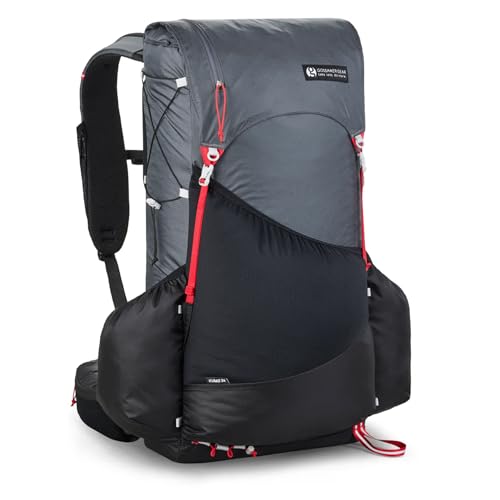



The Gossamer Gear Mariposa is an ultralight backpacking pack built around a removable aluminum-stay frame, sized for multi-day trips and thru-hiking rather than day hikes or short overnights. It sits in the roughly 60-liter capacity class, among the larger packs in Gossamer Gear's lineup, and is designed for hikers who have already trimmed their gear list toward a lower base weight but still want a supportive frame.
What is the Gossamer Gear Mariposa built for?
The Mariposa follows Gossamer Gear's general design approach: a removable aluminum stay for structure, a padded hip belt built to carry most of the load, contoured mesh-faced shoulder straps, and external stretch-mesh pockets sized for quick access to water bottles, snacks, and wet gear. Instead of a heavy top-loading brain and multiple zippered compartments, the pack relies on a roll-top or floating-lid closure and side compression straps to manage volume as food and water weight drops through a trip.
Who is the Mariposa for?
The Mariposa suits hikers carrying multi-day loads — food for several days, a full shelter system, and layers for changing weather — who still want their total pack weight kept low. It's a common choice among thru-hikers on long-distance trails such as the Appalachian Trail, Pacific Crest Trail, and Continental Divide Trail, where hikers restock food regularly but still need enough capacity between resupply points.
Hikers who carry heavier gear lists, use bulkier four-season equipment, or expect to load well beyond the pack's intended range are generally better served by a heavier-duty, more structured backpack. The Mariposa's frame and hip belt are built for ultralight-to-lightweight loads rather than traditional backpacking loads that lean on a rigid frame sheet and heavily padded suspension.
How does the Mariposa's frame work?
The Mariposa uses a single removable aluminum stay rather than a fixed internal frame sheet. Hikers can bend the stay by hand to roughly match their spine's curve, and pull it out entirely to drop weight on trips where a frame isn't needed. This mirrors Gossamer Gear's broader approach to fit, where sizing is handled through fixed torso-length options — commonly small, medium, and large — rather than one harness that slides to fit every body.
Because the frame is removable, the Mariposa can be carried two ways:
- Framed, for trips with heavier food and water carries, colder-weather gear, or longer stretches between resupply, where the hip belt needs the stay's support to transfer weight off the shoulders.
- Frameless, for shorter trips or hikers with a very low base weight who don't need the structure and want to shave ounces from the total pack weight.
How does the Mariposa compare to the Gorilla and Kumo?
The Mariposa is Gossamer Gear's larger, higher-capacity backpacking pack, while the Gorilla covers a mid-size range for lighter multi-day loads and the Kumo is the brand's minimalist, lowest-capacity option. Hikers choosing between them are generally weighing capacity against weight: more room and load support with the Mariposa, a middle ground with the Gorilla, or the lightest possible carry with the Kumo. Choosing between Gossamer Gear's pack lines usually comes down to how much gear a hiker carries between resupply points and how far they've already trimmed their base weight, more than any single spec on the pack itself.
What fabric options does the Mariposa come in?
Like other Gossamer Gear packs, the Mariposa is typically offered in a standard, higher-denier nylon build and, on select runs, a lighter composite-fabric build for hikers chasing the lowest possible pack weight. That composite fabric was originally sold under the name Dyneema Composite Fabric (DCF); its manufacturer now markets the same category of material as "Ultra," though many hikers still refer to it as Dyneema or DCF. The nylon version generally holds up better against everyday abrasion — brushing past rock, scrambling, or setting the pack down on gritty ground — while the composite-fabric version trims weight further at a higher price and with less long-term abrasion resistance. Which one makes sense depends on how a hiker weighs durability against total pack weight, and how much bushwhacking or off-trail scrambling a given trip actually involves.
Hikers deciding between the two fabric options should think about trip type first. A thru-hike on a well-maintained long-distance trail puts less abrasive stress on a pack than frequent off-trail travel, scrambling, or bushwhacking, where a tougher nylon build tends to last longer. Hikers prioritizing the lowest carry weight above all else, and willing to treat the pack more carefully, are the ones who benefit most from the lighter composite-fabric build.