
Best Budget Backpacking Backpack
Best Budget Backpacking Backpack, ranked from aggregated owner ratings and reviews, not first-hand testing. Real pros, cons, and who each pick is best for.

Our Top 3 Picks
Quick Comparison
| Product | Best for | Buy | |
|---|---|---|---|
| Teton 75L Explorer Internal Frame Backpack for Hiking | Top Overall Pick | See Amazon | View |
| Teton 55L Scout Internal Frame Backpack for Hiking | Best Value | See Amazon | View |
| Teton 65L Explorer Internal Frame Backpack for Hiking | Best Hydration Pack | See Amazon | View |
| Bseash 60L Waterproof Hiking Camping Backpack with Rain Cover | Best Ultralight | See Amazon | View |
| Osprey Rook 65L Men's Backpacking Backpack | Best for Multi-Day | See Amazon | View |
| Esup 50L Camping Hiking Backpack Men with rain cover 45l+5l Lightweight | Most Breathable | See Amazon | View |
A budget backpacking pack is a full-size, framed pack (roughly 40 to 65 liters) built to carry multiple days of gear, food and a sleep system, priced below premium ultralight brands by using heavier fabric and a simpler suspension rather than a smaller frame or lower load capacity.
What makes a backpacking pack "budget" versus a daypack?
A budget backpacking pack differs from a budget daypack mainly in frame strength and load range: it needs a real internal frame — usually a single or dual aluminum stay — and a structured hipbelt capable of carrying 25 to 40+ pounds over multiple days, not just the 10 to 20 pounds typical of a day hike. That structural requirement means backpacking packs cost more than daypacks even at the budget end, since a frame and heavier-duty hipbelt can't be built as cheaply as a simple daypack shell.
How much weight can a budget backpacking pack carry comfortably?
Most budget backpacking packs comfortably carry 25 to 40 pounds when properly fitted, following the same 20%-of-bodyweight load guideline that applies to any framed pack regardless of price. The hipbelt should still carry roughly 80% of that load once the pack is adjusted correctly — a budget frame transfers weight just as a premium one does, provided torso length is correctly matched to the hiker.
What frame types show up at this price?
Budget backpacking packs typically use a single internal aluminum stay paired with a semi-rigid plastic framesheet, rather than the dual-stay or perimeter-frame systems found on premium multi-day packs. That single-stay design still transfers load to the hips effectively for most hikers, though it flexes slightly more under very heavy loads than a dual-stay frame.
| Frame element | Budget backpacking pack | Premium backpacking pack |
|---|---|---|
| Stay type | Single aluminum stay | Dual stay or perimeter frame |
| Framesheet | Semi-rigid plastic | Contoured HDPE or carbon |
| Hipbelt | Padded, molded foam | Load-adjustable, swappable sizes |
| Back panel | Flat or lightly channeled foam | Ventilated mesh or trampoline design |
| Fabric | 400–600D nylon/polyester | 100–210D ripstop or DCF |
Which features matter most for multi-day comfort?
For multi-day comfort, the features that matter most are correct torso fit, a hipbelt that stays put under a full pack, and load-lifter straps that angle the pack's weight into the shoulders correctly. Ventilation and pocket organization matter for convenience but affect comfort less over a multi-day trip than fit and load transfer do.
- Torso fit: measured from the C7 vertebra to the iliac crest, matched to the pack's fixed or adjustable range
- Hipbelt stability: should stay positioned on the hip bones without riding up under a loaded pack
- Load-lifter straps: angle the pack's top weight back toward the shoulders rather than pulling backward
- Compression straps: stabilize a partially packed load so gear doesn't shift while hiking
What corners get cut on budget backpacking packs specifically?
Budget backpacking packs most commonly cut adjustable torso sizing (offering fixed S/M/L instead), ventilated back panels (using flat foam instead of mesh), and total pack weight, since heavier fabric and a simpler frame both add ounces compared to premium equivalents. A budget 60-liter pack often weighs 4 to 6 pounds empty versus 2.5 to 3.5 pounds for a premium equivalent — a real difference on a multi-day trip where every pound is carried for days, not hours.
Which value brands build backpacking-specific packs?
Real value-focused brands building dedicated backpacking packs include Kelty (Redwing and Coyote series), ALPS Mountaineering (Mythos and Zion series), TETON Sports (Scout and Explorer series), and REI Co-op's Trailmade line, all offering 45–65 liter packs with genuine internal frames rather than repurposed daypack shells. These differ from budget daypacks by including an actual load-bearing suspension built for multi-day weight, not just a bigger main compartment.
A hiker choosing between one of these and a premium multi-day pack should weigh the difference in pack weight and adjustability against the price gap, covered directly in the comparison of what budget and premium packs actually change. First-time backpackers are often better served starting with a well-fitted value pack, outlined further for beginner hiking backpacks, before investing in premium gear once trip frequency is established.
Full Ranking, Reviewed

Best for Budget Backpacking backpacks
- 65–85 L capacity
- 5.5 lb empty
- Rain cover included
- Teton tough
- Routes a hydration bladder and hose without fuss
- Breathable mesh back keeps air moving against your spine
- That 65–85 L volume is overkill for quick hikes and better suited to multi-night trips.
- At 5.5 lb it is heavier than the lightest packs in its class before you load it.
Verdict: TETON Sports’s 65–85 L backpacking pack pairs a breathable back with room for a bladder, making it the one we would grab first for Budget Backpacking Backpacks.

Best for Budget Backpacking backpacks
- 45–65 L capacity
- 4.1 lb empty
- Rain cover included
- Teton tough
- Set up to carry a reservoir for hands-free sipping
- Airflow channels help your back stay cooler under load
- That 45–65 L volume is overkill for quick hikes and better suited to multi-night trips.
Verdict: TETON Sports’s 45–65 L backpacking pack pairs a breathable back with room for a bladder, making it a strong option for Budget Backpacking Backpacks.
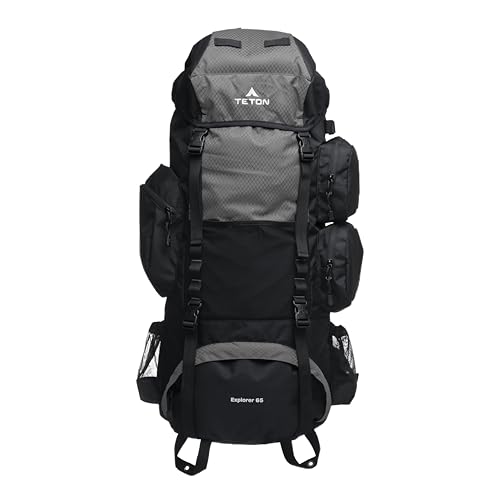
Best for Budget Backpacking backpacks
- 65–85 L capacity
- 5.0 lb empty
- Rain cover included
- Teton tough
- Set up to carry a reservoir for hands-free sipping
- Breathable mesh back keeps air moving against your spine
- At 65–85 L it is more pack — and more weight — than a day hiker needs; it earns its keep on overnight and multi-day loads.
- Empty weight (5.0 lb) runs above ultralight rivals.
Verdict: TETON Sports’s 65–85 L backpacking pack pairs a breathable back with room for a bladder, making it well worth a look for Budget Backpacking Backpacks.

Best for Budget Backpacking backpacks
- 60 L capacity
- Ripstop nylon shell
- 2.2 lb empty
- Rain cover included
- Comfortable Daypack
- Hydration sleeve keeps water within easy reach
- Breathable mesh back keeps air moving against your spine
- At 60 L it is more pack — and more weight — than a day hiker needs; it earns its keep on overnight and multi-day loads.
Verdict: This 60 L backpacking pack pairs a breathable back with room for a bladder, making it a strong option for Budget Backpacking Backpacks.

Best for Budget Backpacking backpacks
- 65 L capacity
- 3.7 lb empty
- Rain cover included
- Adjustable AirSpeed Suspension
- Breathable mesh back keeps air moving against your spine
- Includes a rain cover for sudden downpours
- That 65 L volume is overkill for quick hikes and better suited to multi-night trips.
Verdict: This 65 L backpacking pack pairs a breathable back with a bundled rain cover, making it well worth a look for Budget Backpacking Backpacks.

Best for Budget Backpacking backpacks
- 5–50 L capacity
- Nylon shell
- 2.5 lb empty
- Rain cover included
- Breathable mesh back keeps air moving against your spine
- Packs an integrated rain cover to keep gear dry
- Waterproof build keeps contents dry through real weather
- At 5–50 L it sits between a daypack and a backpacking pack — a touch large for quick hikes, a touch small for long multi-night loads.
Verdict: This 5–50 L hiking pack pairs a breathable back with a bundled rain cover, making it well worth a look for Budget Backpacking Backpacks.
Frequently Asked Questions
How much should I spend on a first backpacking backpack?
Most first-time backpackers do well spending $100–$180 on a value pack with a genuine internal frame, a structured hipbelt, and correct torso fit. That covers 45–65 liter packs from brands like Kelty, ALPS Mountaineering and TETON Sports without needing premium ultralight materials yet.
Can a budget backpacking pack handle a week-long trip?
Yes, provided its liter capacity and load rating match the trip — most budget backpacking packs in the 55–65 liter range carry 25–40 pounds comfortably, enough for a week of food, shelter and a sleep system. Fit and load-lifter adjustment matter more than price for week-long comfort.