

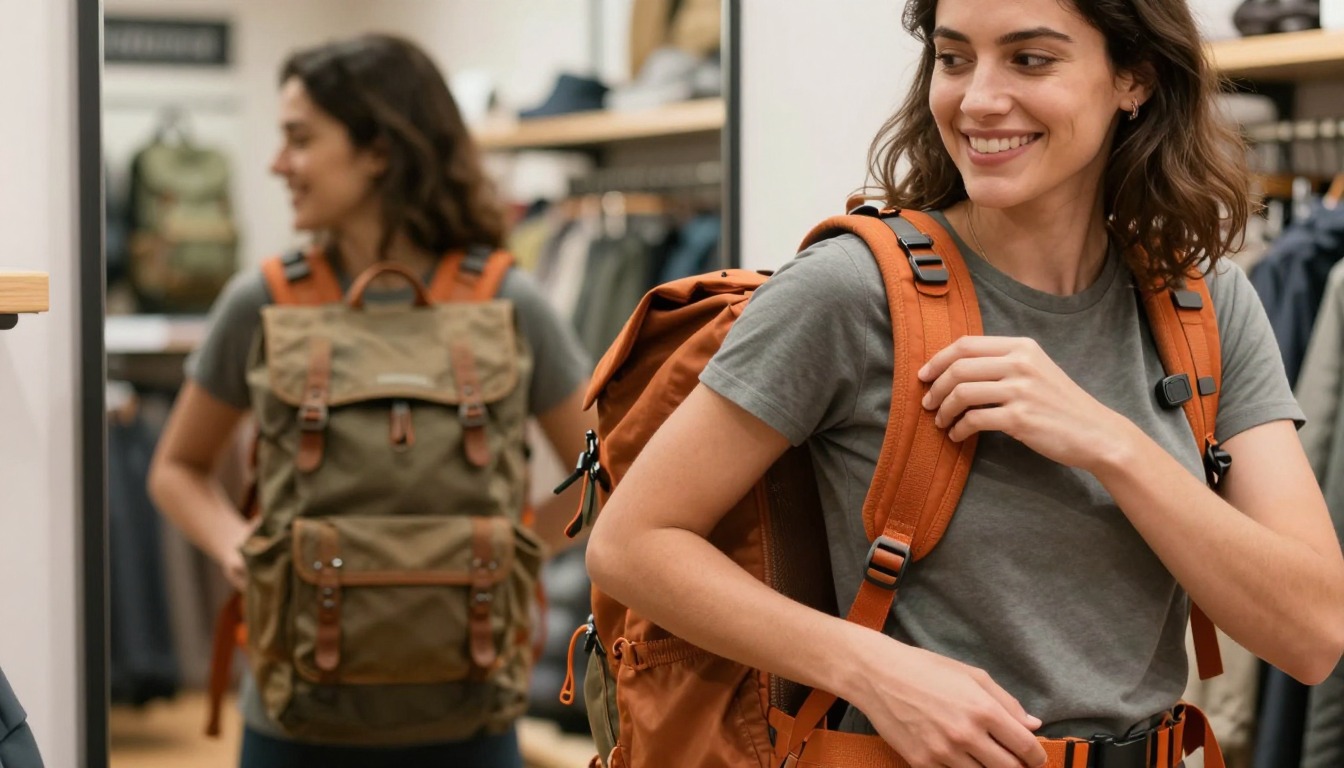
Sizing a women's-fit pack correctly comes down to one measurement matched against the right chart, then two fit checks under load — most sizing mistakes trace back to skipping one of those three steps rather than to the pack itself being wrong for the hiker's body.
How does the women's-fit size chart differ from a unisex chart?
A women's-fit chart compresses its size tiers into a shorter overall span than a unisex chart, typically extra-small through medium across roughly 14 to 18.5 inches, versus small through extra-large across roughly 16 to 22 inches on a unisex chart. Because the women's-fit span is shorter, each size tier often covers a narrower band, commonly a inch and a half rather than two full inches, which means a torso length near a boundary is more likely to fall into a different tier depending on the exact brand.
| Chart type | Typical span | Typical tiers |
|---|---|---|
| Women's-fit | ~14–18.5 in | XS, S, M |
| Unisex / men's-fit | ~16–22 in | S, M, L, XL |
What's the step-by-step process to measure for a women's pack?
Measuring for a women's-fit pack follows four steps: locate the C7 vertebra, locate the iliac crest, measure the distance between them, and match that number to the specific brand's women's chart rather than an average figure.
Standing naturally, without slouching or arching the back, keeps the reading accurate; a hunched posture shortens the apparent measurement, and an arched one lengthens it.
What if my torso measurement falls between two sizes?
A torso length that falls between two women's-fit sizes usually calls for the shorter size if the pack has a fixed frame, since an overly long torso frame is harder to correct than a slightly short one, or for an adjustable-suspension pack set toward the middle of its range. Adjustable suspensions add a small amount of weight over a fixed frame at the same capacity but remove the risk of a half-size miss, which makes them a reasonable default for a hiker who hasn't confirmed their exact number yet.
- Between sizes, fixed frame: size down and check load-lifter reach before buying
- Between sizes, adjustable frame: set to the middle of the range, then fine-tune after a loaded fitting
- Below the shortest listed size: compare packs built for petite and short-torso hikers instead of forcing the smallest standard size
How do I check hipbelt fit on a women's-specific belt?
Check a women's-specific hipbelt by loading the pack with several pounds of gear, fastening the belt so the padding centers directly over the hip bones, and confirming the belt doesn't ride up onto the waist or slip down onto the thighs. A properly centered hipbelt carries roughly 80% of a loaded pack's weight, which is the entire reason hipbelt fit outweighs shoulder-strap fit when something feels wrong.
Shorter hipbelt wings on a women's-specific belt are built to avoid overlapping on a smaller frame; wings that overlap significantly, or a belt that can't cinch fully snug even at its tightest setting, both point to a belt sized too large for the hiker's hip circumference regardless of how well the torso length matches.
Common measuring mistakes that throw off the result
The most common mistake is measuring torso length against height or clothing size instead of the actual C7-to-iliac-crest distance, since two hikers of identical height can have torso lengths that differ by two inches or more. Measuring alone, without a second person, is the next most common source of error, because reaching around to find a consistent starting and ending point changes posture mid-measurement. Comparing the result to a generic "women's size" average rather than the specific brand's own chart rounds out the top three mistakes, since chart boundaries vary by half an inch or more between manufacturers.