



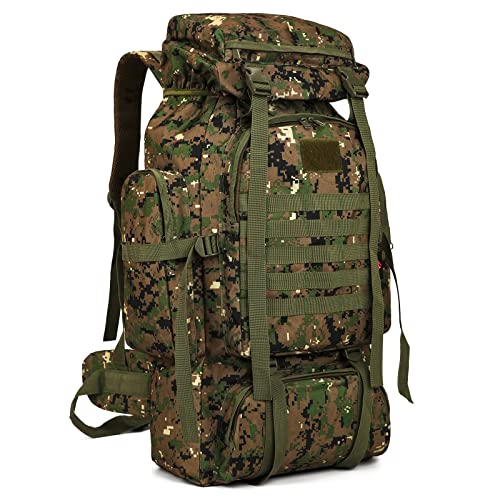


A budget hiking backpack and a premium hiking backpack of the same liter capacity carry weight using the same basic mechanics — a hipbelt, shoulder straps and an internal or external frame — but differ sharply in fabric weight, suspension adjustability, and how much refinement goes into fit.
What actually separates an $80 pack from a $300 pack?
The price gap mostly buys lighter, more expensive fabrics, an adjustable suspension system, and better ventilation, not a fundamentally different way of carrying weight. A premium pack might use 100–210D high-tenacity nylon or Dyneema Composite Fabric (DCF) instead of the 400–600D polyester common on budget packs, cutting pack weight substantially while keeping comparable strength per fiber.
| Factor | Budget pack ($60–$120) | Premium pack ($250–$400+) |
|---|---|---|
| Fabric | 400–600D polyester/nylon | 100–210D ripstop nylon or DCF |
| Suspension | Fixed torso length, S/M/L sizing | Dial-adjustable or ladder-lock, fits a range |
| Back panel | Flat foam | Ventilated trampoline mesh |
| Frame | Single stay or plastic sheet | Dual aluminum stay or perimeter frame |
| Empty weight (50–65L pack) | 4–6 lbs | 2–3.5 lbs |
| Warranty | Limited, 1–2 years typical | Often lifetime, brand-repaired |
Does a cheaper pack carry weight less safely?
No — a correctly sized budget pack transfers load to the hips just as a premium pack does, since the hipbelt-carries-80%-of-load principle depends on fit and frame presence, not price. Safety risk comes from an incorrectly sized or overloaded pack, not from a lower price point; a $90 pack fitted to the right torso length and loaded within the 20%-of-bodyweight guideline carries just as safely as a $350 pack.
What a budget pack lacks is fine-tuning: it can't adjust mid-trip if a hiker's layers change bulk, and it won't fit as precisely if a torso length falls between standard sizes. That's an adjustability gap, not a safety gap.
Which upgrades are worth paying for?
Worth paying for, in rough order of trail impact: lower pack weight, an adjustable suspension useful if torso length is uncertain or a pack will be shared, and ventilated back panels for hot climates. Weight reduction compounds over miles — a pound saved on the pack itself is a pound less carried all day regardless of what's packed inside it.
- Lighter fabric: the single biggest lever on total carried weight over a full trip
- Adjustable torso length: removes guesswork and fits more than one household member
- Ventilated back panel: meaningfully reduces sweat and heat buildup on climbs in warm weather
- Reinforced hardware: buckles and zippers that survive years of heavy trail use without failing
Which upgrades are mostly cosmetic?
Mostly cosmetic in terms of trail performance: extra pocket count beyond what a hiker actually uses, branded trim colors, and marginal weight differences of a few ounces between two otherwise similar packs. A pack with ten pockets doesn't carry a load better than one with five — it only organizes gear differently, which matters for convenience, not safety or comfort under load.
Who should buy premium, and who's fine with a budget pack?
Frequent, long-distance, or hot-climate hikers gain the most from premium features, since weight savings and ventilation compound over many miles and many trips. Occasional day hikers, beginners still learning what they want from a pack, and hikers on a strict budget are typically well served by a properly fitted value pack, since the core carrying mechanics don't change with price.
A hiker unsure which category they fall into is usually better off starting with a well-reviewed budget or mid-range pack and upgrading later once hiking frequency and typical load are established, rather than overspending on features that won't get used. That's especially true for someone still working out their preferred capacity, torso fit, or hiking style.