
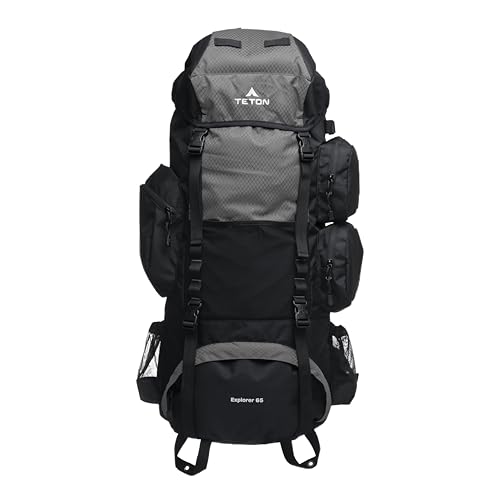


A backpack fits a bear canister when its main compartment is wide and tall enough to hold the canister horizontally near the bottom, close to the frame. Most panel-loading or top-loading packs 60 liters and larger manage this with a standard BearVault BV500; packs under 50 liters usually can't close around one without the canister riding above the collar.
How do you pack a bear canister in a backpack?
Pack the canister horizontally, on its side, low in the main compartment and against the back panel, then build the rest of your gear around and above it. This position keeps the pack's heaviest single item close to your center of gravity, which is more stable than stacking it vertically or high in the bag.
Soft items like a sleeping bag or clothing go below and beside the canister to fill gaps, since a cylindrical canister never fits flush against a rectangular pack body. Heavier items such as a stove, fuel, or a water filter sit just above it, keeping the overall load bottom-heavy and centered. Avoid packing the canister vertically near the top of the bag; it raises the load's center of gravity and makes the pack feel top-heavy on uneven trail.
Which packs fit a BV500 bear canister?
Packs with a wide, barrel-shaped main compartment fit a BV500 more easily than narrow, tall-and-slim designs, regardless of the total liter number on the spec sheet. A 65L pack built with a wide body, like the Osprey Atmos AG 65 or Gregory Baltoro 65, generally swallows a BV500 without the lid straining to close.
A pack's listed capacity is a volume total, not a shape guarantee, so two 60L packs from different brands can fit a canister very differently. Panel-loading packs, which open on the front like a suitcase, sometimes make loading a rigid canister easier than a strictly top-loading design, since you're not forcing it down through a narrow collar. Trying the actual canister in the actual pack before a trip is the only reliable check; canister diameter (about 8.7 inches for a BV500) is the number to compare against the pack's main compartment width.
Do smaller canisters fit mid-size packs better?
Yes: the smaller BearVault BV450, at roughly 8.3 liters, and the Garcia Backcountry Cache both fit into 45–55L packs more comfortably than a full BV500, since their reduced height and diameter leave more room for the rest of a multi-day gear list. A BV450 suits shorter trips or hikers who eat lighter, since it holds noticeably less food.
Choosing canister size against pack size is a genuine trade-off: a BV450 frees up pack volume but holds roughly three to four days of food for one person, while a BV500 holds closer to five to seven days but demands a larger pack to carry it comfortably. Hikers doing a five-night trip in bear country should size the pack around the canister they need, not the other way around.
Which national parks require a bear canister?
Several major backcountry destinations require a hard-sided bear canister rather than a hung food bag, including Yosemite, Sequoia & Kings Canyon, and sections of the John Muir Trail and Pacific Crest Trail that pass through them. Rules vary by trail segment and season, so checking the specific permit or ranger station requirements for a route matters before assuming a bag-hang or bear-bin setup is allowed.
Carrying the wrong storage method in a mandatory-canister zone can mean a citation from rangers, not just a bear-safety risk, so pack fit and canister choice are worth sorting out well before a trip. A canister that barely fits also makes packing slower each morning and evening, which adds up over a multi-night trip in already-limited daylight.