By Dana Okoro, Editorial Reviewer · Published September 14, 2026, 6:03 PM ET · Updated September 29, 2026, 6:16 PM ET
Direct Answer
Shoulder pain often means the hipbelt isn't carrying its share of the load — it's too loose, positioned wrong, or was tightened after the shoulder straps instead of before. Re-buckle the hipbelt over the iliac crest and tighten it first, then reset the shoulder straps without lifting weight off the hips.
In plain English
A hiking backpack holds its weight on your body in two main places: the shoulder straps and the hip belt, the padded belt that wraps around your hips. The hip belt is meant to do the heavy lifting. Your hip bones make a wide, sturdy shelf, while your shoulders are small and full of muscles and nerves that do not like being squeezed for hours.
When your shoulders ache, it usually means the shelf is not doing its job. The hip belt may be too loose, sitting in the wrong spot, or it was tightened after the shoulder straps, so the shoulders grabbed the weight first.
Think of carrying a heavy box. Hugging it against your belly is far easier than hanging it from your fingers. The fix is usually to loosen everything, buckle the hip belt snugly on top of your hip bones, and only then snug the shoulder straps just enough to keep the pack close to your back.
Shoulder pain on a loaded hiking backpack is a symptom, not a strap problem to fix by tightening the shoulder straps further. It often traces back to the hipbelt not doing its job of carrying the bulk of the load.
The most common cause
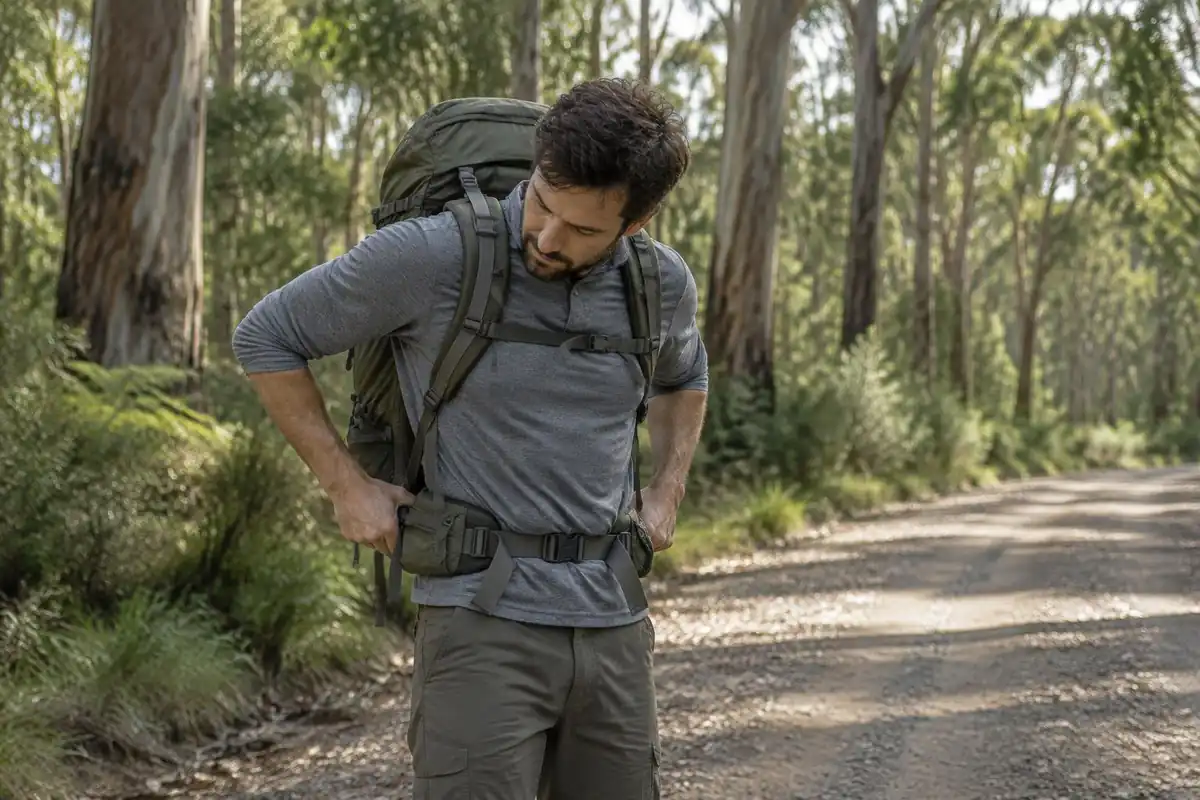
If the hipbelt is loose, positioned too high or low on the hips, or was tightened after the shoulder straps rather than before, the shoulders end up carrying weight that should be on the pelvis. Re-fitting starts by loosening everything and re-buckling the hipbelt first, centered over the iliac crest, before touching the shoulder straps again.
Other contributing causes
Wrong torso length: a pack sized too long or short for a hiker's torso can't route weight to the hips correctly regardless of how the hipbelt is tightened.
Load-lifter straps too tight: pulled past roughly 45 degrees, load lifters lift weight off the hipbelt and onto the shoulders even with a well-fitted belt.
Frameless pack under heavy load: without an internal frame or framesheet, there's no structure to route weight to the hips, so the shoulders carry more by design.
A quick diagnostic check
Check
If yes
Does the pack drop when you loosen the shoulder straps slightly?
Hipbelt is carrying weight correctly; shoulder pain likely has another cause
Does the pack stay in place with shoulder straps loosened?
Hipbelt isn't carrying its share; re-fit hipbelt first
Is the hipbelt sitting on the ribs instead of the iliac crest?
Torso length or hipbelt position needs adjustment
When to check pack weight itself
If the hipbelt is fitted correctly and shoulder pain persists, total pack weight relative to bodyweight is worth checking. A heavy load, including one near the common rule of thumb of about 20% of body weight, puts strain on the whole suspension system, hipbelt included, and no amount of strap adjustment fully compensates for carrying more weight than the pack and body can comfortably manage. If you feel numbness or tingling in your arms or hands, take the pack off and see a doctor if it persists.
How much weight should the hips actually carry?
This page says the hip belt should carry the bulk of the load, and pack makers agree in general terms. The exact share is contested. Big Agnes aims for about 80% of pack weight on the hips,1 the Washington Trails Association also says around 80%,2 and Alpkit gives a range of 60 to 80%.3 The US Army's foot-march manual paints a very different picture: with a pack frame and hip belt, it puts about 30% of the load on the hips and lower back and 70% on the shoulders.4
Those figures describe different packs, loads and ways of estimating, so none is a number you can check at home. What the research agrees on is direction. A study of load-carriage discomfort found the hip region tolerates pack pressure significantly better than the shoulder region, and its authors recommend shifting load from the shoulders to the hips wherever possible.5 A review of soldier load carriage likewise says hip belts should be used whenever possible because they reduce shoulder pressure and increase comfort.6
Why tighter shoulder straps make it worse
The same discomfort study found static strap force was a significant predictor of discomfort.5 Pulling the shoulder straps tighter to stop a pack sagging raises exactly that force. Deuter's fitting guide makes the point plainly: shoulder straps should not be over-tightened, because the waist belt should carry the main load.7 Kelty describes a correctly set shoulder strap as running over the shoulder and just beginning to angle down toward the pack.8
Strap height and shape matter too. Gossamer Gear notes that straps set too high pinch the neck, while straps set too low reduce weight transfer to the hip belt.9 ULA offers S-shaped straps for standard or sloping shoulders and J-shaped straps for flat or square shoulders,10 so a strap that digs in at one spot may simply be the wrong shape for your build.
Load lifters, the 20% figure and warning signs
The page warns against load lifters pulled past roughly 45 degrees. Makers give slightly different ideal angles: Big Agnes says 45 degrees,1 Deuter 30 to 45 degrees,7 and Alpkit 25 to 45 degrees from horizontal.3 Treat 45 degrees as the steep end of a range rather than the one correct setting.
The page also suggests checking whether the load nears 20% of body weight. That figure is a hiking-community rule of thumb with no primary study behind it. Deuter says people can carry a maximum of 20 to 25% of their body weight,11 and a study of Appalachian Trail long-distance hikers found they actually carried about 25% (men) and 28% (women).12 A lighter load is still easier on the shoulders, but 20% is not a line where pain begins.
Some shoulder symptoms are more than soreness. A review of military load carriage lists rucksack palsy among the common injuries of prolonged carrying,6 and another describes neurological injuries such as paresthesias, meaning tingling or pins and needles.13 If your arms or hands go numb, tingle or feel weak, take the pack off, and see a doctor if it does not settle quickly.