
Best Dry Bag For Backpacking
Best Dry Bag For Backpacking, ranked from aggregated owner ratings and reviews, not first-hand testing. Real pros, cons, and who each pick is best for.

Our Top 3 Picks
Quick Comparison
| Product | Best for | Buy | |
|---|---|---|---|
| Frelaxy Dry Bag 5 Pack | Top Overall Pick | See Amazon | View |
| Wise Owl Outfitters Waterproof Dry Bag 3-Pack | Best Value | See Amazon | View |
| Sea to Summit Ultra-SIL Dry Bag Set | Best Ultralight | See Amazon | View |
| Sea to Summit Lightweight Dry Bag | Best Compact Pack | See Amazon | View |
| Outdoor Products Ultimate Dry Sack 3-Pack | Also Great | See Amazon | View |
Choosing a dry bag for backpacking starts with identifying what needs guaranteed protection, then matching material, seal design, and capacity to that job.
What is a dry bag and how does it differ from a stuff sack?
A dry bag is a fully waterproof sack sealed with a roll-top closure, where the top is rolled down three or more times and buckled shut to compress trapped air and form a watertight seal; a standard stuff sack is typically just a drawcord-cinched fabric bag with no waterproof seal or coating. The roll-top mechanism is what makes a dry bag reliable even during a stream crossing or a sustained downpour, while a plain stuff sack only compresses gear and offers no water protection on its own.
What size dry bag do I need for backpacking?
Size the dry bag to the specific item or items it will hold rather than to the pack's total capacity, since most backpackers use several smaller dry bags — one for a sleeping bag, one for insulating layers, one small one for electronics and documents — rather than a single liner-sized bag. The table below gives typical size-to-use pairings.
| Dry Bag Size | Typical Use |
|---|---|
| 1–3 liters | Electronics, phone, wallet, small documents |
| 5–10 liters | Insulating layers, extra clothing |
| 13–20 liters | Sleeping bag on its own |
| 20 liters and up | Full pack liner replacing the main compartment's dry protection |
What material should a backpacking dry bag be made from?
Common dry bag materials include coated nylon and coated polyester, in a range of denier (thickness) ratings; a higher denier fabric resists abrasion and puncture better but weighs and packs more. Backpackers prioritizing minimum weight for electronics or a sleeping bag liner typically choose a lighter, lower-denier fabric, while those using a dry bag for repeated rough handling — canoe trips, scrambling, or frequent ground contact — benefit from a heavier, more abrasion-resistant fabric.
How many rolls does a roll-top seal need?
Most dry bag manufacturers recommend rolling the top down at least three times before buckling to form a reliable seal; fewer rolls increase the risk of the seal loosening under pressure or submersion. A dry bag that isn't fully filled leaves less material to roll, which is why slightly underfilling a dry bag — leaving room for a full three-plus rolls — improves the seal compared to stuffing it to capacity.
Dry bag or trash-bag liner — which for backpacking?
A dedicated roll-top dry bag offers a more dependable seal and far longer service life than a repurposed trash bag, which matters most on extended trips, in wet climates, or for gear where a soaking is a real problem, such as a sleeping bag or electronics. A trash-bag liner remains a workable lower-cost option for short trips in a fair-weather forecast, where the twist-and-fold closure only needs to hold up for a day or two.
Full Ranking, Reviewed
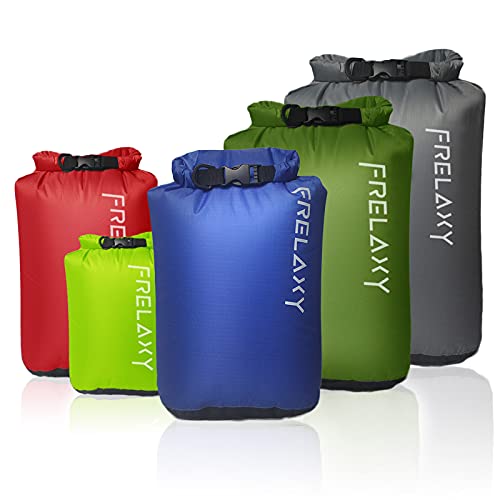
Best for Dry Bags for Backpacking
- 5–20 L capacity
- Polyester shell
- Keep Your Gear Organized
- Low carry weight pays off on big-mileage days
- Waterproof build keeps contents dry through real weather
- At 5–20 L it is best kept to shorter outings — it fills up once you add layers, lunch and water for a full day.
Verdict: This 5–20 L daypack keeps things refreshingly simple, making it the one we would grab first for Dry Bags for Backpacking.
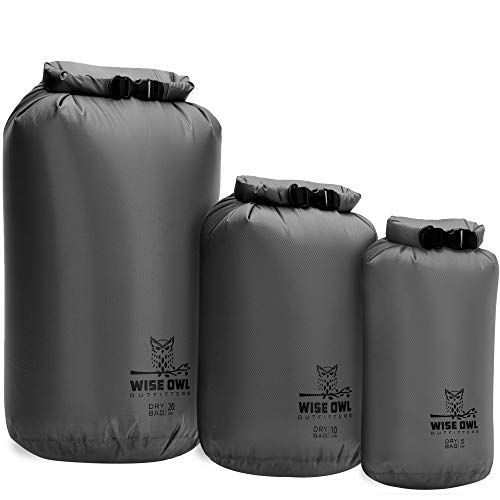
Best for Dry Bags for Backpacking
- 5–20 L capacity
- 190D ripstop nylon shell
- Padded laptop sleeve
- Lightweight and Compressible Design
- Ripstop fabric shrugs off scrapes and snags on the trail
- Low carry weight pays off on big-mileage days
- At 5–20 L it is best kept to shorter outings — it fills up once you add layers, lunch and water for a full day.
Verdict: This 5–20 L daypack pairs a tough ripstop shell with a packable build, making it a strong option for Dry Bags for Backpacking.

Best for Dry Bags for Backpacking
- 5–8 L capacity
- Cordura nylon shell
- Set includes three dry bags
- Ripstop fabric shrugs off scrapes and snags on the trail
- Low carry weight pays off on big-mileage days
- At 5–8 L it is best kept to shorter outings — it fills up once you add layers, lunch and water for a full day.
Verdict: This 5–8 L daypack offers a tough ripstop shell, making it an easy shortlist pick for Dry Bags for Backpacking.

Best for Dry Bags for Backpacking
- 5 L capacity
- Nylon shell
- Waterproof build keeps contents dry through real weather
- Built from hard-wearing nylon
- The 5 L capacity is snug for anything beyond a half-day on the trail.
Verdict: This 5 L daypack keeps things refreshingly simple, making it an easy shortlist pick for Dry Bags for Backpacking.
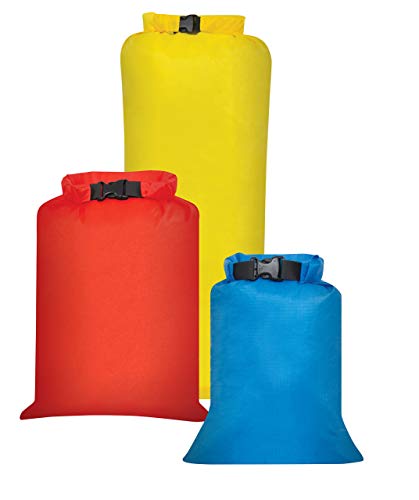
Best for Dry Bags for Backpacking
- 8 L capacity
- Ripstop fabric shell
- Tough, tear-resistant shell built for trail abuse
- Waterproof build keeps contents dry through real weather
- The 8 L capacity is snug for anything beyond a half-day on the trail.
Verdict: This 8 L daypack offers a tough ripstop shell, making it an easy shortlist pick for Dry Bags for Backpacking.
Frequently Asked Questions
Can I use one large dry bag instead of a rain cover?
A large dry bag lining the main compartment protects the contents but does nothing for the pack's outer fabric, zippers, or hardware, unlike a rain cover. The two solve different problems, and a dry bag used as a liner works best alongside a cover, not instead of one.
How long do dry bags typically last with regular backpacking use?
Service life depends on fabric denier, UV exposure, and handling, with lighter-denier bags wearing faster than heavier reinforced ones. Regular checks for pinholes, worn seams, and a roll-top seal that no longer buckles snugly indicate it's time to retire or patch a dry bag.