
Solo hiking safety tips
Hiking alone is quieter, more flexible and, for a lot of people, the best version of a day out. It also removes every backup a group gives you. These are the habits that make up the difference — a plan someone else holds, a trail matched to your experience, a way to call for help, and the discipline to turn around.

In plain English
Hiking alone can be calm and freeing. The catch is simple: if something goes wrong, there is nobody next to you to help or to walk out for help. So a solo hiker has to set up that help in advance.
The most important step happens before you leave home. Tell one reliable person exactly where you are going and when you will be back. Agree on a time when they should call for help if they have not heard from you. It works a bit like a smoke alarm. You hope you never need it, but it has to be set up before the fire.
On the trail, pick routes that are easier than your limit. Carry a light, a warm layer and a way to call for help that does not depend on phone signal. If you get lost, stop and stay where you are. People are found far more easily when they are not moving.
The short answer
Hike solo safely by leaving a detailed trip plan with someone who will act if you do not check in, choosing a trail well within your experience, carrying navigation, light and a satellite messenger, and setting a firm turnaround time you keep even when the summit is close.
Solo hiking is not inherently dangerous — the same terrain, weather and navigation problems exist whether you walk with three people or none. What changes is that nothing gets caught for you and nobody can go for help. Each habit below rebuilds a net a group gives you free.
Leave a real trip plan with a real person
If you adopt one habit from this page, make it this one. A trip plan is the difference between "nobody has heard from them, somewhere in the state" and a search that starts at the right trailhead within hours. It costs two minutes and works even when your phone and your judgment have both failed.
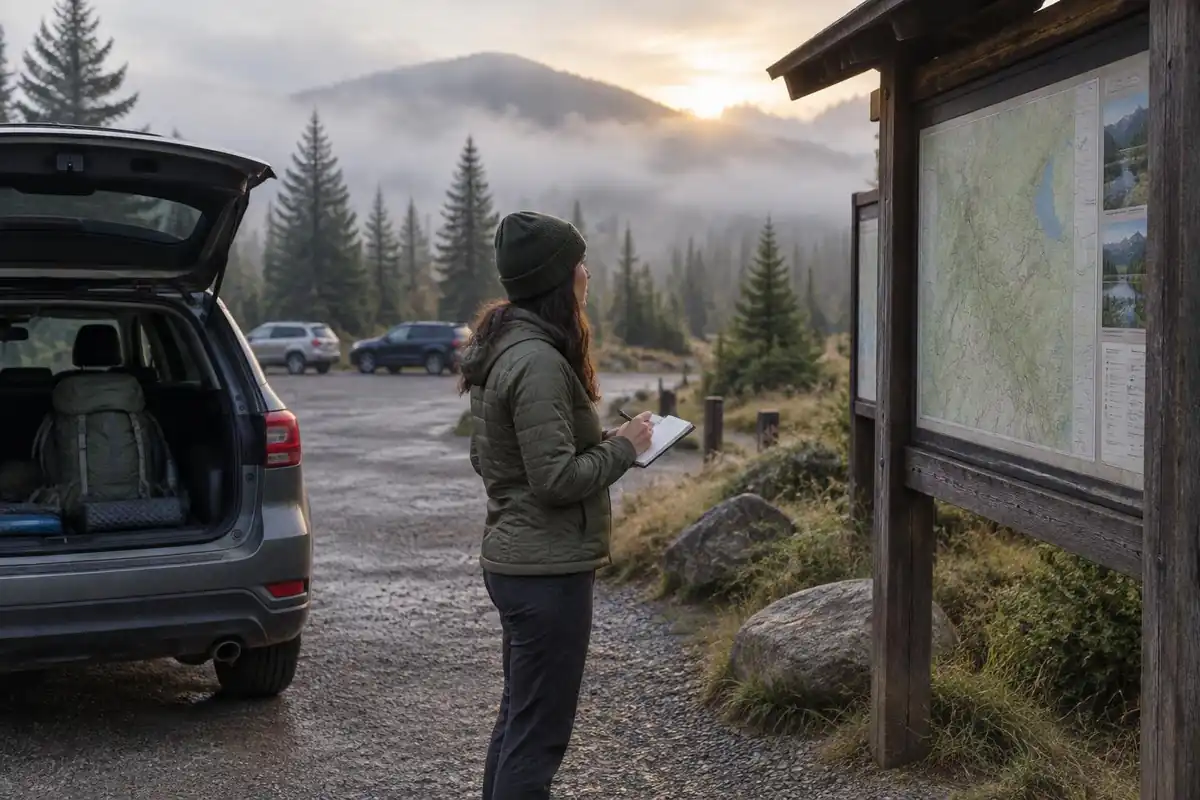
It has to go to a specific person who has agreed to hold it — not a story post or a group chat where everyone assumes someone else is watching.
- Where you are starting. The trailhead and its location, plus the make, color and plate of the car you leave there — a parked car is often the first confirmation searchers get.
- Your route. Trail names and junctions, the direction you are going, and where you plan to turn around. A screenshot of the map with your route on it beats a paragraph.
- Your expected return. The time you expect to be back at the car, and the time you expect cell service again — often two different things.
- Your call-for-help time. A specific hour, later than your expected return, after which they should start calling: back by 5, no word by 8, call.
- Who to call. In the US that is 911 in an emergency. For a late-return call, look up the non-emergency number for the agency that manages your trailhead before you leave.
- What you are carrying. Briefly — shelter, layers, headlamp, messenger — so responders know how long you can sit tight.
Close the loop. A trip plan only works if you check in when you are out. Forgetting to text after getting home is the most common way solo hikers trigger an unnecessary search — set a phone alarm for your return time.
Choose the trail to match solo you
Pick a solo route by assuming something goes mildly wrong — a rolled ankle, a missed junction, a storm an hour early — and asking whether you could handle it with what is on your back and nobody to help. A confident yes makes it a reasonable solo trail; anything that depends on everything going right is better with a partner.
That usually means your solo trails sit a clear step below your maximum. Popular, well-marked routes give you a passive safety net — other hikers who notice someone sitting in the wrong place, and a trail that is hard to lose. Remote or off-trail routes remove that net exactly when navigation gets harder.
Good solo choices
- Well-signed, regularly traveled day trails.
- Out-and-backs — you always know the way home.
- Routes you have already hiked with someone.
- Trails with a known bail-out point partway.
- Settled weather and plenty of daylight left.
Save for a partner
- Off-trail, cross-country or faint routes.
- Anything with scrambling or exposure.
- Creek or river crossings of any depth.
- Snow, ice or avalanche terrain.
- Remote areas with no traffic and no coverage.
Match risk to experience honestly. Plenty of capable hikers go solo in serious terrain, but they got there over seasons of navigation, weather-reading and self-rescue practice. Build the same base on forgiving ground — our map and compass guide covers the navigation half of it.
Communication and gear when there is nobody to help
In a group, gear is shared and problems get solved collectively — one person has the first-aid kit, another has signal, someone walks out. Alone you carry the whole system, and the item that changes most is communication.
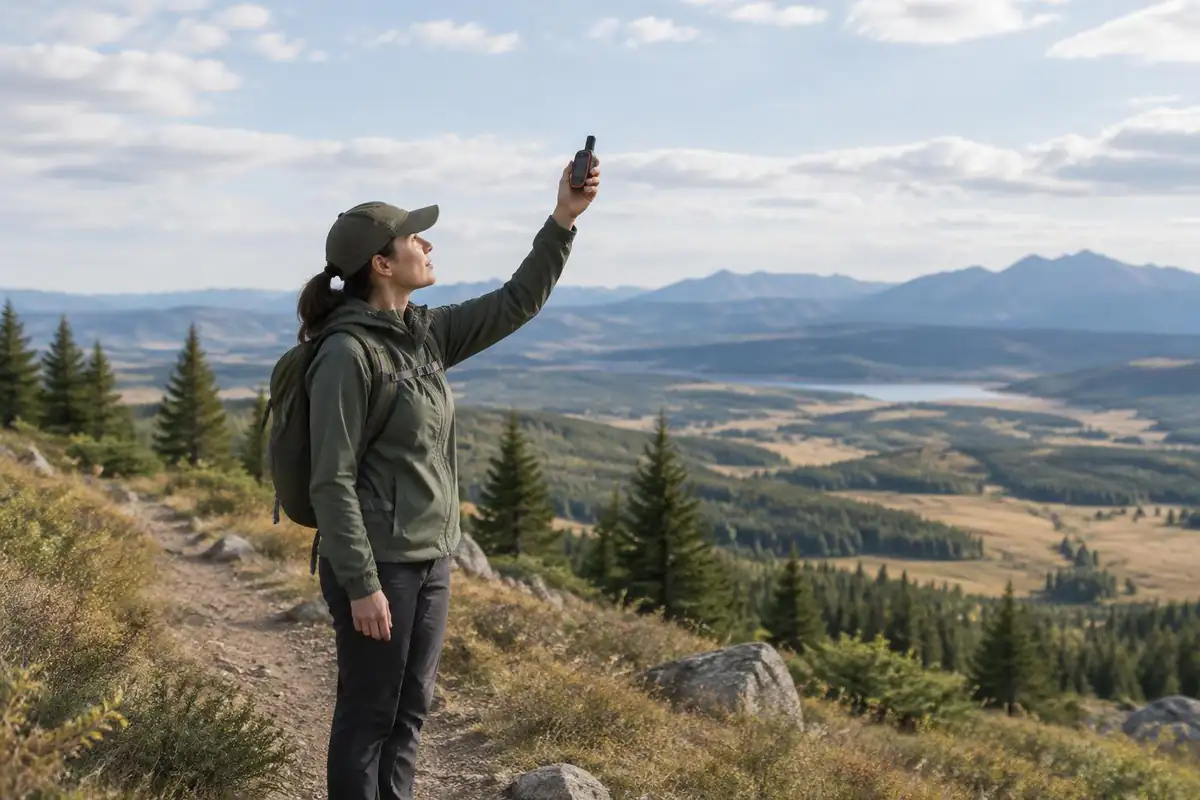
A satellite messenger earns its place fastest once you hike alone beyond cell coverage. It sends an SOS with your coordinates to a monitored response center and, just as usefully, sends routine two-way messages — so "slow going, out two hours late, all fine" reaches your contact instead of silence. Most need a subscription, so set that up before the trip.
Beyond the messenger, the solo adjustments to a normal pack are small but specific:
- Redundant navigation. Offline maps on the phone and a paper map and compass you can actually use. Solo, a dead phone with no backup is a real problem.
- Power and light. A power bank and a headlamp with fresh batteries, even on a short day hike — most unplanned nights out start as a slightly late afternoon.
- A first-aid kit you can work one-handed. Pre-cut tape, blister treatment, a pressure bandage and any personal medication.
- Emergency shelter and insulation. A bivy or space blanket and a warm layer turn "stuck until morning" into uncomfortable rather than dangerous.
- A loud whistle. A whistle carries farther than a tired voice and takes less energy than yelling.
None of this replaces training. Managing a real injury takes a hands-on wilderness first-aid course, and in a genuine emergency the right move is to call 911 or press SOS.
Pace and turnaround time with no group to slow you down
Solo hiking quietly encourages you to go faster than you should. Nobody is waiting, nobody suggests a break, and nobody is visibly tiring to tell you the group is done. The pattern is familiar: a fast morning, then an afternoon further out and more depleted than you meant.
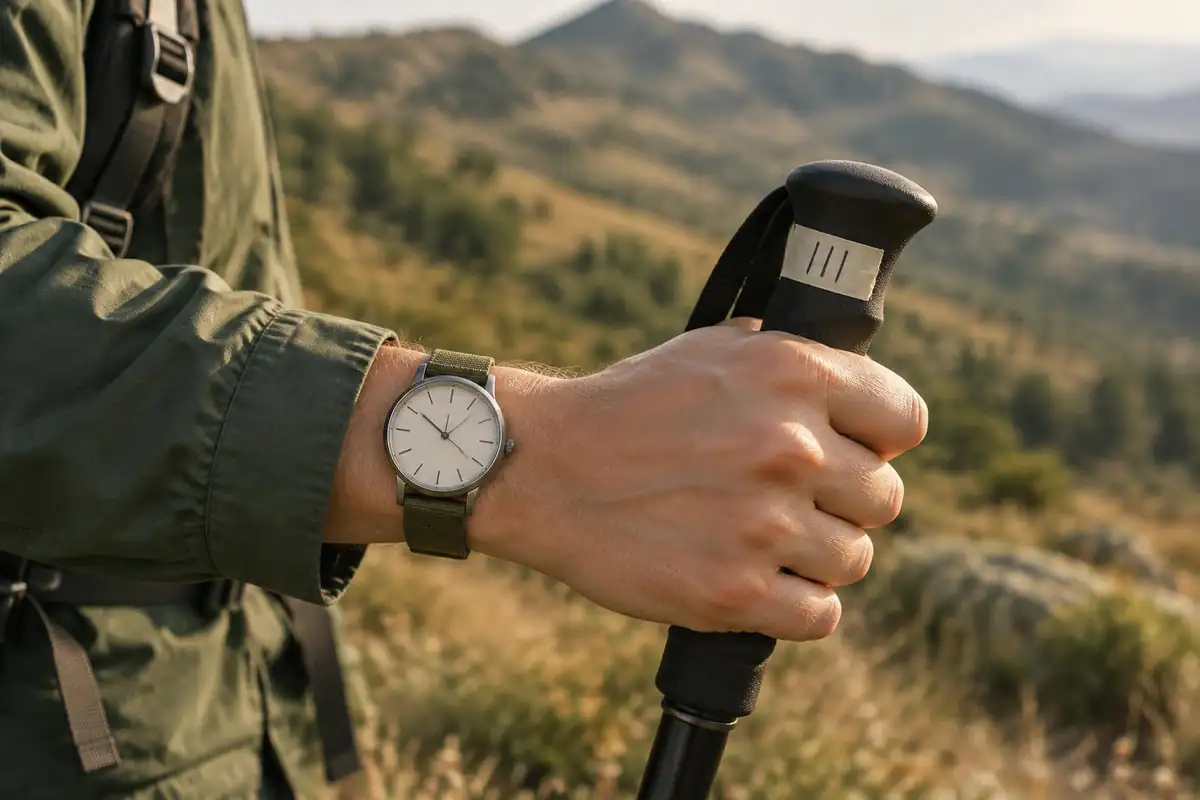
- Set the turnaround time before you start. Decide it at the car, from sunset minus the return time, plus a buffer. A time chosen in advance survives summit fever far better than one negotiated on the ridge.
- Hike at a conversational pace anyway. Even with nobody to talk to, that effort is the one you can hold for hours. If you could not speak a full sentence, you are borrowing from the afternoon.
- Schedule breaks instead of waiting for them. Every hour, stop to drink, eat and check the map. Solo, nobody else calls the break, and skipping food is how judgment degrades unnoticed.
- Check the clock at every junction. Compare where you are with where you expected to be. Running behind early is information, not a reason to hurry.
- Turn around at the time, not at the view. The turnaround is a promise to your contact as much as to yourself — they are expecting you at a specific hour.
The extra caution going alone earns
The last piece is not gear but a slightly different attitude to decisions. In a group you can afford marginal calls, because four people bring four chances to spot a mistake and four sets of hands if it goes wrong. Alone, take the conservative option earlier than you otherwise would.
- Update your contact when the plan changes. Swapped trails at the parking lot, extended the route, exiting a different way — send it while you still have signal. An out-of-date plan sends searchers to the wrong drainage.
- Trust your instincts and act early. A creek pushier than expected, a snowfield you would rather not cross, a person who makes you uneasy — the moment you notice is the moment you have the most options.
- Be more conservative with weather. Darkening skies or a shifted forecast are a reason to turn around sooner alone, because exposure, wet rock and lightning all get worse when you are the only one managing them.
- Avoid marginal route calls. If a junction is ambiguous, back up to the last point you were certain of rather than pushing on and hoping the trail reappears.
- Stay vague with strangers, politely. There is no need to announce that you are hiking alone or where you plan to camp.
- Sit down before you make it worse. Lost, hurt or rattled: stop, drink, eat and think. Most bad solo outcomes are a small problem made large by continuing to move on it.
This is general trail-craft, not emergency, medical or survival training. For real competence, take a wilderness first-aid or navigation course with a qualified instructor; if you are injured, lost or out of options, call 911 or trigger your messenger's SOS as soon as you can. The rest of the habits that keep hikes uneventful are in our hiking dos and don'ts.
What the official guidance says about going alone
The page describes solo hiking as not inherently more dangerous, because terrain and weather don't change with group size. The Park Service frames it more cautiously: it says hiking with a companion is safer and that solo hikers should take extra preparation measures.1 Both points can be true at once. The hazards are the same, but the response is slower when nobody is there to notice, give first aid or go for help.
Some settings move from extra caution to a firm no. The Willamette National Forest advises visiting the winter backcountry in small groups and never alone.2 In avalanche terrain, the Forest Service points out that rescue gear is useless if you travel alone, because a buried person cannot dig themselves out.3 For a solo hiker, those are routes to save for a partner rather than trips to prepare harder for.
Putting numbers on a turnaround time
A turnaround time is only as good as the estimate behind it. The classic starting point is Naismith's Rule: one hour for every three miles, plus one hour for every 2,000 feet of climbing.4 A University of Utah study of GPS data from nearly 30,000 people found that a slow walker takes about 33 minutes on a flat mile but about 97 minutes on a 30-degree slope, which is why steep sections break simple rules.4 The Park Service's own planning advice is to allow at least double the downhill time for uphill sections and to stick to the turnaround time you set.1
Then work back from darkness, not from sunset. The National Weather Service defines civil twilight as the period until the sun's center is 6 degrees below the horizon; during it, terrain is usually visible without a light, but once nautical twilight begins most outdoor activity needs artificial light.5 In a forest or a deep valley, plan as if that line comes earlier.
If something goes wrong with nobody else there
The Park Service's emergency guidance is direct: search and rescue can take hours or days depending on weather and resources, and if you are lost you should stay put unless there is an immediate threat to life, because moving makes you harder to find.6 A whistle carries further and uses less energy than yelling, and the light signal for SOS is three quick, three slow and three quick flashes.6 Bright clothing also makes you easier for rescuers to spot.7
Waiting is where cold becomes the main risk, and it is harder to spot alone. The CDC lists hikers among the people at higher risk of hypothermia and notes that the person affected may not realize it is happening; early signs include shivering, confusion, fumbling hands and slurred speech.8 With no partner to notice those changes, put on insulation early and eat while you still can. The Park Service also suggests learning CPR and basic wilderness first aid, especially for backcountry trips.1
Frequently asked questions
Is it safe for a woman to hike alone?
Broadly yes, and the core practices are the same for everyone: a shared trip plan, a trail matched to your experience, navigation, a way to call for help, and a firm turnaround time. Many women add habits like staying vague with strangers about hiking alone and starting on busier trails. The dominant hazards solo remain terrain, weather and getting lost.
What should I do if someone on the trail makes me uncomfortable?
Trust the feeling and act on it early, while you still have easy options. Keep moving, stay friendly but vague about your route, where you are camping, or that you are alone, and put distance or other hikers between you. Turning around, changing your route or waiting for a group to pass are reasonable choices, not overreactions.
Do I need a satellite messenger to hike alone?
Not for a busy front-country day hike with solid cell service. Once you are alone beyond coverage it becomes the most useful single item you can add, because there is no partner to walk out for help. It also lets you send a simple 'running late, all fine' message instead of triggering a search.
How do I leave a plan if I decide to hike at the last minute?
Send the details by text anyway: the trailhead and where you parked, your intended route, when you expect to be back, and when to start calling. A screenshot of the map with your route drawn on it and a photo of your car and plate takes seconds and gives searchers something concrete to work from.
Should a beginner hike alone?
It is better to build the basics with company first. Hiking solo removes your margin for error: nobody to catch a wrong turn, share gear, or go for help. Start with short, popular, well-marked trails you have already walked, in settled weather, and add distance and remoteness only as your judgment improves.