
Ultralight backpacking tips: how to cut base weight
Going lighter is mostly arithmetic and honesty: weigh everything, find the few items carrying the most weight, and decide which trade-offs you are genuinely willing to make. Here is how base weight works, where the real savings hide, and where cutting weight stops being smart.
In plain English
Ultralight backpacking is simply carrying less stuff and lighter stuff so that walking feels easier. The key number is base weight, which is everything in your pack except the food, water and stove fuel you will use up along the way.
Think of it like packing for a flight with a strict bag limit. You can't shrink the things you truly need, so you look for heavy items you could swap for lighter ones, and for things you packed just in case and never used.
The biggest wins usually come from the three biggest items: the backpack, the tent and the sleeping bag and pad. But lighter gear is often less tough and less forgiving. The goal is not the smallest number on the scale. It is the lightest pack that still keeps you warm, dry and safe on the trip you are actually taking.
The short answer
Ultralight backpacking means cutting base weight — everything in your pack except food, water and fuel. The fastest gains come from the Big Three: pack, shelter and sleep system. Replace those with lighter versions, carry multi-use items, and cut duplicates. Keep the Ten Essentials intact; weight saved is never worth safety lost.
What "base weight" actually means
Before you cut anything, you need the right number to cut. Base weight is the weight of your loaded pack minus consumables — food, water and stove fuel — because those get eaten, drunk and burned as you walk. It is the part of your load that stays the same on night one and night five, which makes it the honest measure of your gear choices rather than your trip length.
Two other numbers matter alongside it. Consumable weight scales with the trip: roughly a pound to a pound and a half of food per day for most hikers, and water at about 2.2 pounds per liter — which is why water carries dominate desert trips. Worn weight covers boots, clothing you hike in, trekking poles in your hands and a phone in your pocket. It is real weight on your body, but by convention it sits outside base weight, and quietly reclassifying a heavy jacket as "worn" is how people talk themselves into a lower number without carrying less.
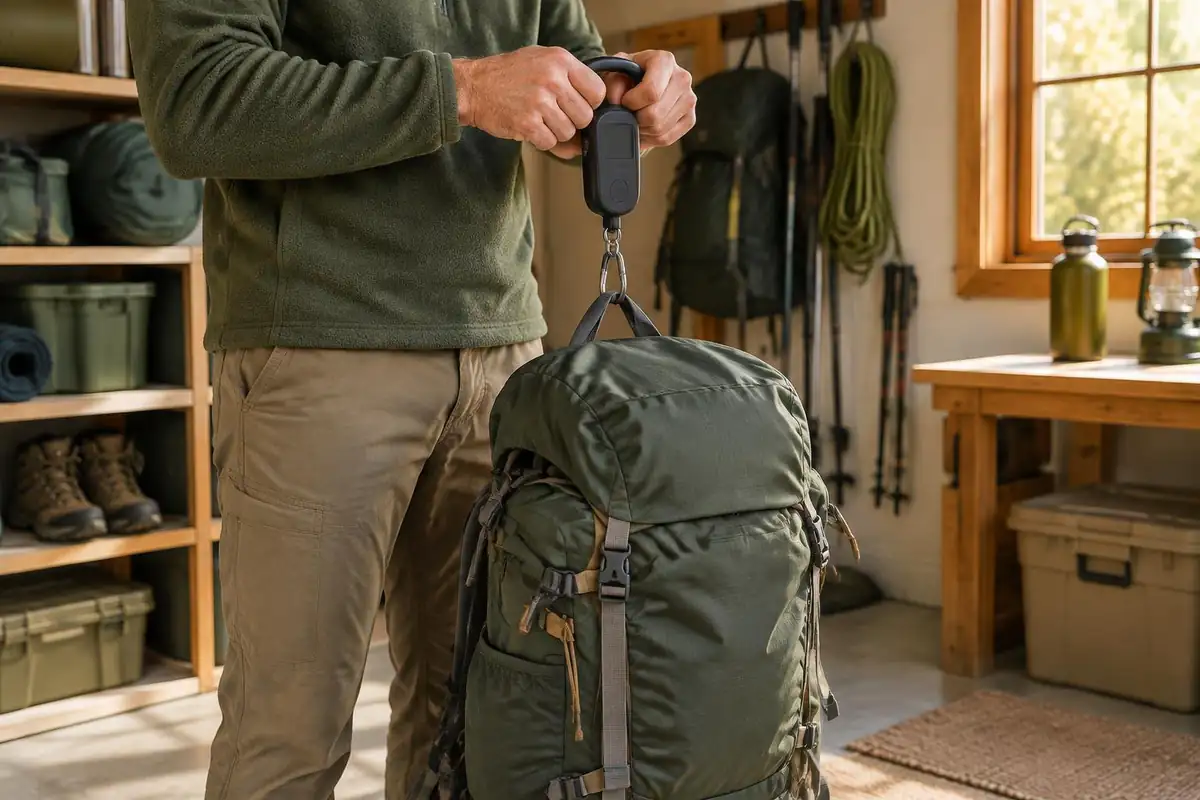
The practical step is to weigh every item individually on a kitchen scale and list it. That list is the whole exercise — you cannot cut what you have not measured, and people are consistently wrong about which items are heavy. Our base weight calculator does the adding up and shows which categories are eating your budget, which is usually more useful than the total on its own.
Start with the Big Three
Once the list exists, a pattern shows up almost every time: three items account for a large share of the total. These are the Big Three — pack, shelter and sleep system — and they are where the leverage is. Trimming half an ounce off a toothbrush is a rounding error next to a shelter that weighs four pounds.
- The pack. Traditional load-hauling packs carry weight beautifully because they contain a lot of structure: an internal frame, thick padding, a substantial hipbelt and heavy fabric. Lighter packs strip some of that out. This is also the item you should replace last, because a minimal pack only carries well once the rest of your base weight has come down — see our ultralight packs under 2 lb for what that category looks like and what it gives up.
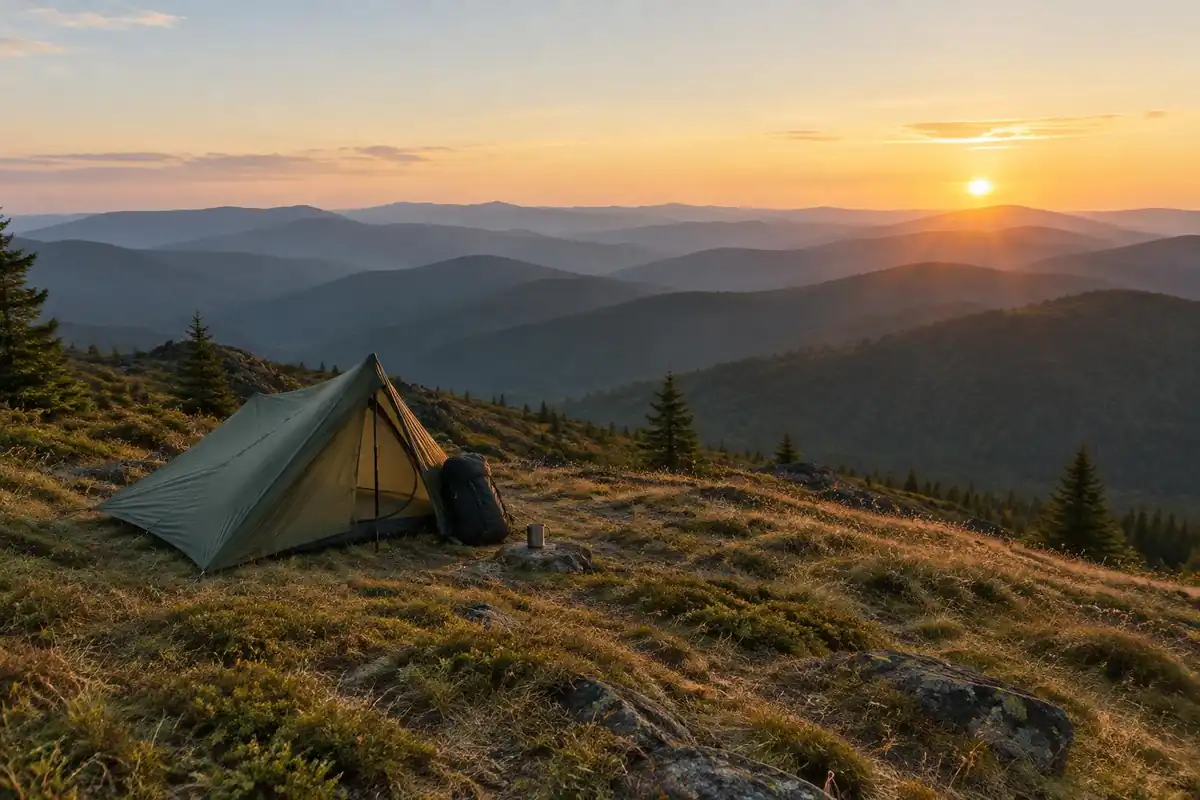
- The shelter. Freestanding double-wall tents are the most forgiving option and usually the heaviest. Semi-freestanding tents, trekking-pole tents, tarps and bivies step down in weight, and each step also steps down in weather protection, ease of pitching, condensation management or livable space. Tent poles are a common place to save weight, since a shelter that pitches with poles you are already carrying removes a whole component.
- The sleep system. Bag or quilt plus sleeping pad. A quilt drops the hood and the compressed insulation underneath you, which saves weight but demands more careful setup on cold nights. Temperature rating is the honest constraint here: a bag rated well below what you will actually encounter is dead weight, and one rated optimistically is a cold, miserable night rather than a clever saving.
Weigh before you shop. Run your current kit through the base weight calculator first. It is common to discover that one of the Big Three is already reasonable and a pile of small forgotten items is the real problem — which is a free fix rather than a purchase.
Cutting the ounces that add up
After the Big Three, weight comes out in small pieces. The philosophy is simple: every item should earn its place, and the best way to earn it is to do more than one job.
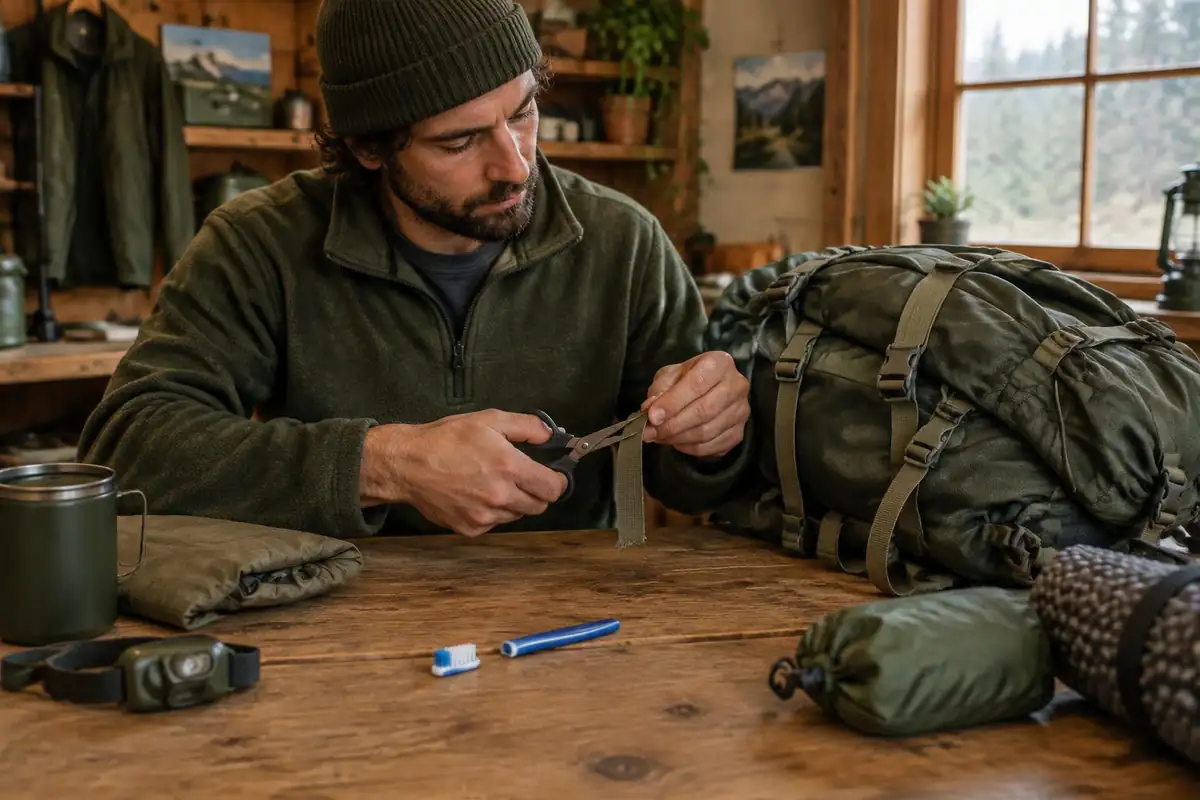
- Make items multi-use. A trekking pole pitches a shelter. A pot doubles as a bowl and a mug. A puffy jacket stuffs into a sack as a pillow. A bandana is a towel, a pre-filter and a sun cover. Each substitution removes an item rather than shaving one.
- Cut redundancy. Most packs contain quiet duplicates: two knives, a stuff sack inside a stuff sack, a full first-aid kit plus loose supplies, a power bank that could charge the group three times over. Pick one of each.
- Right-size the quantities. Repackage food out of retail packaging, decant toiletries into small bottles, and carry the number of days of supplies the trip actually needs rather than a comfortable margin on top of a comfortable margin.
- Carry water, do not hoard it. Water is heavy and frequently the single biggest weight on your back. Learn the reliable sources on your route and carry between them instead of topping off at every stream.
- Leave the just-in-case pile. The clearest signal is your own history: if an item came home unused on the last three trips and it is not a safety item, it is a candidate. Safety items are exempt from this rule, always.
The honest trade-offs
Ultralight is a set of trade-offs, not an upgrade, and it is not the right choice for everyone. A lighter pack is genuinely easier on knees, feet and morale, and it lets you cover more ground with less fatigue. It also asks for things in return, and pretending otherwise is how people end up with expensive gear that does not suit the hiking they do.
What you gain
- Less strain on knees, ankles and feet over long days.
- More miles for the same effort, or the same miles with energy left.
- Easier scrambling, stream crossings and steep descents.
- Faster packing — fewer items to organize and find.
- Lower injury and overuse risk on repeated long trips.
What it costs
- Durability: lighter fabrics and frames abrade and fail sooner.
- Comfort: thinner pads, less padding, tighter shelters, fewer luxuries.
- Cost: the lightest gear is usually the most expensive per ounce.
- Margin: less spare insulation or shelter when conditions turn.
- Skill required: minimal gear assumes you know how to use it.
Where you land on that ledger should depend on the hiking you actually do. Weekend trips on maintained trails in mild weather tolerate a light kit easily. Off-trail travel, shoulder-season cold, heavy brush or long food carries all push back toward sturdier gear and more margin. Hikers with an uncomfortable pack, a bad back or a long-standing injury often get more relief from a well-fitted pack than a light one — fit and load transfer are separate problems from weight, and solving the wrong one is a common, expensive mistake.
Realistic weight tiers
The community uses rough tiers to describe base weight. They are conventions rather than standards — nobody certifies them — but they are useful for knowing roughly where you sit and what a realistic next step looks like.
- Traditional: a base weight above any of the lighter tiers, with a sturdy freestanding tent, roomy pack and full-featured everything. Comfortable in camp, heavy on the trail, and where most people start.
- Lightweight: under 20 pounds by Gossamer Gear's definition. Usually reached by replacing one or two of the Big Three and doing a genuine cull of the small stuff. For most hikers this tier is the best value — a large share of the weight savings for a modest share of the cost and compromise.
- Ultralight: conventionally targets a base weight under 10 pounds. Requires deliberate choices across every category, usually a frameless or minimal pack, a trekking-pole shelter and a quilt.
- Super-ultralight: under about 5 pounds. A specialist pursuit with very little margin, appropriate for experienced hikers in conditions they know well.
Do not treat a tier as a goal in itself. The right base weight is the lightest one that still carries the gear your trip, your climate and your experience actually require.
Common ultralight mistakes
Almost every ultralight problem comes from one of these. Each is avoidable, and the first is the one that matters most:
- Cutting into safety margin. The Ten Essentials — navigation, sun protection, insulation, illumination, first aid, fire, repair kit, extra food, extra water, emergency shelter — are not where you find weight. Neither is your rain shell, your warm layer or your headlamp. Weight comes out of duplicates, packaging and comfort items, not out of the things that handle a night you did not plan for.
- Testing a new setup on a big trip. A lighter kit changes how you camp, not just what you carry. Quilts need drafts managed, thin pads need a smoother pitch, trekking-pole shelters need practice. Shake a new system down on a mild overnight close to the car before it has to work on a remote route.
- Buying before weighing. Shopping first usually means paying to replace items that were never the problem. Weigh, list, cull, then buy — in that order.
- Ignoring conditions to hit a number. Leaving insulation behind because it pushed the total over a target is how a cold, damp night becomes a serious one. Pack for the conditions you might actually get, not the ones that suit your spreadsheet.
- Overloading an ultralight pack. Minimal packs have low comfortable load ceilings. Loading one past its designed range is uncomfortable at best and hard on the pack at worst — the lighter pack has to come after the lighter kit, not before it.
This is general gear and trail-craft guidance, not safety or medical advice. Conditions, terrain and your own experience decide what you need to carry — when in doubt, carry the warmer layer and the extra margin.
Where the tier numbers come from
The weight tiers come from gear makers and trail organizations, not a standards body. The Appalachian Trail Conservancy defines base weight as pack weight with all gear, minus consumables such as food, water and fuel, and calls the pack, shelter and sleeping bag the big three because they are usually the heaviest pieces.1 Gossamer Gear sets lightweight at under 20 pounds, ultralight at under 10 and superultralight at under 5.2 Zpacks says ultralight is generally agreed to mean 10 pounds or less.3
One detail goes beyond those sources: the definitions cited here say nothing about worn clothing, so leaving worn items out of base weight is a community convention; apply it consistently if you compare numbers.
What a pound actually costs you
The case for going lighter has solid physiology behind it. In a lab study, energy use rose roughly in a straight line with pack load, by about 7.6 watts per extra kilogram.4 British infantry testing with 25 to 70 kg loads found metabolic cost rose about 1% for each extra kilogram.5 Where the weight sits matters too: a military review found each kilogram added at the foot raises energy use 7 to 10%, and each kilogram on the thigh about 4%.6 Lighter footwear can save more effort than the same weight trimmed from the pack.
Context helps set expectations. In a 2004 study of Appalachian Trail backpackers, men carried an average of 19.6 kg and women 17.3 kg, or about 25% and 27.9% of body weight.7 Frameless packs save weight but are much less comfortable under heavy loads, according to REI,8 which is why the pack is the last of the big three to downsize.
Consumables and gear you can't cut
Water is the heaviest thing most hikers carry. A liter has a mass of about 1 kg,9 and Guadalupe Mountains National Park advises a gallon per person per day, at about 8 pounds a gallon, which adds up to about 24 pounds for a three-day, two-night trip.10
Food is harder to pin down. The page's figure of a pound to a pound and a half per day is a common estimate, but this site's library has no official backpacking food-weight source. The best-documented energy figures are military: the National Academies put energy needs in the cold at 3,400 to 4,300 kcal a day.11 Research on endurance events also found that sustained energy use levels off below about three times basal metabolic rate, with digestion limited to about 2.5 times, so long trips draw on body stores.12
Some weight is set by law. Rocky Mountain National Park requires bear canisters for all wilderness overnights,13 Glacier Bay's loaner canister weighs 2.8 lb,14 and Denali's small container weighs 3 lb.15 Rules change, so check the park before planning your base weight around them.
Cutting sleep weight without guessing
Sleep systems are where optimistic numbers cause cold nights. Under the ISO rating system, the comfort rating is the temperature at which an average woman sleeps comfortably, the limit rating is where an average man stays in balance while curled up, and the extreme rating marks serious risk of hypothermia and is not a target.16 Pads are rated under ASTM F3340, which gives a repeatable comparison though real-world warmth can differ.17 Big Agnes suggests R-value 2 or lower for summer and 4 to 4.8 for spring through fall.18 Choosing by these ratings rather than by weight alone keeps the savings honest.
Frequently asked questions
What counts as ultralight backpacking?
The widely used rule of thumb is a base weight under about 10 pounds — everything in and on your pack except food, water and fuel. Gear makers define the tiers differently: Gossamer Gear, for example, calls anything under 20 pounds lightweight, under 10 ultralight and under 5 super-ultralight. Kits heavier than any of those are where most people start. The numbers are conventions, not standards, so treat them as reference points.
How much weight can I realistically cut?
Most people carrying a traditional kit can drop a meaningful chunk without buying anything, simply by weighing every item, removing duplicates and leaving behind gear they never used on the last few trips. Getting from there into true ultralight territory usually does require replacing the pack, shelter and sleep system, which is the expensive part.
Is ultralight gear less durable?
Often, yes. Lighter fabrics and thinner frames generally trade abrasion resistance and load capacity for weight saved, so an ultralight pack may need more care around granite, brush and overloading than a burly one. That does not make it fragile or a bad choice — it means the gear has a narrower operating range, and you should match it to the terrain you actually hike.
Do I need to buy all-new gear to go lighter?
No, and starting with a shopping list is usually the expensive way round. Weigh what you own first, cut what you do not use, and find multi-use replacements for single-purpose items. Once your kit is honest, you will know which one or two of the Big Three are actually holding your base weight up, and you can replace those deliberately rather than all at once.
Is ultralight backpacking safe?
It can be, provided the weight comes out of redundancy and comfort rather than safety margin. The Ten Essentials, adequate insulation for the coldest realistic conditions, a way to treat water and a working light stay in the pack regardless of base weight. Ultralight becomes risky when the target number starts deciding what gets left behind.