
Hiking with kids
Hiking with children is a different sport played on the same trails. The distance shrinks, the pace collapses, and the whole day turns on snacks and morale. Here is how to pick the right trail, keep small people moving, stay safe as a group, and redefine what a successful hike actually looks like.

In plain English
A family hike is a different activity from an adult hike. Kids walk slower, stop more and get tired, hungry, hot or cold faster than grown-ups do. Plan for that, and the day goes well.
The single most important safety lesson is easy to teach: if you get lost, hug a tree. That means stop, stay where you are and blow your whistle. Searchers find a child who stays still far faster than one who keeps walking. Practice it at home like a fire drill.
Let kids carry a small pack with a snack, water and a jacket so they feel like real hikers, but keep it light. The adults carry the real load. Bright clothes, frequent snacks and turning back early are all part of a good day, not signs of failure.
The short answer
Pick the trail for your youngest hiker, not your own ambitions: short, mostly flat, and with something worth looking at. Plan frequent snack and play stops, keep kids in sight, and teach them to stay put and blow a whistle if separated. Expect half the distance and twice the time.
Match the trail to the youngest hiker
Almost every miserable family hike starts with a trail chosen for the adults. The fix is a single rule: the least capable person in the group sets the plan. That means the three-year-old, not the ten-year-old, and certainly not the parent who used to knock out twelve-mile days before the kids arrived.
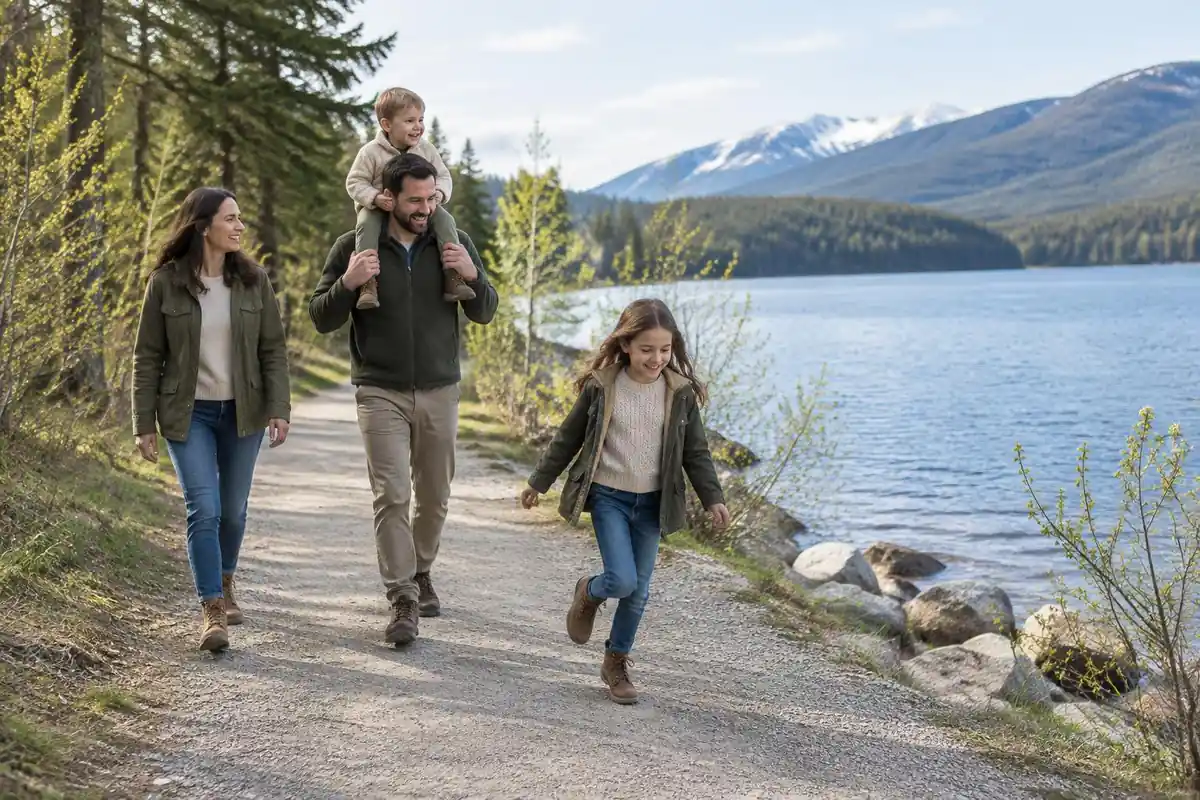
Distance is the smallest part of it. A mile of flat, shaded, well-graded path is a completely different proposition to a mile that climbs eight hundred feet over loose rock. Read the elevation gain before the mileage, and treat sustained climbing as the thing most likely to end the day early. Short legs cover less ground per step and burn through energy faster, so a grade that feels gentle to you can feel relentless to a small child.
Build in an early payoff. Children are far more willing to walk toward something than to walk for its own sake. A creek, a bridge, a waterfall, a boulder field, a lake to throw stones into — a concrete destination gives the hike a plot. Best of all is a payoff that arrives before the halfway point, so nobody has to be persuaded through an hour of nothing first.
Choose an out-and-back over a loop when you are still learning what your kids can handle. An out-and-back lets you turn around at any moment and call it a complete hike; a loop commits you to the whole distance the second you pass the point of no return. Wide, well-marked trails also beat narrow, exposed ones — not only for safety, but because a path you can walk two abreast on is a path where a child can hold a conversation instead of trudging behind you.
Finally, check the practical stuff before you leave: bathroom access at the trailhead, shade along the route, water availability, and how long the drive home will be once everyone is tired. A great trail two hours away is often worse than a good one twenty minutes away.
Keeping kids engaged, not just moving
Adults hike to get somewhere. Children hike to see what is there. Once you accept that, the tactics change: your job is less about maintaining pace and more about keeping curiosity alive, because a curious child walks a surprisingly long way without noticing.
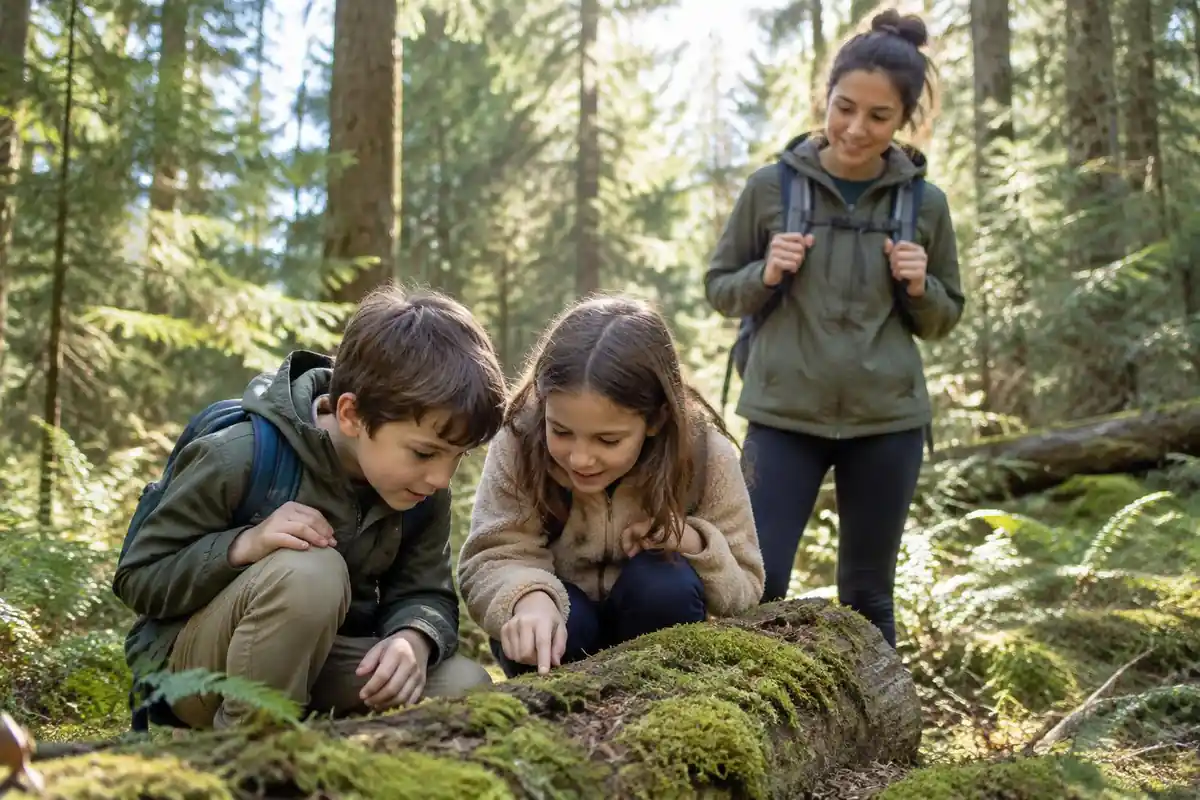
Give them a mission. A scavenger hunt written on an index card — a red leaf, a heart-shaped rock, three kinds of bird sound, something fuzzy — turns walking into searching. Photo challenges work for older kids, as does handing one child a cheap camera or a magnifying glass and letting them document the trip.
Let them lead. A child at the front of the group sets the pace, spots the trail markers, and takes a share of the responsibility, which is enormously motivating. It also slows everyone down, which is the point. Rotate the leader at every junction so nobody is stuck in the back for the whole hike.
Stop more than feels reasonable. Short, frequent breaks suit children better than long ones, and stopping before someone is exhausted is far more effective than stopping afterward. A good rhythm for young kids is a pause every fifteen or twenty minutes, even if it is only two minutes long.
Treat snacks as fuel and as pacing. Small, frequent snacks keep blood sugar and mood steady, and a snack held in reserve is the single most reliable tool for restarting a stalled child. Spread them out rather than handing over everything at the first complaint, and bring more than you think you need — hiking makes kids hungry in a way that a normal day does not.
Do
- Let a child lead and set the pace for stretches.
- Stop before anyone is exhausted, not after.
- Bring more snacks than seems sensible, in small portions.
- Give the hike a destination they can picture.
- Build in unstructured play time at the turnaround.
Don't
- Push through a meltdown to reach a viewpoint.
- Promise a distance you are not certain of.
- Hand out all the snacks in the first mile.
- Rush a child who has found something interesting.
- Start so late that the hike ends in a scramble.
Safety basics when you are hiking with children
Most family-hiking safety is ordinary trail-craft applied with a shorter leash. The two things that genuinely change are visibility — kids move unpredictably and disappear behind a bend fast — and the fact that children dehydrate, overheat and burn more readily than adults, so the margins are thinner.
- Set the sight rule out loud. Agree before you start that everyone stays where an adult can see them, and that nobody passes a junction without stopping. Repeating the rule at each trail split works better than announcing it once in the parking lot.
- Give every child a whistle and teach the response. The widely taught guidance for a lost child is to stop walking, stay put, and blow the whistle in sets of three. Standing still makes them far easier to find. Practice it at home so it is muscle memory rather than a rule they half-remember while frightened.
- Dress them to be seen. Bright colors are genuinely a safety feature in woodland and on rocky ground. A photo of each child taken at the trailhead that morning also means you can show searchers exactly what they are wearing.
- Sandwich the group. With two adults, one leads and one sweeps. With one adult, keep the child in front of you where you can watch them rather than behind you where you cannot.
- Plan sun and water around the kids, not yourself. Children have a higher surface-area-to-weight ratio and are often less inclined to stop and drink, so shade breaks, hats, sun protection and prompted sips need to be scheduled rather than left to instinct.
Beyond that, the general rules still apply: tell someone your route and return time, carry a light in case you are slower than planned, and turn back early rather than late. The full set is in our hiking dos and don'ts.
This is general trail-craft for families, not medical advice. Children vary enormously in what they can handle, and only you and your pediatrician can judge what is right for yours — ask them about any health concern, condition or age question before a trip, and use your own judgment on the day.
Gear that actually matters
Family hiking gear is less about buying more and more about getting three or four things right. Everything else can be borrowed, improvised or skipped.
For the youngest, the carrier is the whole trip. A framed child carrier is what makes hiking possible with a baby or toddler, and it stays useful long after a child can walk, because the ability to scoop up a tired three-year-old is what lets you finish the hike calmly. Fit matters twice over — the harness has to carry a live, shifting load on your hips, and the child has to be comfortable and supported up there. We cover frames, sizing, sun shades and how long a carrier stays worth using in the child carrier backpacks section rather than repeating it here.
Footwear is the next thing that will end a hike. Kids grow out of shoes constantly, and a shoe that fit in spring may be a blister factory by fall. Check fit before each trip, favor a closed toe and a grippy sole over anything specialized, and skip stiff boots for young children who mostly need flexibility. Socks matter as much as shoes: wool or synthetic, never cotton, and a dry spare pair in the adult pack.
Layers beat a single warm coat. Children heat up and cool down faster than adults, so a thin base layer, a fleece and a light waterproof shell give you far more control than one bulky jacket. Pack a complete change of clothes for anyone likely to find water, and a hat for both sun and cold.
Small packs for kids are about ownership. A child-sized daypack holding a snack, a water bottle and a jacket gives a child a sense of being a real hiker. Keep it genuinely light — the adults carry the actual load. Build the family kit from a standard packing checklist and then add the family-specific extras: wipes, a spare outfit, a trash bag, and considerably more food than you would carry alone.
What a successful family hike actually looks like
This is the part that determines whether your kids want to come back. A family hike is not a shorter version of an adult hike; it is a different activity with different goals, and measuring it against the hike you would have done alone guarantees disappointment for everyone.
A realistic good day might be a mile and a half in three hours, forty minutes of which were spent at one creek. Judged as a hike, that is a failure. Judged correctly, it is a complete success: nobody got hurt, nobody was miserable, and at least one child asked when the next one is. Distance is the metric that matters least.
Turning around early is a legitimate outcome, not a defeat, and treating it that way in front of the kids teaches them that stopping when you have had enough is a normal part of being outdoors. The alternative — dragging a tired child to a viewpoint they no longer care about — buys you one photo and costs you their enthusiasm for the next several trips.
Build tolerance gradually. Start with hikes that are comfortably within reach, finish while everyone is still having a good time, and let the distance grow on its own over seasons rather than weeks. Kids who associate trails with fun, snacks and a bit of freedom become teenagers who are willing to carry a pack. That, rather than any particular summit, is the long game worth playing.
Why 'stay put and whistle' works
The advice on the page matches the Park Service's own emergency guidance for adults. If lost, it says, stay put unless there is an immediate threat to life, because moving makes you harder to find, and use a whistle, which helps rescuers find you and saves energy compared with yelling.1 For a child, energy matters: a small hiker who shouts for an hour tires fast, while a whistle keeps working.
Search and rescue can take hours or days depending on weather and resources,1 so a lost child also needs to be findable and warm while waiting. The Park Service notes that bright clothing makes you easier for search and rescue to see,2 and it recommends leaving a trip plan with someone who is not on the hike.3 A spare layer in each child's pack is cheap insurance.
How much a child should carry
Guidance on children's pack weight comes from school-backpack research, and the figures differ. The American Academy of Pediatrics, through HealthyChildren.org, advises that a child's backpack weigh no more than 15% of body weight, carried on both shoulders.4 Nemours KidsHealth gives a wider range of 10 to 20%.5 A 2022 narrative review of backpack ergonomics sets a stricter ceiling of 10% of body mass for children.6
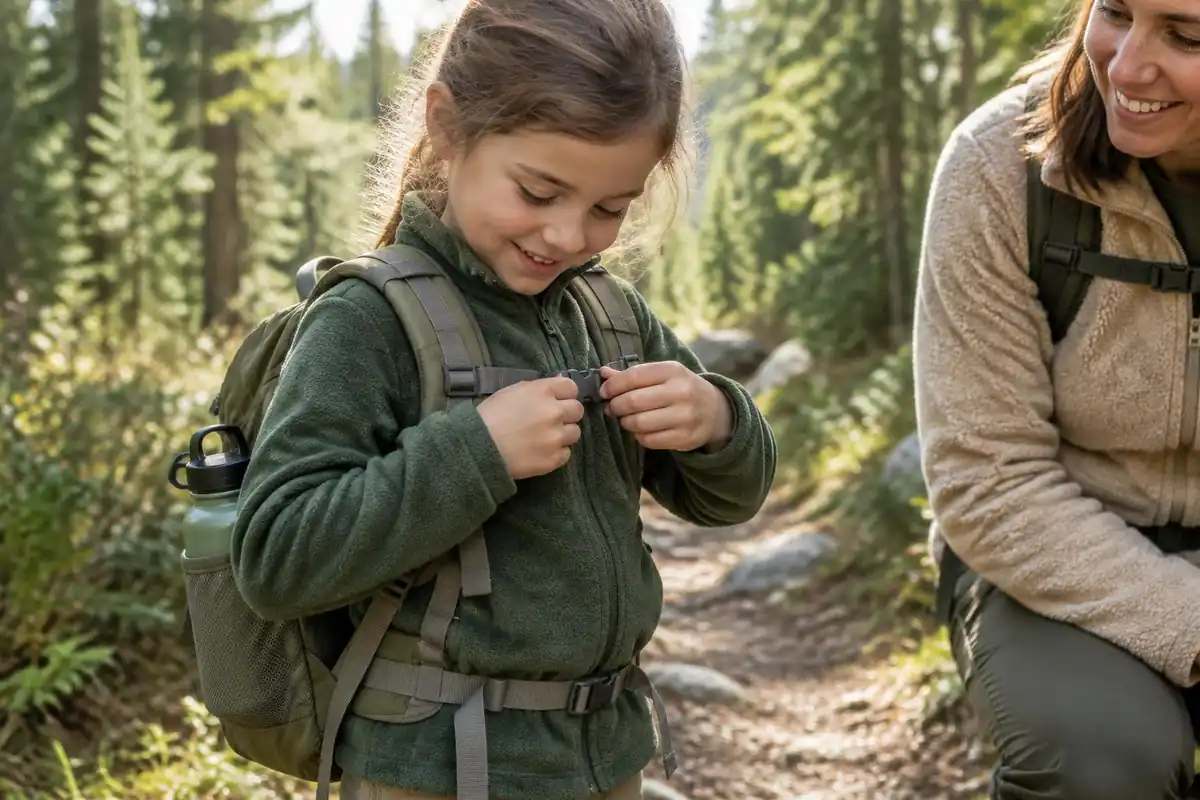
Deuter, a pack maker, puts it in kilograms: no more than about 1 kg for preschoolers and up to 3 kg for elementary-school children.7 In practice, a water bottle, a snack and a light jacket fit well inside all of these limits, which is exactly what the page suggests they carry.
Kids are more exposed than adults
Several hazards hit children harder. The EPA notes children are more exposed to wildfire smoke partly because they are more active and inhale more air per pound of body weight,8 so a smoky forecast is a stronger reason to postpone a family hike than a solo one.
Wildlife guidance singles out children too. The Park Service advises keeping children close in mountain lion country, especially at dawn or dusk, never running from a lion, and making yourself look larger.9 Children should also learn to walk in the center of the trail, which the CDC says reduces tick contact, and to expect a tick check after the hike.10 For any health question about your own child, your pediatrician is the right source.
Frequently asked questions
What age can kids start hiking?
Babies can ride along in a child carrier once they have steady head and neck control — commonly around six months, though that varies by child, and your pediatrician is the right person to ask about your own. Most toddlers start walking short stretches of easy trail somewhere around two or three, with plenty of carrying held in reserve.
How far can a young child hike?
There is no reliable formula, but a commonly repeated starting point is roughly half a mile per year of age for young children on easy terrain — about a mile and a half for a three-year-old. Treat that as a ceiling to test downward, not a target to hit, and let energy and mood decide the real number.
When can a child carry their own backpack?
Many kids enjoy carrying a small pack from around four or five, but it should hold almost nothing — a snack, a light jacket, their own water bottle. The pack is for ownership, not load. Older children can carry more as they grow, and any pack that makes them slower or grumpier is too heavy.
What should I teach my child to do if we get separated?
The widely taught advice is simple: stop walking, stay put, and make noise. Give each child a whistle on a jacket zipper, show them how to blow it in bursts of three, and tell them a searcher will come to them. Practice it in the yard first so it becomes a habit rather than a lecture.
Is a carrier better than letting a toddler walk?
Both, on the same hike. Many families let a toddler walk the first fresh stretch, then ride once the legs give out — which is why a carrier stays useful well past the age a child can technically walk. Having the option removes the pressure to turn back the moment someone tires.