
Hiking with dogs: a beginner's guide
A dog can be the best hiking partner you will ever have — but they cannot read the trail sign, judge the distance or tell you their paws hurt. This is the beginner's version: how to know if your dog is ready, what the rules actually are, what to carry, and the hazards that catch new dog-hikers out.
In plain English
Hiking with a dog can be one of the best parts of having one. It just takes a little more planning than hiking alone, because your dog cannot tell you when it is too hot, too far or too rough underfoot.
The first question is whether dogs are even allowed. Rules change from one park or forest to the next, a bit like how some shops welcome dogs and others do not. Check the land manager's rules for the exact trail before you drive.
Then plan for your dog the way you plan for yourself: water, snacks, a way to carry out their waste, and an eye on the weather. Dogs cool down much less easily than people do. On a warm day, a short early hike is kinder than a long afternoon one.
The short answer
Hiking with a dog works when the dog is fit for the distance, the trail actually allows dogs, and you carry water, a bowl, waste bags and basic first aid for them as well as yourself. Check leash rules with the land manager before you go, watch paws and heat, and turn back early.
Is your dog ready for the trail?
Dogs hide their limits. A dog will happily follow you up a mountain well past the point where they should have turned around, and do it without complaining — so the judgment has to be yours, not theirs.
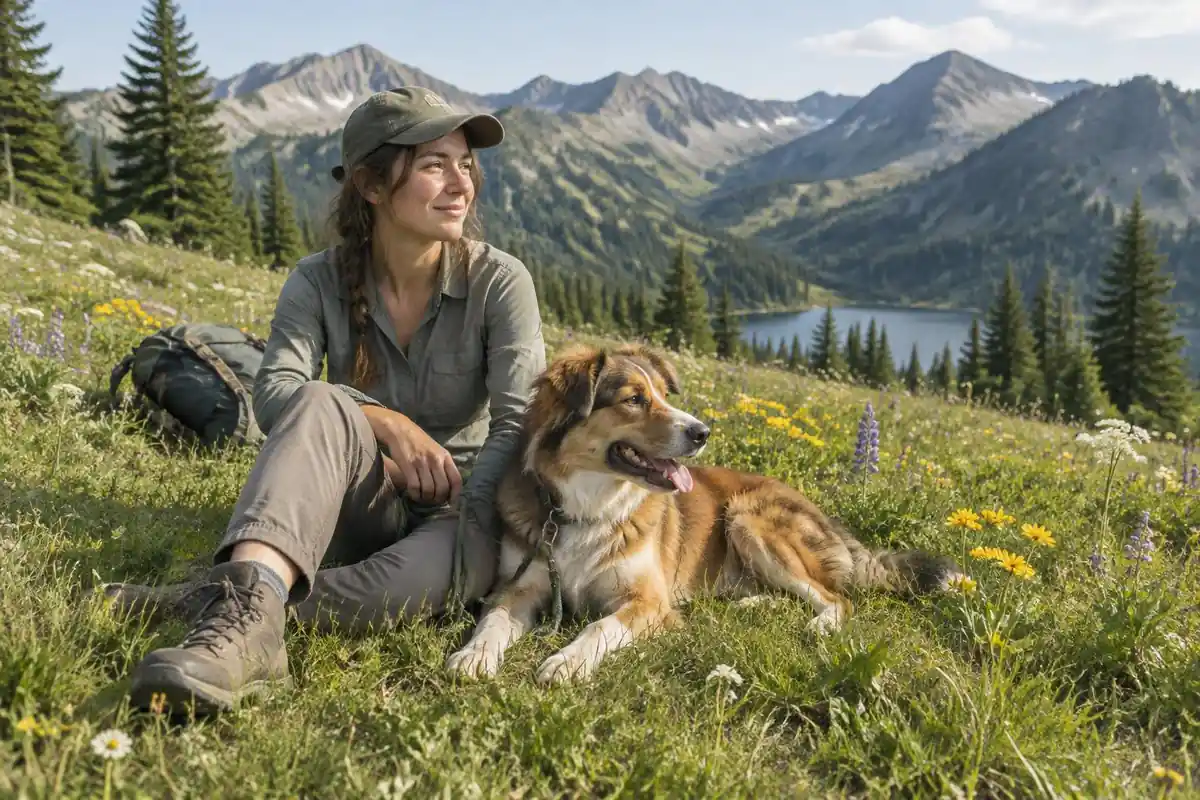
Think about conditioning the way you would for yourself. A dog whose exercise is a couple of neighborhood walks a day is not conditioned for eight miles and 2,000 feet of gain, however energetic they look at the trailhead. Build up over weeks with longer, hillier outings, and watch how they move the day after — stiffness or soreness the next morning means you went too far, too fast.
Age and build matter too. Very young dogs are still growing and older dogs may have stiff joints or less heat tolerance, so keep distances conservative for both. Short-nosed (brachycephalic) breeds generally struggle far more with heat and exertion, thick double coats hold heat, and short-legged dogs cover the same trail in a lot more steps. None of that rules a dog out — it changes what a sensible first hike looks like.
Temperament is the other half. A dog that lunges at passing hikers, cannot settle at a break, or ignores recall around wildlife is not ready for a busy trail yet, whatever their fitness. Work on that at home and on quiet local paths first.
This is general trail guidance, not veterinary advice. Your veterinarian is the right person to say whether your specific dog — their age, joints, weight, coat and breed — is suited to a given hike, and what preventive care they need first.
Trail rules and etiquette for dogs
The most common rookie mistake is assuming dog rules are national. They are not. Policy is set by whoever manages the land, and it can change from one side of a parking lot to the other: national parks, national forests, BLM land, designated wilderness, state parks and city trails all set their own rules, and some add seasonal closures for wildlife.
As a starting expectation, US national park units tend to be the most restrictive and often limit dogs to developed areas and a handful of paved paths, while national forests are frequently more permissive — but treat that as an expectation, never a guarantee. Always check the specific destination's current rules before you go, on the managing agency's own page or by calling the local office. Where leashes are required there is usually a maximum length, and a long flexi lead may not satisfy it.
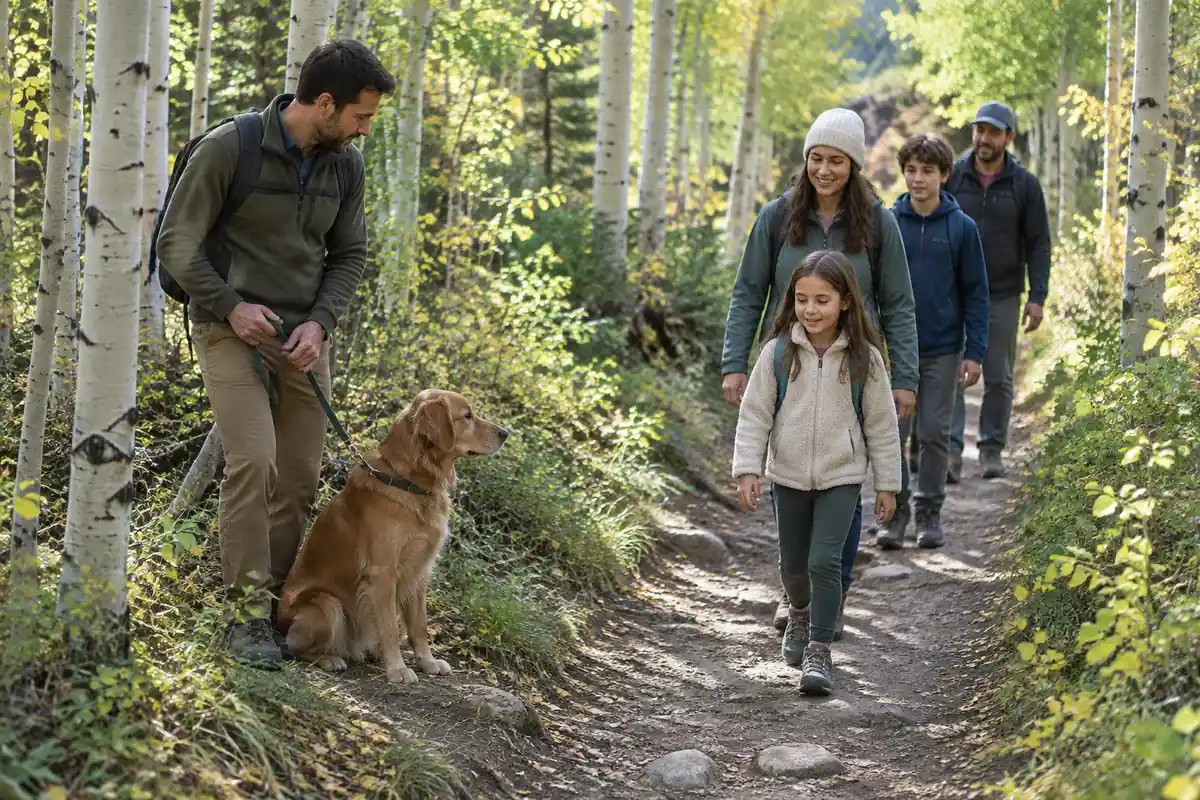
Etiquette is simpler. Keep your dog on the trail and on your side of it when you pass someone, and step aside with a shortened leash for hikers, runners, bikes and especially horses. Assume the person coming toward you is nervous around dogs until they say otherwise.
Waste is non-negotiable, and it is where dog owners lose the most goodwill: bag it and carry it out. A bagged pile left beside the trail "to grab on the way back" is litter, and it is very often forgotten. The rest of the trail-sharing basics are in our hiking dos and don'ts.
Do
- Check the managing agency's dog rules for that exact trail, before you drive.
- Use a fixed-length leash that meets the local limit.
- Pack out every bag of waste, every time.
- Step off and shorten the leash when yielding to others.
- Fit a collar or harness with current ID tags.
Don't
- Assume dogs are allowed because they were on a nearby trail.
- Let your dog greet other dogs or hikers without asking first.
- Leave bagged waste beside the trail to collect later.
- Let a dog off leash where it is not permitted.
- Let your dog cut switchbacks or trample vegetation.
What to pack for a dog
A dog roughly doubles the number of things that can go wrong, so the kit is small but worth being deliberate about. Add these to your own packing checklist rather than swapping anything out of it.
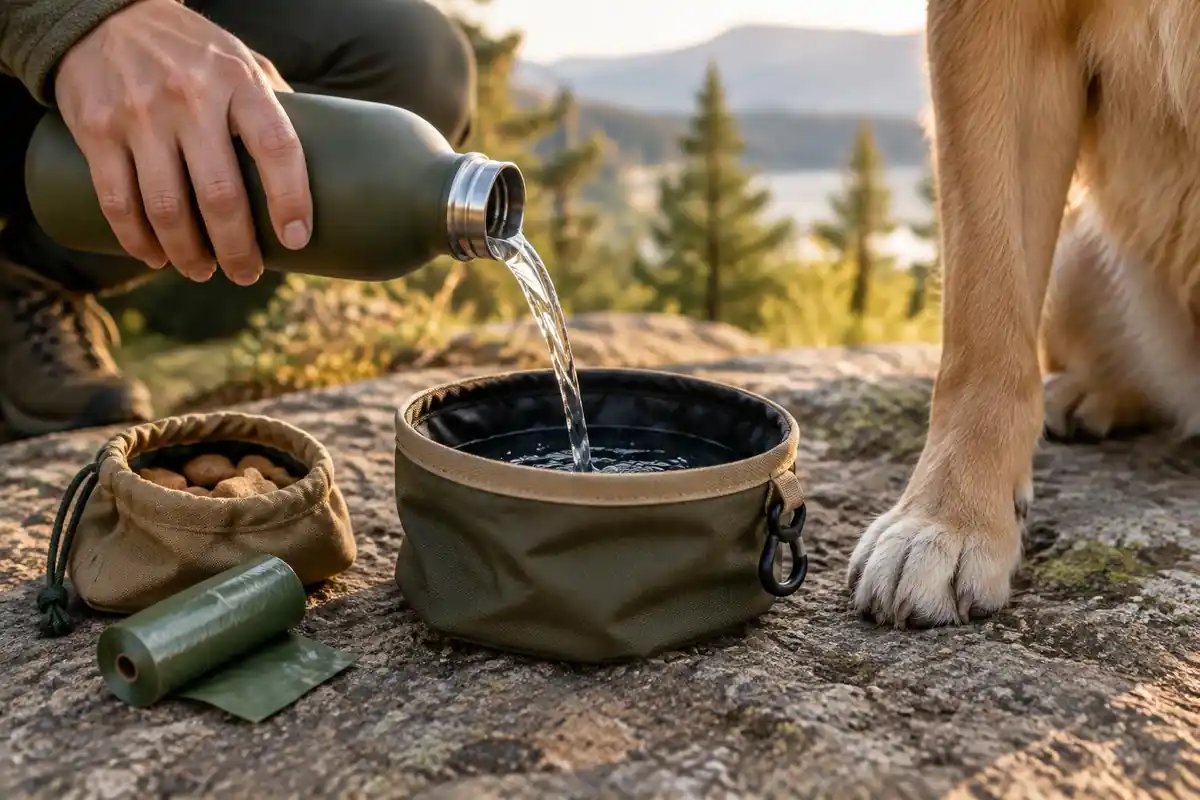
- Water — more than you expect. Do not plan around streams being there, flowing, or safe. Offer water at every break rather than waiting for the panting to get dramatic.
- A collapsible bowl. Dogs drink badly from bottles and cupped hands, and a bowl is the difference between water carried and water drunk.
- Food or snacks for any hike long enough that you would want one yourself, plus a little extra in case the day runs long.
- Waste bags and something to carry the used ones in — an outer pocket or a dedicated dry bag keeps that job civilized.
- A leash and a spare, plus a well-fitted harness or collar with ID. A snapped clip miles from the car is a bad afternoon.
- Dog-specific first aid basics alongside your own kit — typically self-adhesive wrap, gauze, tweezers for splinters and ticks, and a way to protect a cut pad. Ask your vet what belongs in yours.
If you refill from natural water sources, the same logic applies to your dog's bowl as to your own bottle — see water treatment methods for hikers before you scoop from a stream.
Dog packs let a conditioned dog carry some of their own water and gear, and they are a real product category worth browsing in our gear guides. Treat one as a training project, not an accessory: fit matters as much as it does on your own pack, the load should start at essentially nothing and build very gradually, and a loaded dog balances and squeezes through gaps differently. How much any dog can reasonably carry varies enormously, so ask your veterinarian rather than trusting a rule of thumb from the internet.
Paws, heat and trail hazards
Paws take the brunt of hiking, and they cannot be re-laced or loosened. Check them at every break — between the toes as well as the pads — and stop at the first sign of wear rather than the first limp. Granite, scree, sharp lava rock and long descents abrade pads faster than soft dirt, and pads used only to sidewalks wear quickly on their first real trail.
Hot surfaces are the hazard people underestimate. Asphalt, slickrock and bare stone hold far more heat than the air temperature suggests, and a surface you would not comfortably rest the back of your hand on is too hot for paws. Winter brings the opposite problems: ice balls packing between the toes, and de-icing salt on approach roads. Boots help in both cases, but introduce them at home first — most dogs walk like cartoon characters in them at first.
Heat itself deserves real caution. Dogs shed heat far less efficiently than we do, they are working harder than you at the same pace, and they are closer to the reflected heat of the ground. Hike early, use shade, keep water going in, and be willing to cut the day short. If a dog seems distressed, disoriented or is struggling to recover at rest, get them into shade and cool air and contact a vet — heat illness is an emergency, not something to push through.
Finally, the small stuff that hitches a ride: ticks in brushy country, burrs in the coat, and grass awns or foxtails, which can work their way into ears, noses, eyes and between toes. Check thoroughly at the car and again at home, and talk to your vet about tick prevention for the areas you hike.
Wildlife and other hikers
A dog changes your relationship with wildlife, and usually not in your favor. Dogs chase, dogs get chased, and dogs are very good at finding the one animal you would rather have walked past — porcupines, skunks, snakes, moose, and in some places bears. A loose dog can also bring an agitated animal straight back to you at speed. The most effective control for all of it is a leash, which is part of why leash rules exist.
Respect the wildlife side of it too. Dogs stress nesting birds, deer and small mammals even when they never make contact, which is exactly why many sensitive areas restrict dogs seasonally or entirely. Keeping your dog on the trail and under control is the whole ask.
With people, work from the assumption that your dog is yours to manage and nobody else's to enjoy. Children move unpredictably, runners appear quietly from behind, and plenty of hikers have a reactive dog of their own and are hoping you will give them room. A cheerful "can I let them say hello?" — and a graceful acceptance of "no thanks" — covers almost every encounter.
This is general trail-craft for dog owners, not veterinary or emergency advice. For anything concerning your dog's health, fitness or injury, consult your veterinarian; for your own emergencies on trail, call your local emergency number (911 in the US).
Why the rules vary so much
Dog rules on public land are set by the land manager, and the differences are real. The National Park Service says many parks prohibit pets on trails and advises checking first; where dogs are allowed, it asks for a six-foot leash.1 Its B.A.R.K. Ranger program sums up park expectations as bag your pet's waste, always leash, respect wildlife, and know where you can go.2
National forests work differently. Gifford Pinchot National Forest requires six-foot leashes in developed recreation areas, but most of the forest has no leash requirement, though some individual trails do. Dogs may not chase game animals anywhere.3 That is one forest's policy, not a national rule, so the page's advice to check the specific destination stands. A long retractable lead often will not meet a six-foot limit.
Heat, water and pacing for a dog
The Park Service states plainly that dogs are at higher risk of overheating.1 The practical consequence is that your comfort is a poor gauge for theirs. Plan dog hikes for the cool part of the day, favor shaded routes, and choose trails with breaks you can take in shade, not just a destination at the top.
Water planning follows the same logic as for people, with one addition: do not count on streams. Natural water may be dry by late summer, and the CDC notes that even clear mountain streams can carry germs.4 Carry what your dog needs from the trailhead. For anything about your own dog's heat tolerance, breed or fitness, your veterinarian is the right person to ask.
Ticks, wildlife and hunting seasons
The CDC says ticks are most active from April through September, though exposure can happen year-round, and that walking in the center of trails and avoiding high grass and leaf litter reduces contact.5 Keeping a dog on the trail helps with ticks and with the wildlife rule the Park Service applies to everyone: observe animals from a distance and never feed them.6 Ask your vet about tick prevention for the areas you hike.
In fall, remember that many public lands allow hunting. Hunting is authorized in 76 Park Service units, mainly national preserves rather than national parks proper.7 The Forest Service recommends blaze orange for hikers in all major firearm seasons and warns not to assume hunters will hear you.8 Many owners extend that logic to their dog with a bright vest or collar.
Frequently asked questions
Can dogs hike in national parks?
It depends entirely on the land manager, so check the specific destination before you drive. Many US national parks limit dogs to developed areas, campgrounds and a small number of paved paths rather than backcountry trails, while national forests and many BLM lands are often more permissive. Rules also change seasonally, so confirm the current policy.
How far can a dog hike in a day?
There is no universal number — it depends on the individual dog's age, build, fitness and the weather, not just the mileage. Build up gradually over weeks the same way you would for yourself, start well under what you think the dog can handle, and ask your veterinarian what is reasonable for your specific dog.
How much water does a dog need on a hike?
More than most people bring, and you should carry it rather than count on the trail. Offer water at every break instead of waiting for obvious thirst, and bring a collapsible bowl so the dog can actually drink it. If you plan to refill from a stream, treat that water the same way you treat your own.
Should my dog be off leash on the trail?
Only where it is explicitly allowed and only if your recall is reliable under real distraction — wildlife, other dogs, bikes. Many trails require a leash of a set maximum length, and an off-leash dog is the single most common complaint other hikers have. When in doubt, leash up and check the local rule.
Do dogs need boots for hiking?
Not usually on soft dirt trails, but they help on hot rock, sharp scree, ice or de-icing salt. Introduce them at home first, because most dogs need time to walk normally in them. Check paw pads at every break regardless — cuts, cracks and worn pads are easier to catch early than to hike out on.