
Best Hiking Backpack With Detachable Daypack
Best Hiking Backpack With Detachable Daypack, ranked from aggregated owner ratings and reviews, not first-hand testing. Real pros, cons, and who each pick is best for.


Our Top 3 Picks
Quick Comparison
How does a detachable daypack conversion work?
A detachable daypack conversion works by unclipping the lid or brain from the main pack body, usually via two or four side-release buckles, and reattaching it to a waist strap or the pack's own hipbelt. The converted piece then functions as a small lumbar pack or summit pack, typically sized between 5 and 15 liters.
The lid stays connected to the main pack through the same straps used to secure it as a top pocket; those straps simply reroute around the wearer's waist once detached. Some designs, including the Osprey Aether and Ariel AG series, build a dedicated waist strap into the lid specifically for this purpose. Others use the pack's hipbelt itself, meaning the main pack's hipbelt has to come off before the lid can go on.
What size daypack conversion do you actually need?
A detachable daypack conversion in the 5-10 liter range suits short day trips carrying water, a snack, and a light layer, while a 10-15 liter conversion fits a rain shell, a first-aid kit, and lunch for a longer day trip from camp. Larger conversions add carrying capacity but also add weight to the main pack when the lid stays attached.
Sizing here is a trade-off. A larger detachable lid earns more use on day trips but also adds bulk and weight to the main pack for the majority of the trip when the lid isn't detached. Hikers who plan mostly short exploratory walks from camp get more value from a smaller, lighter lid, while hikers summiting from a high camp with a full day's gear list benefit from the larger option.
What should you look for in the conversion itself?
Look for a lid that includes its own waist strap or a way to secure it around the body once detached, a stable connection that won't sag or bounce while worn as a daypack, and enough internal organization, such as a zippered mesh pocket, to keep small items from sliding around.
A few features separate a conversion that works well from one that's merely present:
- A dedicated waist strap built into the lid, rather than one borrowed from the main pack's hipbelt
- Side-release buckles rated for repeated daily attachment and removal without wearing out
- An internal zippered pocket for a phone, keys, or a permit
- A stable, low-bounce fit when worn on its own rather than sagging away from the body
Who benefits most from this feature?
Hikers who set up a basecamp and explore from it, climbers summiting from a high camp, and backpackers who want the option to leave the loaded main pack behind all benefit from a detachable daypack. Hikers who rarely stop moving long enough to use a separate daypack, including most thru-hikers and fastpackers, get little practical use from the feature.
Basecamp-style trips, common in national parks with backcountry camping zones, are where this feature earns its keep: a hiker sets up camp, then explores nearby trails or a summit route carrying only the detached lid instead of the full loaded pack. Multi-day trips with a rest day built in also benefit, since the rest day becomes an opportunity to explore lighter.
Trips built around constant forward movement, where a hiker breaks camp every morning and doesn't return to the same site, rarely create a situation where detaching the lid makes sense. For those trip styles, the extra straps, buckles, and hardware that make a lid detachable mostly add weight without adding function.
What are the trade-offs of a detachable daypack pack?
The main trade-off is weight: the hardware that lets a lid detach and convert into a daypack adds several ounces over a simple fixed lid or no lid at all, a real cost on trips where the feature never gets used. A detachable lid can also fit slightly less securely as a lumbar pack than a purpose-built daypack.
Hikers weighing this feature should honestly assess how often a basecamp or rest-day exploration trip actually happens versus how often the pack is used for point-to-point travel where the lid stays attached the whole time. A hiker who takes one basecamp trip a year but backpacks point-to-point the rest of the time may find the added weight isn't worth carrying on every other trip, while a hiker who regularly bases out of one camp gets consistent use from the feature.
Full Ranking, Reviewed

Best for Packs With a Detachable Daypack
- 15 L capacity
- Nylon shell
- 13 oz empty
- Detachable External Storage Pouch
- Light enough that you forget you are wearing it
- Plenty of pockets keep small gear sorted and findable
- The 15 L capacity is snug for anything beyond a half-day on the trail.
- Water-resistant shell handles showers, but a liner or cover is wise for all-day rain.
Verdict: This 15 L daypack keeps things refreshingly simple, making it our overall pick for Packs With a Detachable Daypack.

Best for Packs With a Detachable Daypack
- 19 oz empty
- Padded hip belt
- Dual Main Compartments & Multi-Pocket Organization
- Padded hip belt shifts load onto your hips, not your shoulders
- Light enough that you forget you are wearing it
- Colours and exact capacity options change often on Amazon — confirm the current variant on the listing before buying.
Verdict: This hiking pack offers real hip-belt support, making it an easy shortlist pick for Packs With a Detachable Daypack.
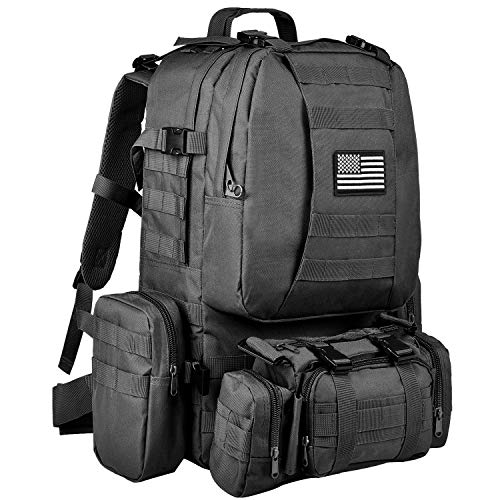
Best for Packs With a Detachable Daypack
- 50–60 L capacity
- 3.9 lb empty
- Hydration-ready
- Hydration sleeve keeps water within easy reach
- Airflow channels help your back stay cooler under load
- Padded sleeve doubles it as a commuter and travel bag
- At 50–60 L it is more pack — and more weight — than a day hiker needs; it earns its keep on overnight and multi-day loads.
Verdict: This 50–60 L backpacking pack pairs a breathable back with room for a bladder, making it a strong option for Packs With a Detachable Daypack.

Best for Packs With a Detachable Daypack
- 20 L capacity
- 600D nylon shell
- 22 oz empty
- Hydration-ready
- Padded compartment & hydration ready
- Hydration sleeve keeps water within easy reach
- Ventilated back panel cuts sweat on long climbs
- At 20 L it is best kept to shorter outings — it fills up once you add layers, lunch and water for a full day.
- The fabric is water-resistant rather than fully waterproof, so a pack liner helps in sustained rain.
Verdict: This 20 L daypack pairs a breathable back with room for a bladder, making it a strong option for Packs With a Detachable Daypack.
Frequently Asked Questions
Can a detachable lid replace a separate daypack?
A detachable lid can replace a separate daypack on basecamp trips where a hiker needs a small pack for day exploring, but it's usually smaller and less padded than a purpose-built daypack. For regular daypack use outside of backpacking trips, a dedicated daypack still fits and carries better.
Does removing the lid save meaningful pack weight?
Removing a detachable lid typically saves a few ounces up to around a pound, depending on the pack. Ultralight hikers who rarely use the lid's daypack function sometimes leave it at home entirely to save that weight on every trip.