
Training and fitness for hiking
Hiking asks for something a gym routine rarely trains: hours of steady effort, carrying weight, over ground that never repeats itself. Here's a sensible way to build toward that — cardio base, hills, loaded pack walks, strength work and a taper — plus the mistakes that undo good preparation.

In plain English
Getting ready for a hike is mostly about walking more, and gradually making those walks more like the real thing. Hills, a backpack and rough ground all make walking harder, so you add them one at a time, a bit like adding weight to a barbell in small plates instead of all at once.
Your heart and lungs get fitter fairly quickly. Your feet, knees and back take longer to toughen up. That is why going too hard too soon so often ends in a sore heel or knee a few weeks in.
Going downhill deserves special practice. It feels easy on your breathing but it is hard on your thigh muscles and knees, which is why people are often sorest two days after a big descent. A few weeks of walking down hills and stairs before the trip makes a real difference.
The short answer
Train by walking. Spend four to eight weeks building an aerobic base, add a weekly hill or stair session, then start walking with a loaded pack — light at first, adding weight gradually. Work legs, hips and core twice a week, practice descents, and ease off in the final days before your trip.
This is general fitness guidance, not personalized medical or training advice. If you have any health concerns, an existing injury, or you're returning to exercise after a long break, check with a doctor before starting a new strenuous program.
Why hiking fitness is different
Plenty of people who run comfortably or lift regularly still finish their first real hike wrecked. That's not a fitness failure — it's a specificity problem. Hiking loads the body in four ways a standard gym session mostly doesn't.
- It's weighted. Every step is taken with a pack on. That changes your posture, shifts your center of gravity backward and upward, raises your heart rate at the same walking speed, and puts steady pressure on shoulders, hips and feet that an unloaded workout never applies.
- It's sustained. A hard gym hour is short. A hiking day is four, eight, sometimes twelve hours of low-to-moderate effort. Endurance at that intensity — plus the habit of eating and drinking while you keep moving — is a separate quality from being able to go hard briefly.
- The ground is uneven. Roots, loose rock, mud, off-camber trail and stream crossings mean your ankles, hips and core are making constant small corrections. Treadmills and smooth sidewalks train the engine but not the stabilizers that keep you upright on scree.
- Downhill is its own workload. Descending loads the quads eccentrically — the muscle lengthens while resisting — and that's the kind of contraction that produces the deep, delayed soreness people feel two days after a big hike. It's also where most trips and knee complaints happen, and it's the part almost nobody trains.
The fix is straightforward: make your training look more like hiking. Walk more, walk uphill and downhill, and eventually walk with the weight you'll actually carry.
A general training progression
Below is a conservative, widely used order of operations. Treat it as a shape rather than a prescription — stretch it out if you're starting from a low base, compress it if you already walk a lot. The principle behind it is simple: add one new stress at a time, and give your body a couple of weeks to absorb each one before adding the next.
- Weeks 1–3: build the aerobic base. Walk, cycle or jog three to four times a week at a pace where you could still hold a conversation. The goal is time on your feet, not speed. Extend one of those sessions each week so you have a comfortable "long walk" habit before anything gets harder.
- Weeks 2–4: add hills or stairs. Once a week, find a climb — a hill, stadium steps, a parking garage, or a treadmill set to a real incline — and repeat it. Climbing trains the specific effort that actually slows people down on a trail, and it does it in far less time than a long flat walk.
- Weeks 3–6: introduce the loaded pack. Start walking with your pack on, beginning with a light load on familiar, mostly flat ground. Add weight or distance — one or the other, not both in the same week — and keep the pack fitted and adjusted the way you'd wear it on trail.
- Throughout: strength twice a week. Two short sessions a week covering squats, lunges or split squats, step-ups, calf raises, hip and glute work, and a few core exercises like planks and side planks. Bodyweight is a perfectly good starting point; the aim is durability, not maximum load.
- Every week or two: a long day. Do one session that's meaningfully longer than the rest, ideally on terrain resembling your trip. This is where you learn what your feet, socks, boots and pack do after hour four — the things no short session will ever reveal.
- Deliberately practice descending. Walk down the hills you walk up rather than looping around them, and add slow, controlled step-downs and lunges to your strength days. Eccentric work is uncomfortable to train and miserable to skip.
Progress by feel as well as by calendar. Lingering soreness, a nagging joint, or sessions that feel harder week over week are signals to repeat a week rather than advance one.
Training with a weighted pack
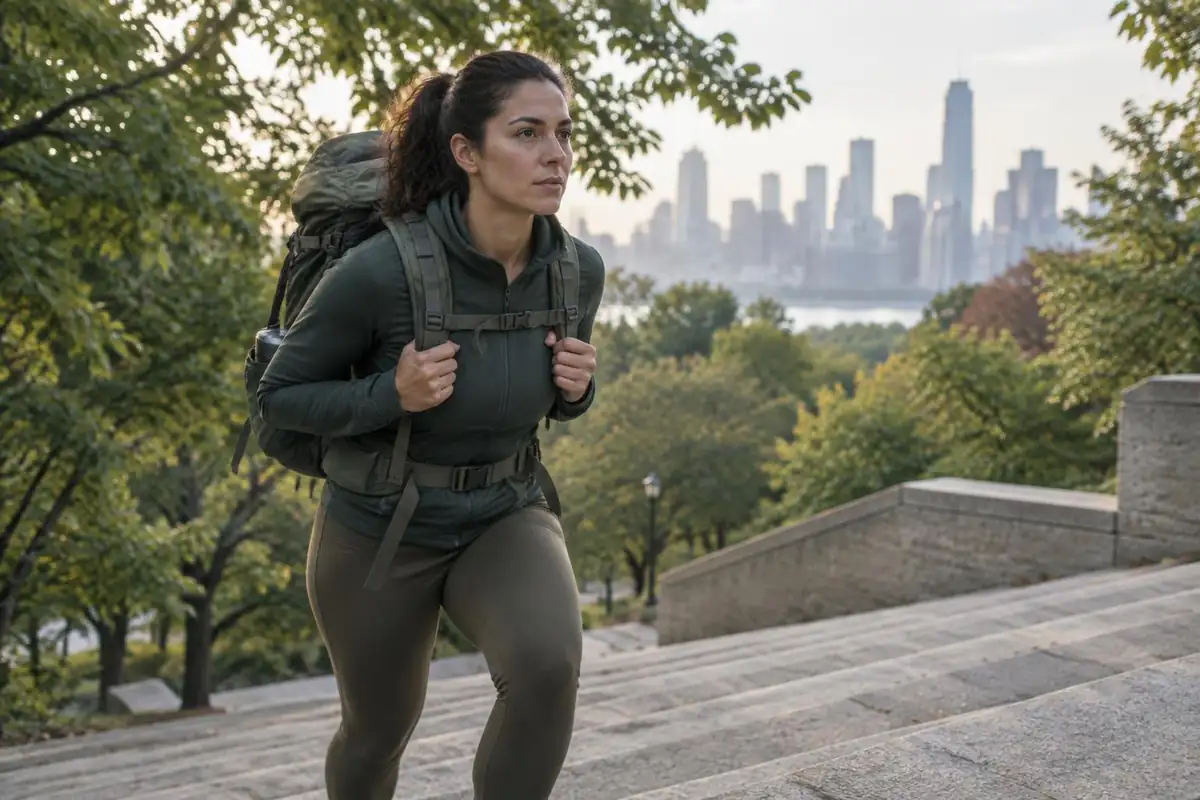
Loaded walking — sometimes called rucking — is the most specific hiking training there is, and also the easiest to overdo. The load is doing the work whether you notice it or not, so the rule is to start lighter than feels necessary and add weight slowly.
Do
- Start light — a load that feels almost too easy on the first walk.
- Add weight in small steps every week or two, not every session.
- Train with the pack you'll actually hike in, fitted properly.
- Use real gear, water or sandbags that sit against your back.
- Work up toward the load you plan to carry, then stop there.
Don't
- Jump straight to trip weight in your first loaded week.
- Add weight and distance in the same step up.
- Train far heavier than your trip load to "build a margin."
- Let weight ride loose or sit low and sag away from your back.
- Push through a hot spot, a sharp joint pain or numb hands.
How heavy is heavy enough? A common rule of thumb is that a loaded backpacking pack shouldn't exceed roughly 20% of your body weight, though it is a popular guideline rather than a proven limit, and day packs sit well below that. Treat it as a sensible training ceiling: there's little reason to train heavier than the load you'll carry. Work out what you'll genuinely be carrying with the base weight calculator first, then build toward that number rather than an arbitrary one.
Pack the training load sensibly, too. Weight that sits high and close to your spine carries the way a real pack does; a loose dumbbell rolling in the bottom of the bag teaches your body a load it will never meet on trail.
Tapering before the trip
The last week before a big hike is for arriving fresh, not for last-minute fitness. Training adaptations take weeks to land, so nothing you do in the final few days will make you stronger — but plenty of it can make you tired or sore.

- Final full week: keep your normal frequency but cut the volume — shorter walks, lighter pack, same rhythm.
- Last three or four days: easy, unloaded walking only. Skip heavy leg days entirely.
- Day before: a short, gentle walk at most. Spend the energy on packing, food and sleep instead.
- Don't introduce anything new: no new boots, insoles, socks, pack or diet in the final week.
Common training mistakes
Most training problems aren't about effort — they're about sequencing. These are the ones that show up again and again.
- Ramping mileage too fast. Enthusiasm at week one is what produces a strained calf or an angry Achilles at week three. Increase distance gradually and hold steady whenever a niggle appears; a repeated week costs nothing, an injury costs the trip.
- Skipping downhill and eccentric work. People train climbs because climbs feel hard, then meet the descent with untrained quads. That's the recipe for shaky legs on the way down and two days of deep soreness afterward. Walk down what you walk up, and add slow step-downs.
- Ignoring footwear break-in. Boots and feet need the same progressive loading your legs do. Wear the exact boot-and-sock combination you'll hike in on your training walks, and follow a proper boot break-in routine — hot spots found at home are a nuisance, and the same hot spots found at mile eight become a blister you have to manage on the trail.
- Training the legs only. A loaded pack is carried by your hips, back, shoulders and core. Neglect those and the first thing to fail on a long day is posture, not leg strength.
- Training unloaded, then hiking loaded. Walking ten miles empty says surprisingly little about walking eight with thirty pounds on. At least some of your training needs to be under the weight you'll carry.
- No rest days. Fitness is built during recovery, not during the session. Hard days back-to-back with no easy days between produce fatigue, not adaptation.
- Never rehearsing the whole system. Do at least one training walk with the full setup — pack, boots, socks, layers, food and water — exactly as you'll carry them. The rest of the trail-day checklist lives in our hiking dos and don'ts.
This is general fitness information for healthy adults, not medical or personalized training advice. Anyone with heart, lung, joint or other health concerns — or who is pregnant, recovering from injury, or new to strenuous exercise — should talk to a doctor before beginning a training program, and stop and seek advice if something hurts in a way that doesn't feel like ordinary exertion.
Training plans for specific treks
This guide covers the general method. If you are preparing for a particular route, each plan below scales the same structure to that trek's published distance, climbing and terrain. See all of them in our hiking and trekking training plans.
How much training the guidelines call for
The CDC's baseline for adults is 150 minutes of moderate activity a week, or 75 minutes of vigorous activity, plus at least two days of muscle-strengthening work.1 The American College of Sports Medicine puts it as 30 or more minutes on five or more days, resistance training for each major muscle group on two to three days a week, and balance and agility work as well.2 That last part matches the page's point about uneven ground: balance is a trainable quality, not just a side effect of walking.
The Compendium of Physical Activities shows how much harder trail walking is than flat walking. One MET is roughly the energy of sitting quietly, 1 kcal per kilogram of body weight per hour.3 Hiking with no load through fields and hills rates 5.3 METs, backpacking 7.0, climbing hills with a 21 to 40 lb load at a 3 to 10% grade 7.5, and climbing with 20 lb or more on 5 to 20% grades at a moderate to brisk pace 10.0.4 Steep, loaded climbing costs close to twice the energy of unloaded hiking, which is why the hill session earns its place.
Weight is not the only dial
In a lab study, metabolic energy rose roughly in a straight line with backpack load, by about 7.6 watts per extra kilogram.5 A major military review adds that the energy cost of walking with a pack rises with load, body mass, speed and grade.6 Researchers working on soldier conditioning point out that speed, grade and terrain can be adjusted to change the intensity of loaded walking, not just the weight.7 For hikers, that means a steeper route or a slightly faster pace can progress training without adding pounds.
Injury patterns explain why progression should be slow. The same military review lists foot blisters, stress fractures, back strains and knee pain among the common injuries from prolonged load carriage.6 A systematic review of hiking injuries found blisters and ankle sprains to be the most common, with the lower limb the most injured area in every study reviewed.8
The 20% figure, honestly
The page uses 20% of body weight as a training ceiling. It is a popular hiking rule of thumb, but it has no primary scientific source. Deuter, a pack maker, says people can carry a maximum of 20 to 25% of body weight.9 A 2022 narrative review suggests adult loads in hiking and military settings should generally stay under 40% of body mass.10 A 2026 study of long-distance hikers cites a 10 to 15% suggestion in the literature and found forefoot pressure rose 5.41% with a pack at 10% of body weight and 8.73% at 20%.11 US Army doctrine targets about 30% for a fighting load and 45% for an approach march for conditioned soldiers.12 And in a 2004 study, Appalachian Trail hikers actually carried 25% (men) to 27.9% (women).13
The practical takeaway still holds: train up to the load you will really carry. Just treat 20% as a sensible target, not a proven safety line.
Descents, poles and altitude
On a 25-degree downhill ramp, hiking poles lowered knee compressive and shear forces by 12 to 25%.14 Another study found poles reduced lower-limb joint loads on descents with no pack, a 15% body-weight pack and a 30% pack alike.15 On level ground, though, poles did not appear to reduce knee compression, even when people pushed much harder on them.16 Practice with poles on training descents if you plan to use them on the trip.
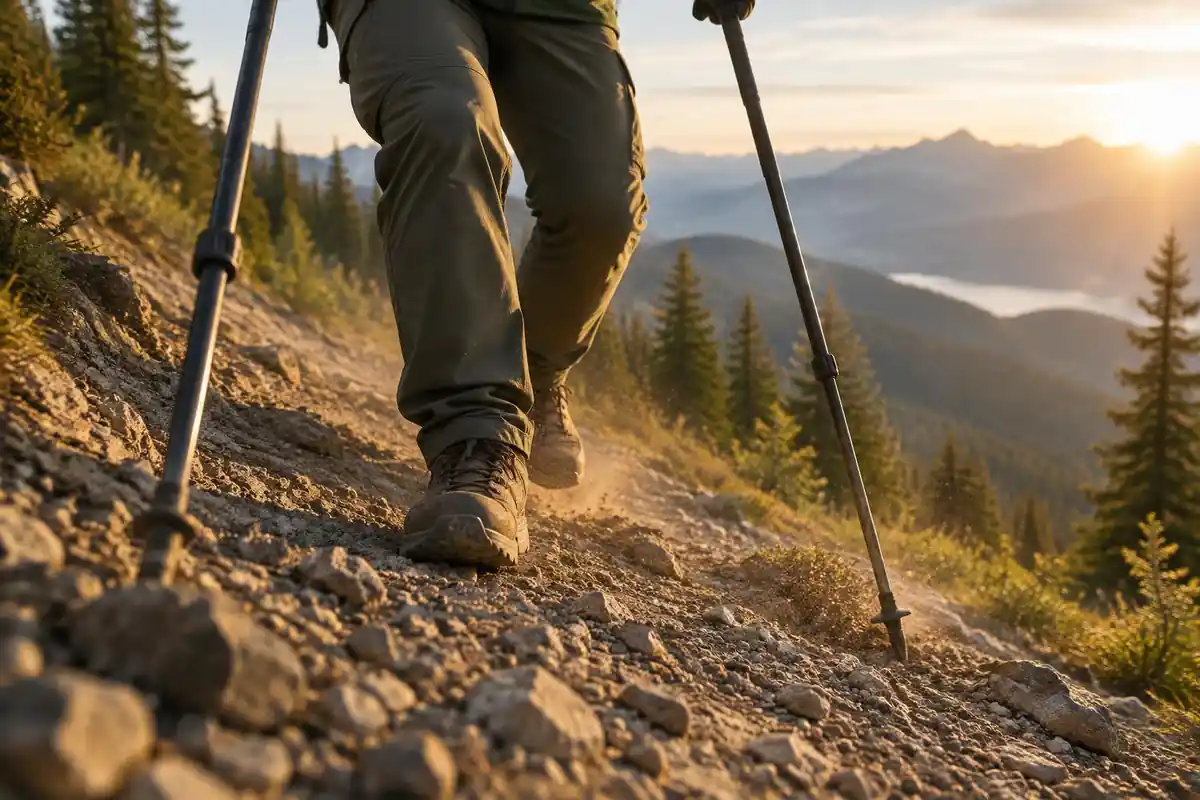
If the trip goes high, fitness has a limit. The CDC Yellow Book says physical fitness and training do not protect against altitude illness, and that any unacclimatized person sleeping at 8,000 feet or higher is at risk.17 A slow ascent plan matters as much as the training block.
Frequently asked questions
How long does it take to get fit for a hike?
For a healthy adult with some activity base, six to eight weeks of consistent walking is a reasonable window for a long day hike, and roughly eight to twelve for a multi-day trip with a full pack. Consistency matters far more than intensity — three or four moderate sessions a week beats one heroic weekend.
Can I train for hiking without hills nearby?
Yes. Stairs, stadium steps, parking garages and a treadmill on an incline all reproduce the sustained climbing effort. For the downhill side, which stairs replicate poorly, add slow step-downs, split squats and controlled lunges so your quads get some eccentric work before the trail supplies it.
How much weight should I train with in my pack?
Start with something genuinely easy — many people begin around ten pounds — and add weight in small increments over several weeks. A commonly quoted ceiling is about 20% of your body weight for a loaded backpacking pack, though that is a rule of thumb rather than a proven safety line; there is rarely a reason to train heavier than the load you actually plan to carry.
Is walking enough, or do I need the gym?
Walking with a pack is the single most specific thing you can do, and for many day hikers it is enough. Adding two short strength sessions a week — legs, hips and core — helps with steep descents, stream crossings and stability on rocky ground, especially as trips get longer or heavier.
Should I train on back-to-back days before a multi-day trip?
It is a useful rehearsal. A couple of weeks out, try two loaded walks on consecutive days at a comfortable distance. It shows you how your feet, shoulders and hips feel on day two — the day most problems appear — while there is still time to fix boots, socks or pack adjustment.