
Best Trekking Poles (2026)
Trekking poles are a pair of adjustable or fixed-length shafts with grips and wrist straps that give a hiker two extra points of contact with the ground. They take load off your knees on descents, add stability on uneven or slick terrain, and help you balance during stream crossings, and some models even pitch as the support poles for trekking-pole tents.
Who it's for
Almost any hiker can benefit, but the payoff varies. Someone doing steep descents with a loaded pack will feel the most knee relief, while a fastpacker or trail runner may want a light, packable pair mainly for balance. Backpackers using a trekking-pole tent need poles that hit a specific length range, and winter hikers often want baskets and grips suited to snow and cold hands.
How to choose trekking poles
Aluminum poles are heavier but tend to bend under stress rather than snap, so they're forgiving if you catch a pole in a rock crack or lean on it awkwardly. Carbon fiber poles save real weight and dampen trail vibration well, but a hard sideways impact can crack or shatter the shaft outright rather than bending — the trade-off to weigh against the weight savings.
Telescoping poles adjust in length for steep climbs and descents and for sharing between hikers of different heights, but they add a few joints that can loosen over time. Folding poles collapse into short sections for fast packability, ideal for stashing on a pack when not in use. Fixed-length poles are simplest and lightest but only suit one height and terrain type.
Telescoping poles rely on a lever (external cam) lock or an internal twist lock to hold each section in place. Lever locks are easy to adjust with gloves on, stay reliable in cold or wet weather, and are simple to tighten if they loosen. Twist locks are lighter and lower-profile but can slip under load if grit gets inside or the collar isn't seated tight.
Cork grips mold to your hand shape over time and wick sweat well, foam grips are soft and absorbent for warm-weather comfort, and rubber grips insulate against cold but tend to cause more hand sweat and blistering on long days. Padded, adjustable wrist straps let you rest weight through your wrists instead of gripping tightly, which matters most on long descents.
A pole's tip does the real work of gripping terrain: hardened carbide tips bite into rock, roots and hardpack far better than plain metal or rubber. Rubber tip protectors are worth carrying for pavement or fragile trail surfaces. Baskets keep the tip from sinking into mud or snow, and swapping to wider winter baskets makes a big difference once the ground softens or turns to powder.
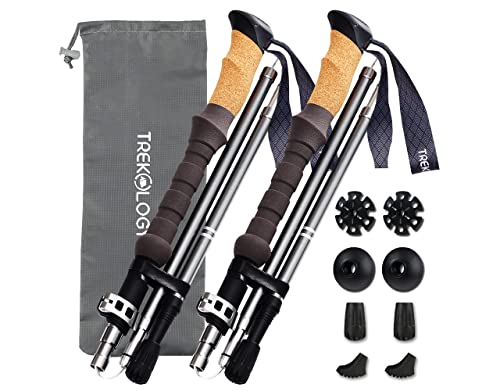
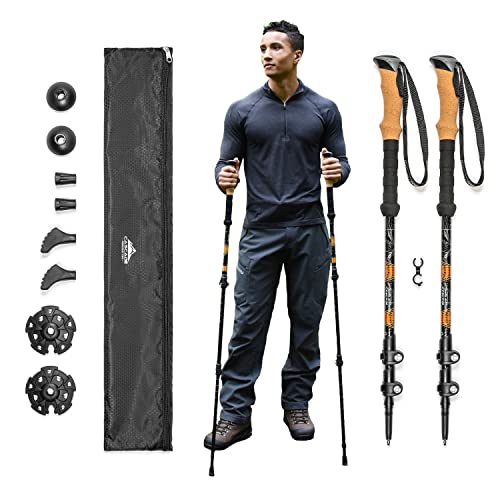
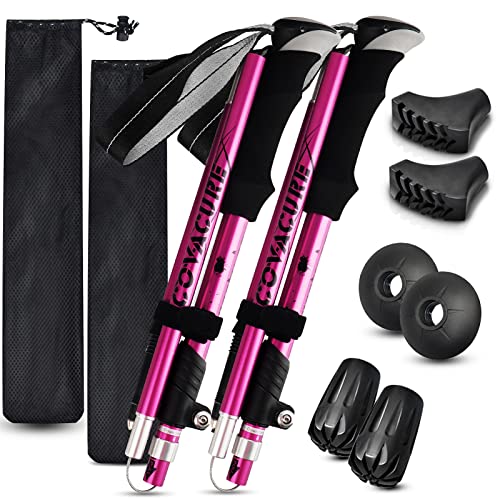
3 pair of poless to compare
Real options that fit the criteria above. We don't publish prices or ratings — check the current price and reviews on Amazon.
Common questions
Do trekking poles really help on the trail?
Yes. Studies and most hikers' experience agree that poles reduce compressive load on the knees on descents, improve balance on uneven ground or during creek crossings, and can boost uphill efficiency by engaging your arms and shoulders. The benefit is most noticeable with a loaded pack or on technical terrain rather than flat, easy trail.
What length should trekking poles be?
A common starting point is a length that lets your elbow sit at roughly a 90-degree angle when the pole tip touches the ground beside your foot. Shorten poles a bit for steep climbs and lengthen them for descents. If you plan to use a trekking-pole tent, check the tent's required pole-length range before you decide on a pair.
Are two poles better than one?
For most hikers, yes. A pair distributes effort evenly on both sides of the body, which helps more with balance, load transfer and rhythm than a single pole. A single pole can still help on moderate terrain or if you need a free hand, but two poles generally give more stability on steep or technical sections.
This is a general buying guide, not a lab review — it explains what to look for so you can choose well, and links to real products to compare. We publish no prices or ratings; current price, availability and reviews are shown on Amazon. Product links are affiliate links: we may earn a commission at no extra cost to you. See our affiliate disclosure.