
Backpacking Meal Planning: Calories & How Much Food to Pack
Food is the one thing in your pack that you can't borrow, improvise, or leave behind, and it's also the heaviest consumable most backpackers carry. Planning it well means knowing roughly how many calories a day of hiking burns, how much that food weighs, and how to spread it across the days you'll be out. This page walks through the general rules of thumb hikers use to build a trip's food list, as general planning guidance rather than personalized nutrition advice.
Affiliate disclosure: this page contains affiliate links. Purchases made through them may earn us a commission at no extra cost to you. See our affiliate disclosure.
In plain English
Planning food for a hike means answering two questions: how much energy will I burn, and how much will that food weigh? Energy from food is measured in calories. A day of walking uphill with a heavy bag burns a lot more than a day at a desk, so you need more food than usual.
Because you carry every bite on your back, hikers also think about how many calories each ounce of food gives them. Nuts, oil and peanut butter pack a lot of energy into a small, light package. Fresh fruit is mostly water, so it is heavy for the energy it gives.
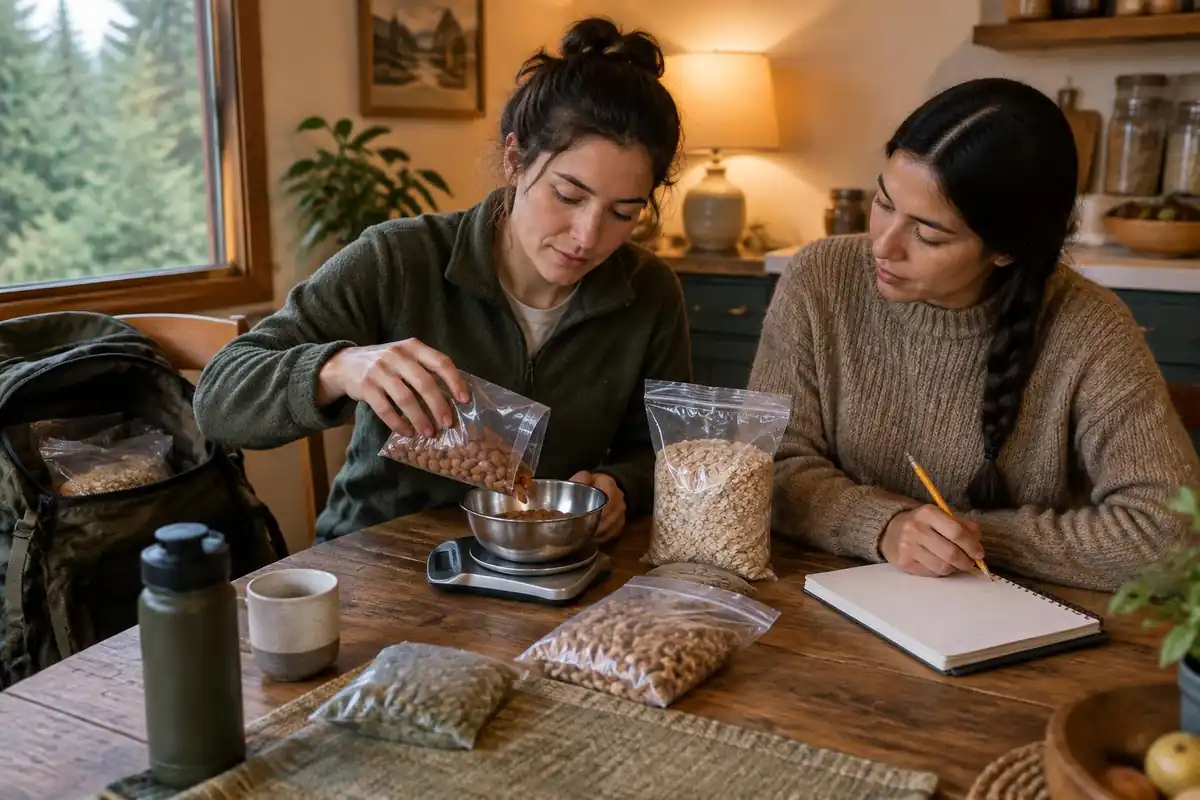
Nobody can tell you your exact number in advance. The best approach is to start with a sensible estimate, write out every meal by day, weigh the food, and then adjust after each trip based on whether you came home hungry or with leftovers.
Who it's for
This matters most once you're carrying more than a single day's food. A weekend overnighter is forgiving: bring a little extra and you'll barely notice. But on a five-day route, or a thru-hike where you're resupplying every few days, small errors in calories per day compound into either a hungry finish or pounds of food you never open.
How to plan it
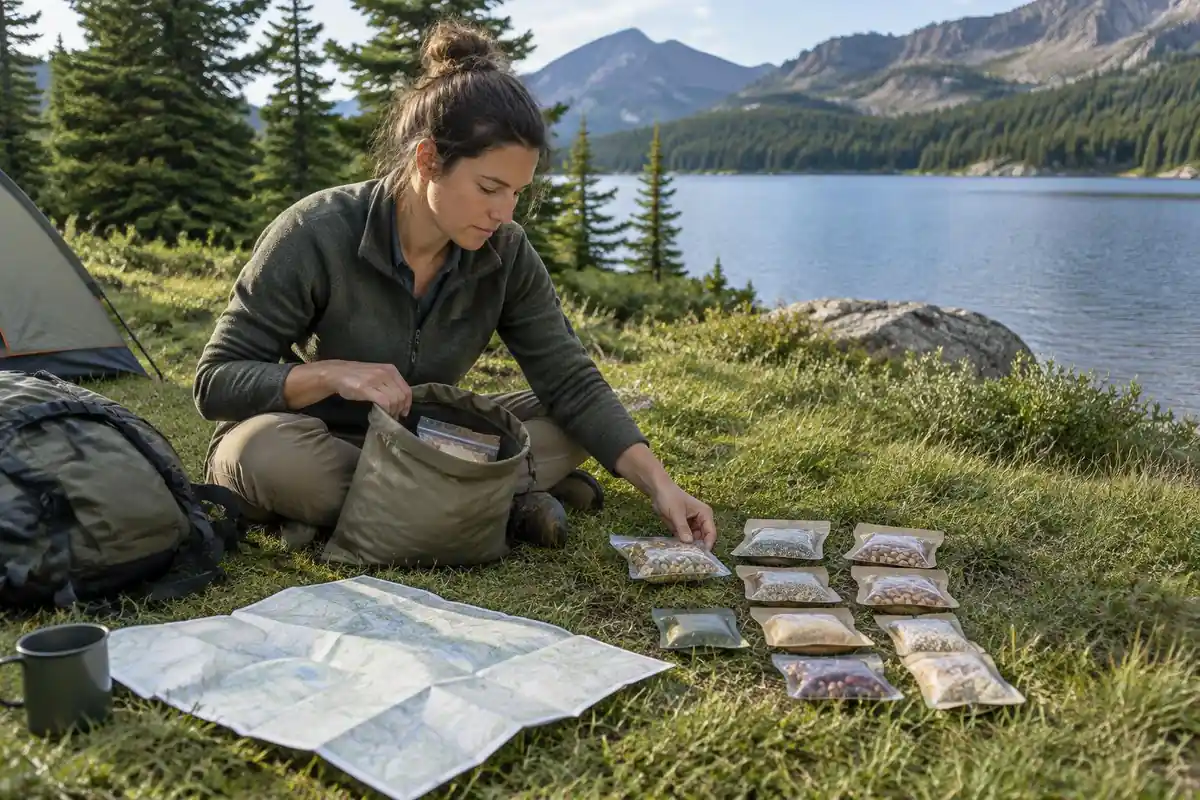
Backpacking burns far more than a desk day. A widely repeated hiker rule of thumb, not an official standard, is roughly 2,500 to 4,500-plus calories per day, with terrain, pack weight, body size, pace and cold weather pushing you up or down within it. Easy summer miles with a light pack sit near the bottom; long days, big climbs and cold nights sit near the top.
Most hikers plan food by weight, not by counting every calorie. The commonly cited rule of thumb (not an official figure) is roughly 1.5 to 2.5 pounds of food per person per day, with shorter, easier trips at the light end and long, cold, high-mileage days at the heavy end. Multiply by your day count and you have a target to build toward.
Weight is the real constraint, so judge food by calories per ounce rather than by volume. Many hikers use roughly 100 to 125 calories per ounce as a working target, though it is a rule of thumb rather than a published standard; fats and oils sit well above it, while fresh fruit, vegetables and anything water-heavy sit far below. A few heavy comfort items are fine, as long as you know what they cost you.
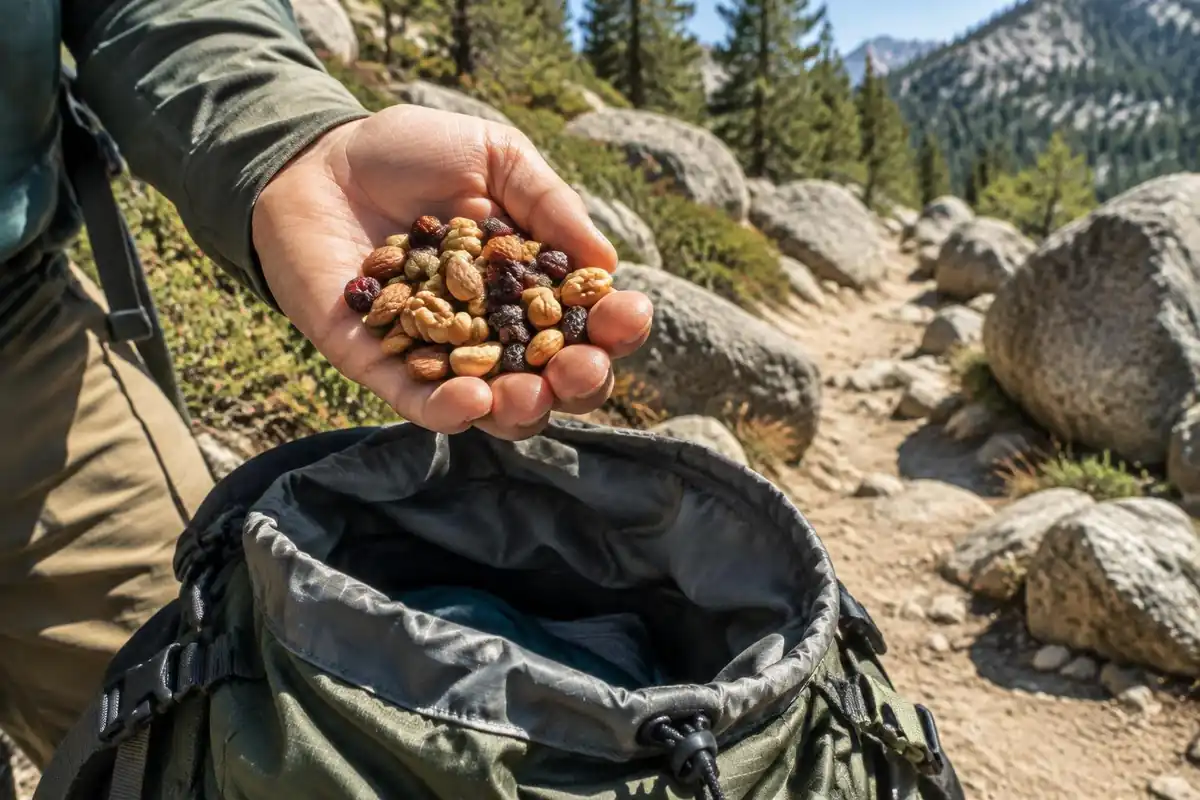
Carbohydrates are what you burn while moving, so they usually make up the largest share: snacks, grains, dried fruit. Fat carries the most calories per ounce, which makes nuts, nut butters, olive oil and cheese efficient ways to add energy without bulk. Protein supports recovery across consecutive hard days. You don't need precise ratios, just all three present daily.
Lay the trip out as a grid: one row per day, columns for breakfast, lunch, dinner and snacks. Filling it in beats guessing from a pile of groceries, and it shows immediately where a day is thin. Count travel days at each end honestly, since a late-afternoon start still needs dinner and the drive home rarely needs a full day's food.
Past about five days, carrying everything gets heavy and awkward, so long routes get broken into segments between resupply points: a trail town, a box mailed ahead, or a cached container where that's permitted. Work backward from each pickup, pack only the days in that segment, and carry a spare day's food in case the schedule slips.
Where the calorie numbers come from, and where they don't
The 2,500 to 4,500-plus range on this page is widely repeated in hiking circles, but no public-health or nutrition body publishes it as a backpacking standard. The research that does exist gives you tools rather than a single answer. The Compendium of Physical Activities rates backpacking at 7.0 METs, where one MET is roughly 1 kcal per kilogram of body weight per hour, about the cost of sitting quietly.1,2 As rough arithmetic, a 70 kg (154 lb) hiker walking for six hours at 7.0 METs spends about 2,940 kcal during the walking hours alone, before counting the rest of the day.
Terrain moves that number. The Compendium rates climbing hills with a load of 20 pounds or more at a 5 to 20% grade at a moderate to brisk pace at 10.0 METs.1 A day of steep climbing can therefore cost noticeably more per hour than the same time on gentle trail.
The best-known daily figures are military, and should be labelled that way. A National Academies review for the military found energy needs in the cold range from 3,400 to 4,300 kcal a day, or 45 to 57 kcal per kilogram for a 75 kg man, and the Military Recommended Dietary Allowance for cold-weather rations is 4,500 kcal.3 The same review notes that snow travel and bulky clothing, boots and packs raise the energy cost of activity.3
The ceiling on what you can eat
Packing more food only helps up to a point. A 2019 study in Science Advances found that sustained energy expenditure over long events levels off below three times basal metabolic rate, the energy your body uses at complete rest, and that the digestive system can supply only about 2.5 times that rate; spending more draws down body stores.4 On a long, hard trip, some shortfall may be unavoidable however much you carry. That is a reason to favor food you will actually eat over food that only looks good on a spreadsheet.
The pounds-per-day and calories-per-ounce rules
The page's 1.5 to 2.5 pounds of food per day and its 100 to 125 calories-per-ounce target are community rules of thumb; neither comes from a nutrition authority. They are really one calculation. Divide the calories you plan to eat by the density of your food: 3,000 calories at 125 calories per ounce is 24 ounces, or 1.5 pounds, while the same calories at 100 per ounce is about 1.9 pounds. Add up the label calories in your actual food bag and weigh it, and you have your own figure.
Volume and water can limit you before weight does
Where canisters are required, their size sets the menu. Denali's small canister weighs 3 pounds and holds 3 to 5 days of food for one person, and its larger one weighs 5 pounds and carries 7 to 10 days.5 Canister rules are park-specific, so check the current rules for your route.
On dry routes, water can outweigh food. Guadalupe Mountains National Park advises a gallon per person per day and notes that water weighs about 8 pounds per gallon, or about 24 pounds for a three-day trip.6
Common questions
How many calories do I actually need per day?
There's no single number; it depends on terrain, pack weight, body size, pace and temperature. A common hiker rule of thumb, not an official figure, is roughly 2,500 to 4,500-plus calories a day, and most hikers land somewhere in the middle. Treat it as a starting point, note how you felt after a trip, and adjust next time. This is general guidance, not personalized nutrition advice.
Is it better to pack extra food or cut it close?
For most trips a small buffer is worth the ounces: one spare dinner or a few extra bars covers a slow day, a wrong turn, or weather that pins you down. Cutting it close only makes sense on short, well-traveled routes near a trailhead. Being hungry on the trail affects judgment and pace more than a modest weight penalty does.
Why am I not hungry on day one but starving by day three?
Appetite often lags behind effort. Many hikers notice that hunger builds over the first few days as the body catches up with the energy being spent, then stays high for the rest of the trip. Plan the same calories for every day anyway, and pack snacks you'll eat even when you don't feel like eating.
This is general backpacking-food guidance, not a lab review — it explains what to look for and how to plan so you can choose well. See our affiliate disclosure.