
Backpacking Food Storage & Bear Safety
Food is the one thing in your pack that smells interesting to every animal within a mile. Storing it properly protects you, protects the people camping after you, and protects the wildlife that learns to associate humans with an easy meal. This page covers the main storage methods used in backcountry camps, the campsite habits that go with them, and why you should always check the current rules for the specific place you're headed.
Affiliate disclosure: this page contains affiliate links. Purchases made through them may earn us a commission at no extra cost to you. See our affiliate disclosure.
In plain English
To a bear, a mouse or a raccoon, your food bag is a free buffet with a thin fabric lid. Animals follow their noses, and they can't tell a granola bar from a tube of toothpaste. Food storage simply means putting everything that smells inside something they can't open, or can't reach, and keeping it away from where you sleep.
There are three main ways to do it. A bear canister is a hard plastic barrel with a lid an animal can't open, a bit like a childproof lid built for bears. A bear-resistant sack is a very tough fabric bag you tie to a tree. A hang lifts your food bag high up on a rope over a branch.
Which one you use is often not your choice. The park or forest you visit sets the rule, and the rule can change from one valley to the next, or from one season to the next. Look it up before every trip.
Who it's for
This applies to anyone sleeping outside with food, from a single overnight to a months-long thru-hike. Even in areas without bears, rodents, raccoons and birds will chew through a pack to reach a snack bar. Longer trips raise the stakes simply because you carry more food and camp more nights, but the habits are the same from night one.
Storage methods
Storage requirements vary a lot by location, and they change. Some backcountry areas require an approved hard-sided container, some accept a hang, and some supply metal lockers at established sites. Before every trip, check the managing agency's current regulations for the exact area and season you'll be in — a rule you remember from a past trip or another park may no longer apply.
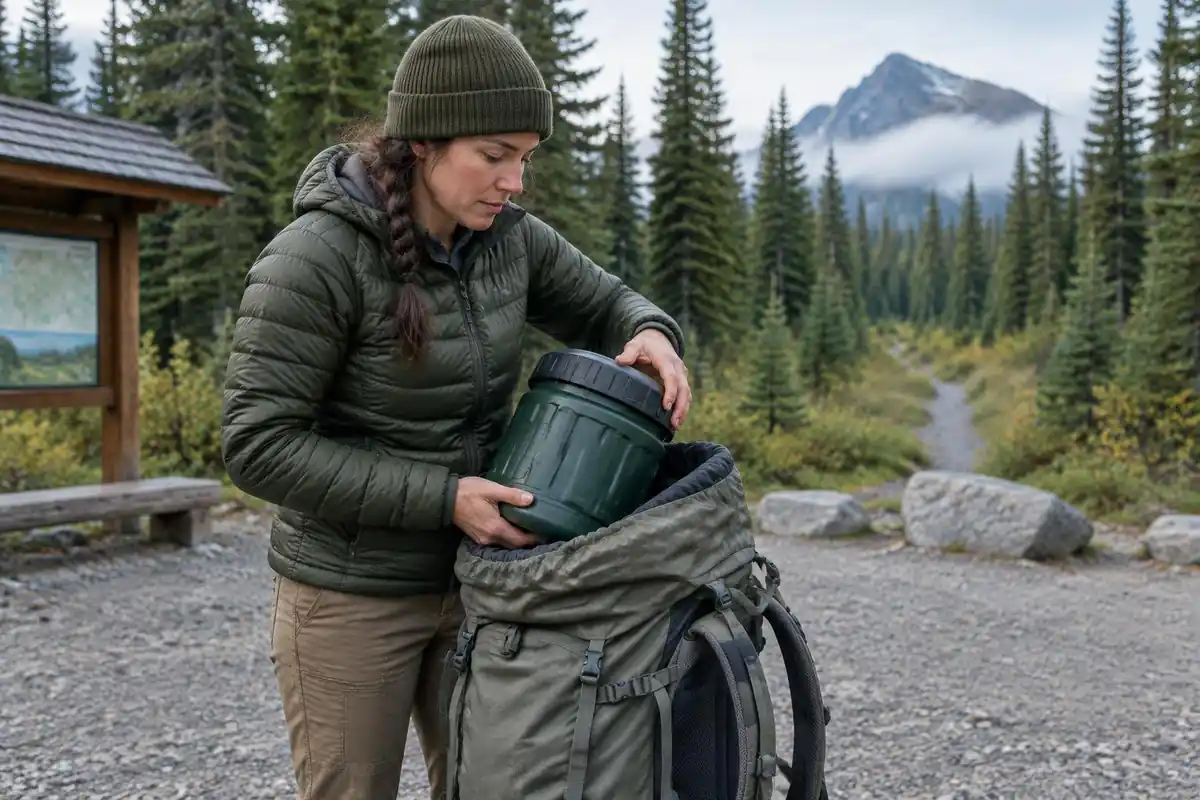
A bear canister is a rigid container with a lid an animal can't open. It's the most foolproof option: nothing to rig, nothing to fail in the dark, and it works above treeline where hanging isn't possible. Many high-use backcountry areas in the US require an approved model. The trade-offs are weight, bulk and limited volume.
Soft bear-resistant sacks are made from cut- and tear-resistant fabric and tie off to a tree trunk. They pack down smaller and weigh less than a canister, and they mold to whatever food you have left. Contents can still get crushed, and they aren't accepted everywhere a hard-sided canister is — another reason to confirm what your destination allows before you pack.
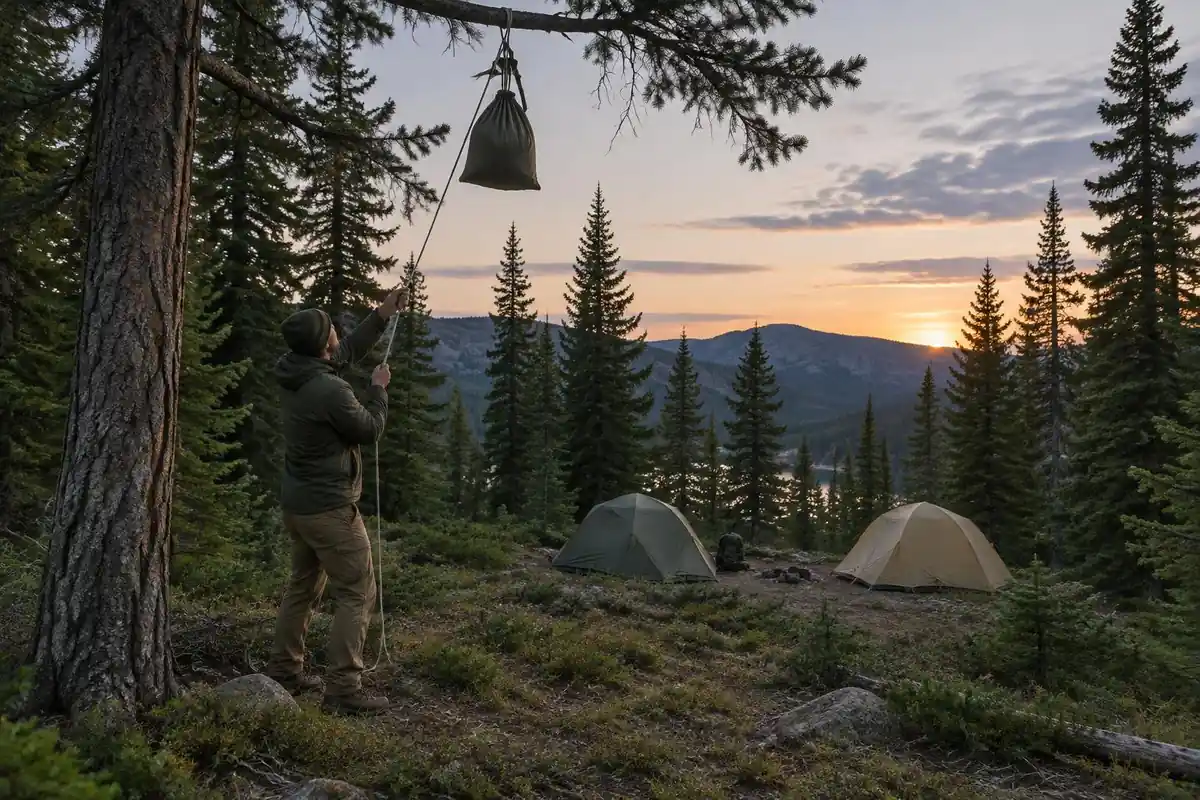
A bear hang suspends food out of reach on a branch, well away from the trunk. The counterbalance method splits food into two bags of similar weight and balances them over a limb; the PCT method uses a single bag, a stick toggle and a haul line. Both need a suitable branch and practice; a sloppy hang gives little protection.
Storage isn't just about losing your dinner. An animal that gets a food reward comes back, gets bolder, and starts approaching people — and a bear that becomes a repeated problem is often killed by wildlife managers. That's the real reason these rules exist: good storage protects wildlife as much as it protects you.
Where you eat matters as much as where you store. Cook and eat away from where you sleep, and put food, trash, cookware and anything scented into storage overnight — never in your tent. Pack out every wrapper and crumb, and scatter strained dishwater well away from camp.
Hang or canister: why the answer depends on the map
The hanging advice on this page varies with where you are. The Idaho Panhandle National Forests ask for food hung at least 10 feet up and 4 feet out from the trunk.8 Inyo National Forest in California sets a higher bar for counterbalance hangs, at least 15 feet up and 10 feet from the trunk, allows them only where a canister is not mandatory, and applies its food rules year-round in all wilderness areas.2 In Yosemite, hanging food is illegal everywhere.1
Canister rules are just as local. Rocky Mountain National Park requires a canister for every wilderness overnight and asks to see it before issuing a permit.9 New York's Eastern High Peaks Wilderness requires one from April 1 to November 30.10 Sequoia and Kings Canyon require containers from May 1 to October 31 only in named areas such as Dusy Basin and the Rae Lakes Loop, and highly recommend them everywhere else in both parks.11 Seasons and boundaries change, so treat these as examples and check the current rules.
What a canister costs you in weight and space
Denali's small container weighs 3 lb and holds 3 to 5 days of food for one person; its larger one weighs 5 lb and carries 7 to 10 days.5 Glacier Bay's loaner, at 560 cubic inches and 2.8 lb, holds about 6 days.4 New York's DEC describes typical canisters as roughly 8 by 12 inches, holding up to 5 days of food.10 Base weight leaves out consumables such as food, water and fuel, but the canister is gear, so it counts.12
A full canister is dense, so pack it with the other heavy items. The Appalachian Mountain Club suggests dense items such as food sit about two-thirds of the way up the main compartment, centered and against your back.13 On longer trips, canister volume rather than appetite often sets how many days you can go between resupplies, which is why compact, calorie-dense food matters most where a container is required.
Using the container correctly, and what 'approved' means
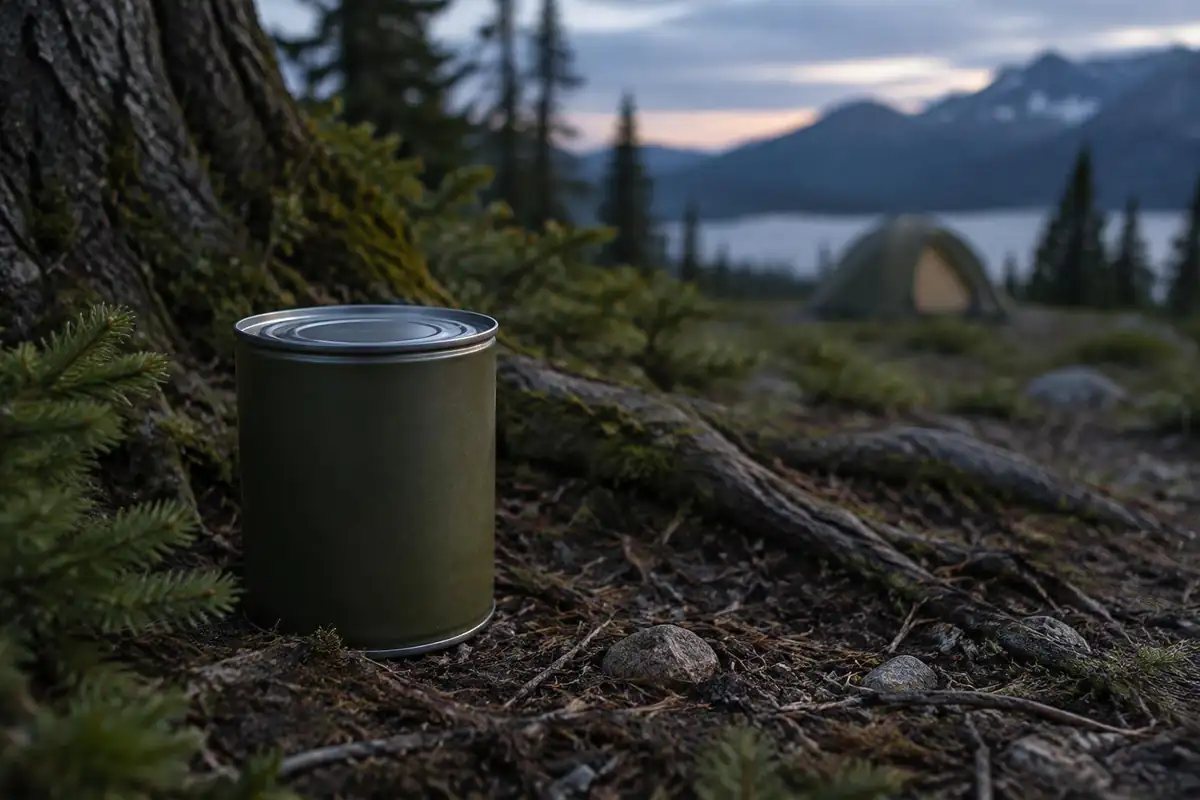
A canister only works closed and locked. The National Park Service advises setting it on flat ground at least 100 feet from camp, away from cliffs or water where a bear could roll or knock it away.3 Rocky Mountain National Park asks for 200 feet at all times, a reminder that distances are local too.9 The page's FAQ now lists these local distances, including one Forest Service guideline: the Idaho Panhandle forests suggest pitching tents 100 yards uphill from cooking and food storage where possible.8
'Approved' has a specific meaning. The Interagency Grizzly Bear Committee certifies products that met minimum standards for how much effort a grizzly must spend to reach the contents, and says certification does not mean bear-proof.6 Parks also keep their own lists: Yosemite's allowed list includes the Garcia 812 and BearVault models 110B through 500.14 A container accepted in one place may not be accepted in another, which applies to soft sacks as much as to canisters.
Why storage protects wildlife
The U.S. Fish & Wildlife Service says most human-bear conflicts involve unsecured garbage and food.15 National Park Service Leave No Trace guidance is to observe wildlife from a distance and never feed animals, and to wash at least 200 feet from streams or lakes with small amounts of biodegradable soap.16 Feeding includes the accidental kind: a dropped wrapper, or a food bag left out for one night. What counts as food is broad, too. Yosemite's rule covers all food and drinks, trash, toiletries and other scented items.1
Common questions
Do I really need a bear canister if there aren't bears where I'm hiking?
Bears aren't the only reason. Mice, squirrels, raccoons and ravens raid camps constantly and will chew holes in a pack to get at food. Where a canister isn't required, a hang or a bear-resistant sack usually handles smaller raiders. Check what the area requires first — some places mandate a specific approved container regardless.
How far from my tent should I store food?
A common guideline is to keep your cooking area, your storage spot and your tent well separated — often described as a triangle. The distances vary by land manager: the National Park Service says to set a canister at least 100 feet from camp, Rocky Mountain National Park asks for 200 feet, and Idaho Panhandle National Forests suggest pitching tents 100 yards uphill from cooking and food storage where possible. Follow the local guidance for the area you are visiting.
What counts as 'scented' and needs to go in with the food?
More than meals. Anything with a smell an animal might investigate — snacks, drink mixes, spices, trash, toothpaste, lip balm, sunscreen, insect repellent, soap, used wrappers and scented wipes — belongs in your storage container or hang overnight. Empty packaging still smells strongly of food, so it goes in too rather than staying loose in your pack.
This is general backpacking-food guidance, not a lab review — it explains what to look for and how to plan so you can choose well. See our affiliate disclosure.